Gather a few things See what you’ll need
- A pen
- Your journal
- One weather or seasonal detail you noticed
Choose an exercise 3 things to try as you read
Write what you noticed before choosing a symbol
Take the broad weather word and add one real detail. “Windy” might become “Had to hold my notebook open on the bench.” “Cold” might become “First morning I wanted gloves.” Keep the sentence plain; you’re recording the part you actually remember.
If you’re writing in the moment, look or listen for something specific: where the light falls, what the pavement looks like, whether rain interrupted a plan. You don’t have to turn every observation into a reflection. Sometimes the detail itself is the whole entry, and that’s enough to keep.
Write your versionWhat did the weather change in this moment?
What did the weather change in this moment?
Replace the broad weather word with a time or place and one observed detail. A complete weather report is optional.
At the bus stop after lunch
Rain hit the pavement hard enough to bounce.
I waited under the bakery awning.
Your words have a place now.
Use only what you actually remember. One specific observation can be the whole entry, and a later change in the weather does not cancel it.
- Words on this card
- 20
ONE WORKED EXAMPLE
Rain on the way home
You want to keep the walk home when a brief shower caught you outside. The rest of the day was dry, and you are making a memory note rather than a weather log.
Before
A rain-cloud drawing under the date seems to describe the whole day and leaves out the part you actually remember.
After
The note reads: “After the library, a shower caught us halfway home. The book stayed dry inside my jacket.” A small rain cloud sits beside that sentence, with the date above it.
What changed—and what to check
The time and event limit what the symbol describes. The protected book supplies the personal detail that a cloud alone cannot carry.
Try this check. Read the note without the icon; check that the moment and its place in the day remain clear.
Choose the little drawing that brings you back
Choose the drawing after you have the sentence. A mitten beside “First morning I wanted gloves” can bring back the moment more readily than a generic cloud. The twelve examples include sun, rain, wind, snow, a rainbow and seasonal details; you only need the one your note calls for.
If the conditions changed several times, you can record the moment that mattered to the entry instead of squeezing a whole forecast into the margin. A rain cloud beside the story of your interrupted walk makes sense even if the sun came out later. Add the time in words if you want that distinction preserved.
“Take the broad weather word and add one real detail.”
Make the cloud roomy and the raindrops simple
Press Draw it on your chosen example to follow the stroke order. Pause at any stage or step through the drawing manually. On scrap paper, start around 35–45 mm wide so the rays, drops, and small openings stay clear with an ordinary pen.
For rain, a low cloud and a few broad drops will read without dozens of tiny lines. For sunshine, keep the rays separate from the sun’s outline. If you copy a design that has a line for a date or time, replace the example detail with your own handwritten one.
Try the exampleWhich mark belongs to this moment?
Which mark belongs to this moment?
Compare rain, wind, and a falling leaf beside the entry. Keep the drawing small enough that the written observation stays easy to find.
Read the words in this example
- A drawing beside words
- Your words
- Separate drawing and writing areas
- Dashed box shows the drawing footprint.
The drawing footprint stays clear of the reserved writing area.
The longer side of “Rain-Drop Trio” uses 35% of the inner page width; its proportions stay intact. The reserved area still contains four sample writing rules. The dashed footprint includes empty space around the strokes; it flags layout overlap, not an exact ink collision or handwritten capacity. Choose the moment that matters to this entry. The drawing is a cue, not an exact weather measurement or a requirement to record every change in the day.
- Drawing, longer side
- 35%
- Drawing footprint width
- 35%
- Gap across inner page
- 6.3%
- Reserved sample rules
- 4
Keep exact information in ordinary writing
If you want to record temperature, snowfall, or hours slept, write the number and its unit beside the drawing. A small mark can help you locate that information, but its size or shape won’t preserve an exact measurement unless you’ve deliberately defined a scale.
An arrow can point where wind comes from or where it travels, and those are opposite directions. Add words such as “from the west” if that distinction matters. For a casual impression, “gusts lifted the page” may preserve more of your experience than an unlabelled arrow.
Leave room for the quiet seasonal firsts
The first fallen leaf you notice, the first evening you turn on a lamp early, or the first day you leave the jacket at home can be worth a line. You’re recording your own noticing, so there’s no need to decide whether it was the official beginning of a season.
Add a date and one of the seasonal drawings if you’d enjoy finding those moments again. You could collect a few on one page over time, or simply let them appear in your daily entries. They can stay occasional; you don’t owe the notebook a weather report every day.
Try a what-ifTwo weather moments, one date
Two weather moments, one date
Decide what each mark is meant to describe.
Your morning note says “mist hid the hill.” Your evening note says “ate outside in sunshine.” You want both moments to remain distinct.
Compare the three choices
How would you label the drawings?
- Use the evening sun as the symbol for the entire date.
That is a valid daily summary, but it would lose the morning contrast you want to keep.
- Combine mist and sunshine into one larger symbol.
A combined icon may suggest mixed conditions at one moment. It leaves the sequence unclear.
- Place each drawing beside its morning or evening sentence.
The nearby time labels keep the observations separate without asking the icons to carry chronology alone.
Give changing conditions a time or event when the difference matters to the memory.
What would you try?
Choose an option to see what it would do. You can explore all three.
GO A LITTLE FURTHERFinish while the moment still feels like itself
Finish while the moment still feels like itself
Once you’ve written the detail and added a recognizable mark, pause before building a whole scene around it. If you want an afternoon of drawing, enjoy it. If you came here to record the day quickly, the little cloud or mitten has already given the sentence a visible place to land.
When you next reread these notes, look for one detail you would otherwise have lost: the open window, the wet sleeve, the lamp switched on early. If the drawing helps you find that sentence, keep using it. There is no need to fill the intervening dates.
Pick a drawing and follow along
Choose a drawing below. Watch the whole shape appear, or tap a numbered step to see just that part. The faint outline is there if you’d like a little guidance.
Pick a drawing. We’ll take it one stroke at a time.
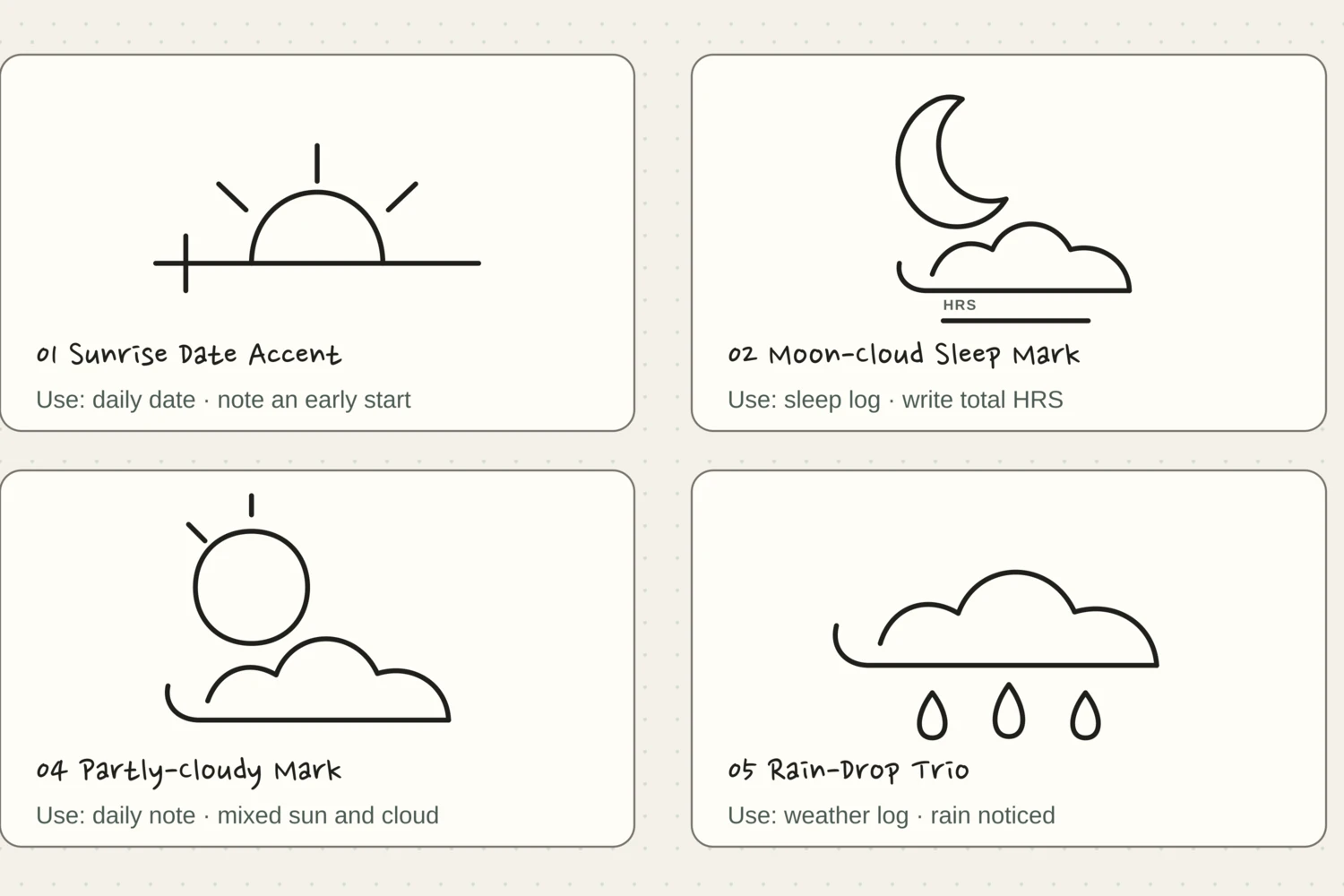
Sunrise Date Accent
A half sun rises above a quiet horizon with five evenly spaced rays.
The finished drawing. Watch it once, then try one step at a time.
Let’s draw it together.
Give it a place.Put it beside the date when an early start or a sunrise mattered.
If the line wandersSet both ends of the sun on the horizon and leave a consistent gap before the rays.
Moon-Cloud Sleep Mark
A slender crescent rests behind one small, rounded night cloud.
The finished drawing. Watch it once, then try one step at a time.
Let’s draw it together.
Give it a place.Add it to a sleep log and write the hours beside the drawing.
If the line wandersStop the crescent at the cloud edge so neither outline crosses the other.
Clear-Sky Sun
A round sun shines through eight long, evenly spaced rays.
The finished drawing. Watch it once, then try one step at a time.
Let’s draw it together.
Give it a place.Use it beside a clear-sky observation or a bright-day memory.
If the line wandersLeave the same gap between the circle and each ray, then turn the page for the diagonals.
Partly-Cloudy Mark
A small sun peeks from behind a broad cloud with a rounded base.
The finished drawing. Watch it once, then try one step at a time.
Let’s draw it together.
Give it a place.Use it when both sun and cloud shaped the day.
If the line wandersDraw only the visible sun arc so the cloud looks solid without needing any fill.
Rain-Drop Trio
Three broad raindrops fall beneath a low, softly rounded cloud.
The finished drawing. Watch it once, then try one step at a time.
Let’s draw it together.
Give it a place.Add it beside a rainy commute, a wet walk, or a change of plans.
If the line wandersKeep the drops broad at the bottom, with clear paper between each one.
Storm Alert Mark
A broad lightning bolt falls from a dark-weather cloud with two short rain strokes.
The finished drawing. Watch it once, then try one step at a time.
Let’s draw it together.
Give it a place.Put it beside a storm note or one weather-related task.
If the line wandersLeave the bolt a clear gap below the cloud, and make its lower point long enough to read instantly.
Snowflake Depth Mark
Six evenly spaced arms branch into a crisp, open snow crystal.
The finished drawing. Watch it once, then try one step at a time.
Let’s draw it together.
Give it a place.Place it beside a written snow-depth measurement or a first-snow note.
If the line wandersCross all three long strokes at one point, then keep every little branch shorter than its arm.
Rainbow Time Mark
Three nested rainbow arcs sit beside a small clock with two clear hands.
The finished drawing. Watch it once, then try one step at a time.
Let’s draw it together.
Give it a place.Mark a brief rainbow sighting and write the exact time beside the clock.
If the line wandersKeep the arc spacing even and leave a clean gap before the little clock.
Wind Direction Mark
Three curling gusts flow toward one small, open direction arrow.
The finished drawing. Watch it once, then try one step at a time.
Let’s draw it together.
Give it a place.Use it in a field note and write the wind direction nearby.
If the line wandersLet the gusts curl only once; leave enough space that each line can be followed on its own.
Umbrella Note Mark
A domed umbrella has three scalloped panels and a curved handle.
The finished drawing. Watch it once, then try one step at a time.
Let’s draw it together.
Give it a place.Set it beside a wet-day reminder, such as packing a cover.
If the line wandersMake the three scallops meet at the rib ends, and start the shaft exactly under the crown.
First-Fall Leaf
A pointed leaf drifts diagonally above a single open falling curve.
The finished drawing. Watch it once, then try one step at a time.
Let’s draw it together.
Give it a place.Place it beside the date of the first autumn leaf you noticed.
If the line wandersKeep the falling curve separate from the stalk so it feels like movement, not another branch.
Winter-Mitten Pair
Two softly rounded mittens turn their thumbs inward above wide ribbed cuffs.
The finished drawing. Watch it once, then try one step at a time.
Let’s draw it together.
Give it a place.Add them beside a cold-day memory, a first-gloves note, or the temperature.
If the line wandersKeep the thumbs broad and separate, then make both cuffs the same depth.
Something for a future page?
The Washi Tape ShopAffiliate links: we may earn a commission if you buy through these links.
Where this idea began
The National Weather Service’s JetStream introduction provides context for weather observation as a practice of recording conditions. The twelve marks here are original decorative journal cues; they are not scientific instruments, forecasts, official observation symbols, or evidence of firsthand testing by Tiny Systems Co.
Want to explore the techniques a little further? Here are the maker tutorials and references behind this guide.
- Observation contextNational Weather Service JetStream: Introduction to Weather Observations
Weather-observation context informs recording conditions; the original decorative marks are not official meteorological symbols.
- Website implementationW3C: Pause, Stop, Hide for moving content
W3C guidance informs animation pause controls, not the craft or writing method.
- Website implementationMDN: SVG stroke-dashoffset
SVG stroke-dashoffset documentation explains the on-page stroke animation, not a drawing method.