Gather a few things See what you’ll need
- A pen
- Your journal
- One ordinary moment you want to keep
Choose an exercise 3 things to try as you read
Choose the detail that belongs to this day
Think of one thing you could picture without checking your phone. Perhaps it’s the mug you held while waiting for the house to wake up, the meal someone made, or the headphones you wore on a walk. Follow whichever detail arrives most easily.
Write a sentence about what made that moment worth keeping. “Coffee” is a subject. “Coffee on the step before anyone else woke up” begins to locate you in a day. You don’t need to make it profound. A place, a person, or one small action can give the memory enough shape.
Write your versionWhat makes this cup or book belong to today?
What makes this cup or book belong to today?
Replace the sample subject with a place, action, or person that gives it a particular moment.
Coffee
On the step before the house woke up
The mug warmed both hands.
Your words have a place now.
Keep a remembered phrase only if you recall it. If the exact words are uncertain, describe what was said rather than making a quotation.
- Words on this card
- 14
ONE WORKED EXAMPLE
Two cups, two mornings
You are collecting small morning memories on one page. Both Tuesday and Saturday involved the same mug, so a different drawing would add work without helping you remember.
Before
Two cup drawings are both captioned “coffee.” They look pleasant, but nothing on the page distinguishes the hurried morning from the quiet one.
After
Tuesday: “Coffee beside my keys while I waited for the lift.” Saturday: “Coffee on the step; the cat settled against my ankle.” Each dated sentence keeps the same simple cup outline beside it.
What changed—and what to check
The repeated object becomes a familiar entry point. The location and action distinguish the days without requiring a more complicated illustration.
Try this check. Cover the cup drawings and check that each caption still points to a different morning.
Pick the object that helps you recognize the sentence
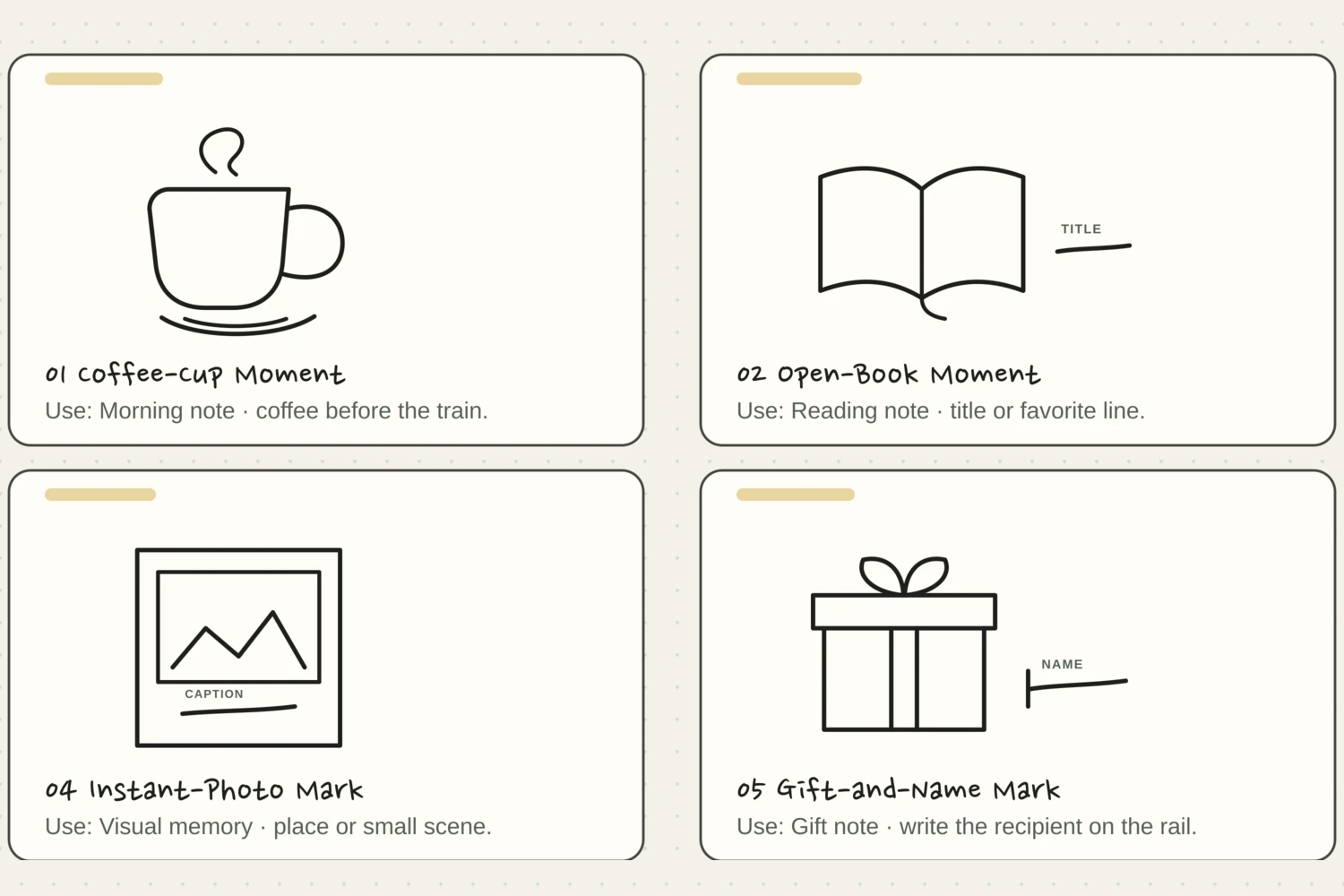
Look through the twelve drawing examples below. There’s a cup, an open book, headphones, an instant-photo shape, a gift, a cake, a music note, a suitcase, a house, a candle, a plate, and a paw. Choose the one that points most clearly toward your memory.
Choose the object you can recognize most easily, even if it was not the centre of the event. A plate can lead you back to a long conversation over lunch. Let the sentence explain the connection; adding every object on the table usually makes a small drawing harder to read.
“The same little cup could accompany a hundred different mornings.”
Learn the outline before adding your own detail
Choose “Watch it draw” on one example and notice the order of its strokes. Pause between them or move through the numbered steps individually. Try the complete shape around 35–45 mm wide on scrap paper, leaving room for its handle, open pages, or the gaps between a paw’s toes.
Bring the outline to the space beside your sentence before adding the smallest marks. At that size, can you still see the handle opening or the gap between pages? Keep those spaces open. Add a name or place on an example’s writing line only when it contributes something the sentence has not already kept.
Try the exampleChoose an object that leads you to the sentence
Choose an object that leads you to the sentence
Compare a cup, book, and paw beside the writing. Change their size and side while keeping the actual memory in the words.
Read the words in this example
- A drawing beside words
- Your words
- Separate drawing and writing areas
- Dashed box shows the drawing footprint.
The drawing footprint stays clear of the reserved writing area.
The longer side of “Coffee-Cup Moment” uses 35% of the inner page width; its proportions stay intact. The reserved area still contains four sample writing rules. The dashed footprint includes empty space around the strokes; it flags layout overlap, not an exact ink collision or handwritten capacity. The object gives your eye a recognizable beginning. Repeating the same cup or book on different days is useful when the words preserve what changed.
- Drawing, longer side
- 35%
- Drawing footprint width
- 34.7%
- Gap across inner page
- 6.7%
- Reserved sample rules
- 4
Let the words hold what the picture can’t
The same little cup could accompany a hundred different mornings. Write the café name, who sat across from you, or the thing you were waiting for if that’s what you want to remember. A book drawing becomes much more useful with the title beside it.
You can add a short remembered phrase, too, as long as you’re comfortable keeping it. If you can’t recall the exact words, describe what was said instead of putting a guess in quotation marks. The page can be warm and personal without pretending you preserved every second perfectly.
Your cup is allowed to have a crooked handle
If the shape is recognizable, it can stay. A leaning house, an uneven cake, or two slightly different headphone cups can still lead you straight to the memory. Look at the drawing beside the sentence before deciding it needs fixing.
When something becomes cramped, simplify the next attempt. Leave the cake with one candle. Keep the book’s pages open. Give the paw fewer interior details. You can always spend longer drawing when that’s what you want to do, but the memory doesn’t have to wait for your illustration skills to catch up.
Try a what-ifWhen the tiny cup loses its handle
When the tiny cup loses its handle
Consider this page before choosing your next move.
Your practice cup reads clearly at 40 mm, but the handle opening closes into a dark blob when you shrink it beside the caption.
Compare the three choices
What would preserve recognition at this smaller size?
- Enlarge the handle opening and omit its inner line.
An open gap carries the handle’s shape; removing a competing line gives that gap room at the final size.
- Trace the handle again to strengthen its outline.
A stronger edge may help a faint line, but another pass here would further close the gap you need.
- Add steam curls above the cup.
Steam may suggest a warm drink, but it does not repair the crowded handle beside the body.
At a small size, protect the spaces that make the object recognizable.
What would you try?
Choose an option to see what it would do. You can explore all three.
GO A LITTLE FURTHERLeave a little space for another ordinary day
Leave a little space for another ordinary day
You can put one of these notes in your daily journal, or begin a page of small moments and add another whenever something occurs to you. Give each one a date so the cup, the song, and the ridiculous slipper story keep their place in time.
When you add a second cup or book, reread the first caption. Keep the familiar outline and change the words that locate this new moment. A week later, those captions should let you distinguish the two days without relying on the drawing’s color or position.
Pick a drawing and follow along
Choose a drawing below. Watch the whole shape appear, or tap a numbered step to see just that part. The faint outline is there if you’d like a little guidance.
Pick a drawing. We’ll take it one stroke at a time.
Coffee-Cup Moment
A warm cup with an oval rim, roomy handle, and shallow saucer.
The finished drawing. Watch it once, then try one step at a time.
Let’s draw it together.
Give it a place.Add it beside a café stop or your favorite part of a slow morning.
If the line wandersKeep the handle roomy. If the rim tilts a little, let the cup tilt with it.
Open-Book Moment
Two gently bowed pages open around a clear center fold.
The finished drawing. Watch it once, then try one step at a time.
Let’s draw it together.
Give it a place.Place it beside a book title, a favorite passage, or a finished chapter.
If the line wandersLet the pages differ slightly; the center fold and lower corners make it read as a book.
Headphone Listen Mark
A double arched headband joins two cushioned earcups.
The finished drawing. Watch it once, then try one step at a time.
Let’s draw it together.
Give it a place.Use it beside a song, album, or podcast you want to find again.
If the line wandersLeave white space inside each earcup instead of making the cushions thicker.
Instant-Photo Mark
A slightly tilted instant photograph holds mountains and a small sun.
The finished drawing. Watch it once, then try one step at a time.
Let’s draw it together.
Give it a place.Draw it beside a view, a photo you took, or a place you want to remember.
If the line wandersKeep the bottom border wider than the other three; that is what makes it an instant photo.
Gift-and-Name Mark
A neatly wrapped parcel has broad ribbon and two generous bow loops.
The finished drawing. Watch it once, then try one step at a time.
Let’s draw it together.
Give it a place.Set it beside a gift idea or thank-you note, and write the person’s name in your entry.
If the line wandersMake the bow loops wider than the knot so they stay readable at a small size.
Birthday-Cake Mark
A single candle rises from a round cake with a loose scallop of frosting.
The finished drawing. Watch it once, then try one step at a time.
Let’s draw it together.
Give it a place.Put it beside a birthday, anniversary, or small win worth celebrating.
If the line wandersKeep the frosting shallow enough to leave a clean band of cake below it.
Music-Note Memory
A single flagged note sits beside a small clock for the moment you heard it.
The finished drawing. Watch it once, then try one step at a time.
Let’s draw it together.
Give it a place.Mark the song that played on the journey, in a shop, or during a memorable evening.
If the line wandersKeep the note head broad and the flag open inside; neither needs shading.
Suitcase Trip Mark
A rounded suitcase has a raised handle, two straps, and short feet.
The finished drawing. Watch it once, then try one step at a time.
Let’s draw it together.
Give it a place.Add it beside a destination, departure day, or memory from the journey.
If the line wandersPlace the straps the same distance from each side, even if the case itself leans.
Home-Day Mark
A welcoming house has a small chimney, heart window, and arched door.
The finished drawing. Watch it once, then try one step at a time.
Let’s draw it together.
Give it a place.Use it for a quiet day in, a family visit, or a small home project.
If the line wandersKeep the roof peak above the heart and leave enough wall between the window and door.
Evening-Candle Mark
A slender candle with a soft wax drip rests in a shallow dish.
The finished drawing. Watch it once, then try one step at a time.
Let’s draw it together.
Give it a place.Put it beside an evening reflection or a peaceful moment before bed.
If the line wandersGive the flame plenty of space above the rim. One wax drip is enough.
Meal-Plate Mark
A round plate with a quiet inner rim sits beside a three-tine fork.
The finished drawing. Watch it once, then try one step at a time.
Let’s draw it together.
Give it a place.Mark a memorable meal, from a quick bowl of noodles to a birthday dinner.
If the line wandersKeep a generous gap between the fork and plate so each shape stays clear.
Pet-Paw Moment
Four soft toe pads sit above a broad paw pad, with a small heart nearby.
The finished drawing. Watch it once, then try one step at a time.
Let’s draw it together.
Give it a place.Put it beside the funny, ordinary, or tender thing your pet did today.
If the line wandersKeep a paper gap between every toe and the big pad. Uneven toes add character.
Something for a future page?
The Washi Tape ShopAffiliate links: we may earn a commission if you buy through these links.
Where this idea began
All doodle geometry is original to Tiny Systems Co. Bullet Journal’s reflection on creativity informed the general idea of adding small creative layers to a Daily Log. This page does not copy its drawings and does not claim firsthand testing or experience.
Want to explore the techniques a little further? Here are the maker tutorials and references behind this guide.
- Creative contextBullet Journal: Rethinking Creativity
A reflection on creative additions to daily logging; the guide’s life-icon drawings are original.