Gather a few things See what you’ll need
- A notebook or loose sheet
- A pen
- A pencil for rough notes
Choose a meal with a scene attached
It might be an elaborate dinner or toast eaten in the doorway. Choose the meal because you remember something around it: who was there, where you sat, what changed, or why it interrupted the day. You do not need to choose the best food you have ever eaten.
Write the date as accurately as you know it. For an older memory, a season and place are useful. If the meal is connected to a difficult occasion, you can keep the factual scene without adding reflection. Choose the amount of context you want this notebook to hold.
Draw a plate or a seating sketch
Leave most of the page for words. A simple circle can stand for the plate, or a rectangle can show the table with names placed around it. The drawing is an organizer, not an illustration test. Make it only large enough to anchor the caption beside it.
Add three prompts: On the table, Around the table, and What stayed. The first identifies the food; the second records the people and place; the third keeps the distinguishing moment. Use three separate lines if boxes would make the page feel too formal.
Find the memory around the plate
The meal gains company and then the action worth keeping.
A bowl and bread identify the meal’s setting.
The sketch is an organizer, not a recipe.
“A meal page is complete when it brings back the occasion as well as the food.”
Keep an improvised soup supper
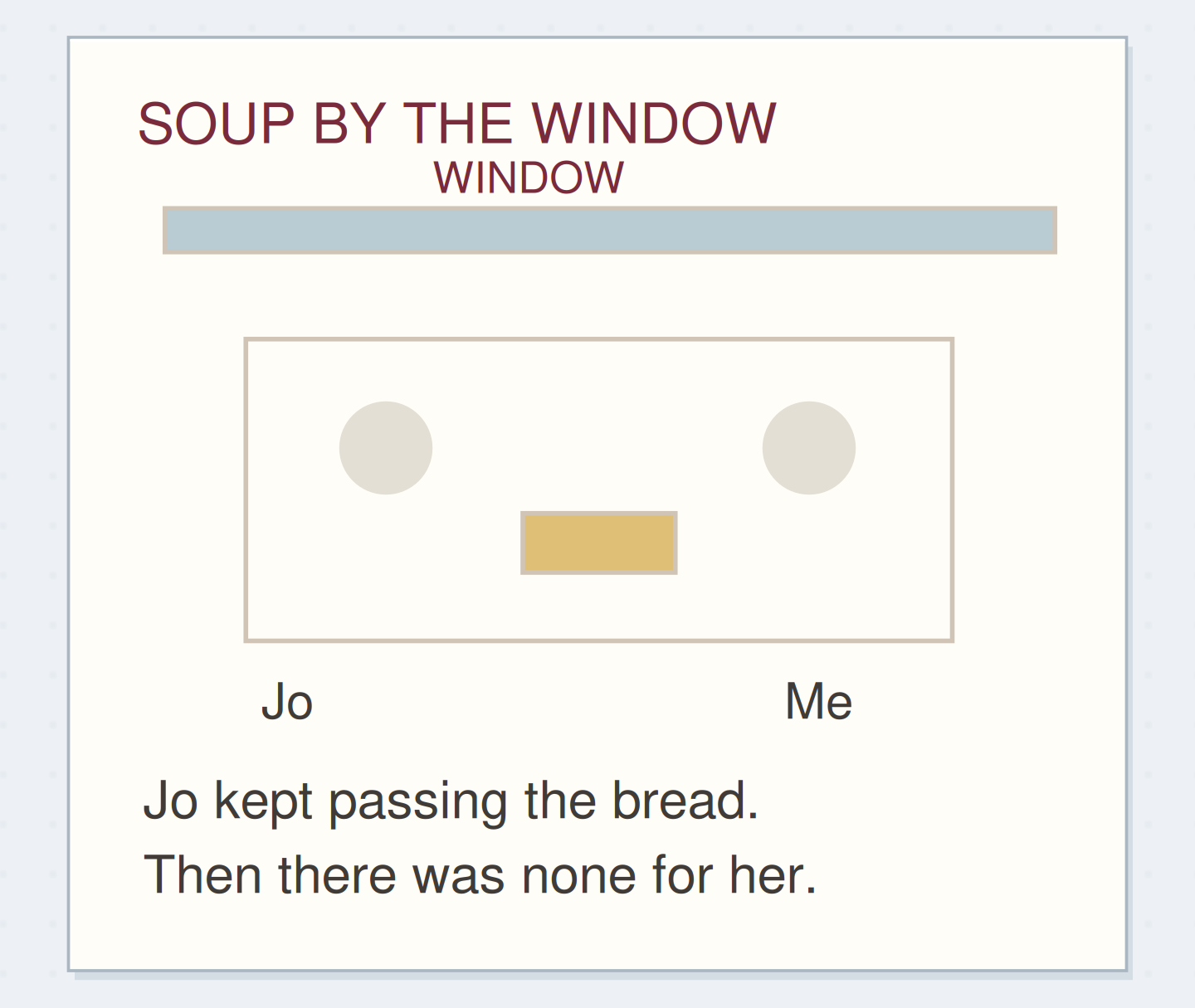
An example reads: On the table: tomato soup, thick bread, the last olives. Around the table: Jo and me by the open kitchen window, bowls on folded tea towels. What stayed: Jo kept moving the bread nearer while telling the story, then realized there was none left for herself.
A tiny seating sketch can show the window behind Jo and the bread between you. It helps explain the movement in the story. There is no need to draw every spoon or record exact ingredients unless those details are part of what you want to remember.
Write a meal memory
Edit the example into a record of your own. Leave out anything you do not know.
On the table:Tomato soup, thick bread, last olives.
Around the table:Jo and me by the open kitchen window.
What stayed:She kept passing the bread until none was left for her.
Your words have a place now.
This is an occasion record, not a nutritional log.
- Words on this card
- 33
Keep useful cooking notes elsewhere
If you want to make the meal again, add a page reference to the recipe or a brief ingredient reminder. Keep that practical information distinct from the memory. A cooking instruction and a recollection have different jobs, and one can change without making the other inaccurate.
For a meal someone else made, describe what you know rather than reverse-engineering an exact recipe. “Lentils with something smoky” is an honest memory. You can ask the cook later and date the added information. The original scene does not need to wait for a complete ingredient list.
When everything says “delicious”
Replace one evaluation with a detail you could point to. Was the bread warm enough to bend? Did everyone reach for the same bowl? Was the meal eaten standing because the table was covered in paper? The page becomes more specific when it shows what happened instead of assigning a verdict.
If you cannot recall the flavor, record the setting and leave taste out. A photograph may remind you of the plate, but it cannot tell you exactly what you experienced. You do not have to add a sensory description simply because a food page seems to call for one.
Replace “delicious” with a scene
Move the reveal to see which information changes the record.
Before the revision
An evaluation tells little about this particular meal.
Let a solo meal have its own shape
For a meal alone, “around the table” can describe the room, light, sound, or interruption. Write what kept you company without pretending that solitude requires an explanation. A bowl eaten beside a half-finished puzzle can be as particular as a crowded holiday table.
For a gathering, keep the page focused on one interaction rather than making a seating chart into a full account of every guest. Invite another person’s sentence only if they want to contribute. The outings-and-visitors guide can hold the wider occasion if dinner was one part of it.
Choose what belongs around this meal
Try the form that matches the evidence or space you have.
A gesture between people can carry the memory.
Keep one interaction rather than every conversation.
Stop at one remembered moment
A meal page is complete when it brings back the occasion as well as the food.
Check that you have named the dish enough to recognize it, placed the scene, and kept one detail that a recipe would omit. Then leave the rest. You do not need to document every meal in a week or make the next dinner more photogenic because you have started this notebook page.
Where this idea began
Want to follow the idea further? These community discussions and maker references are a good place to start.
- Multiple journals with different purposes
A participant describes an A6 notebook of meal sketches made to remember enjoyed food.
- Postcrossing: What should I write on a postcard?
Official prompts include local daily life, meals, memories, and a connection with the recipient.