Gather a few things See what you’ll need
- A notebook
- A pen
- The recipe or method you already use
- An optional loose note for the kitchen
Give the starting version an address
Write the recipe name and where it came from: your own method, a cookbook page, a saved recipe, or a note from a person who agreed to share it. Record the quantities and method you actually used if they differ from that source. A version label such as “Lemon dressing, attempt A” connects later notes to a particular attempt. You don't need to rewrite a whole published recipe if a clear reference and your changes will serve. Keep enough detail that “same as last time” won't become meaningless when the earlier source disappears or your memory fades.
Name the difference between these attempts
Choose a situation and notice how the example changes. Each choice gives a different useful next move.
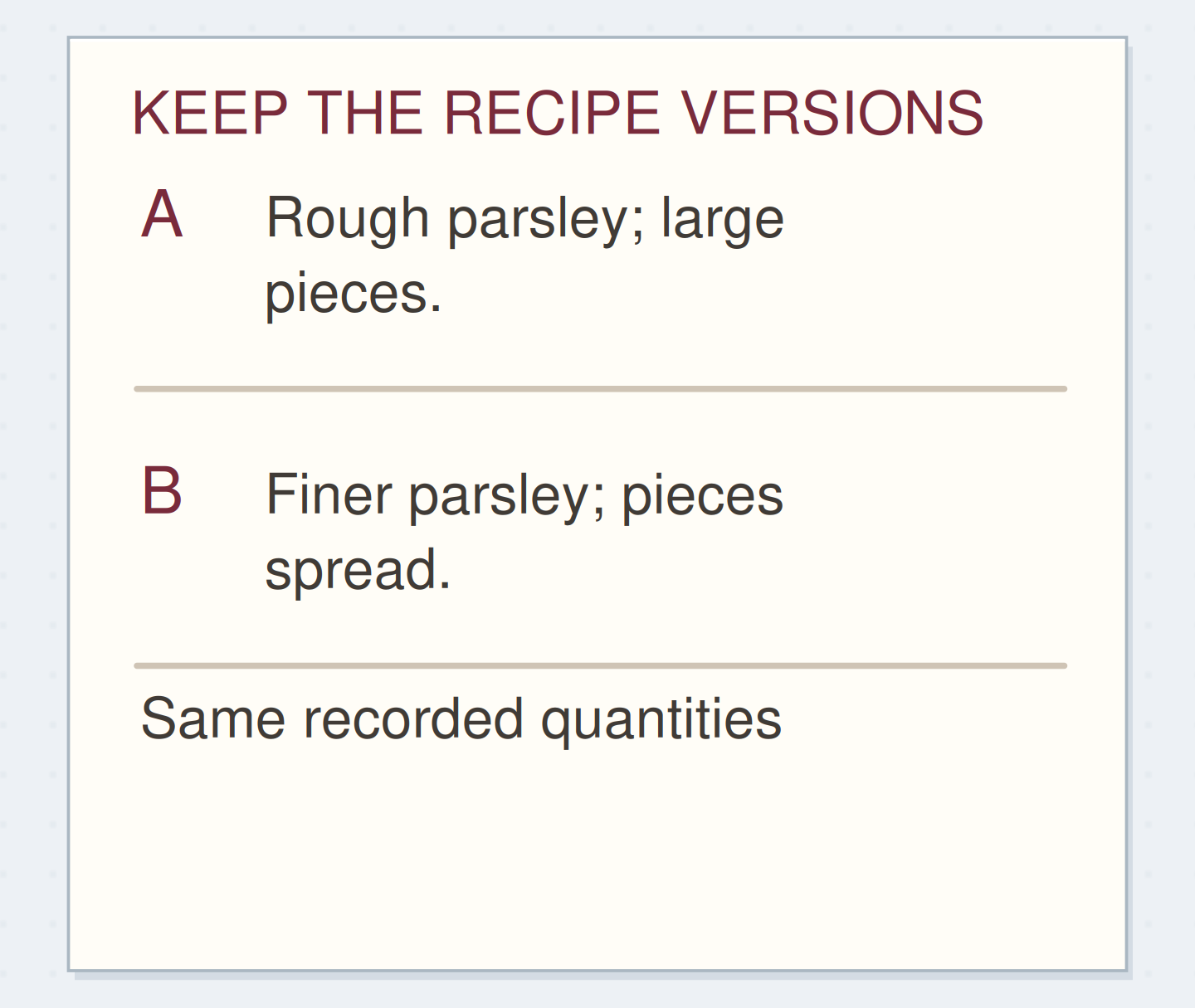
Keep a narrow method comparison.
The recorded quantities stay the same while the parsley is chopped more finely. You can compare the two attempts cautiously, keeping the result as a personal observation rather than a universal recipe rule.
Choose one question for the next attempt
Name the feature you want to compare, such as how strongly a herb comes through or how much dressing coats the salad you usually make. Write one deliberate change in specific terms. If you alter several things, record all of them and treat the result as a new version, without claiming which single change caused the difference. Recipe-journaling communities often describe keeping notes while recipes are still in flux. That practical idea is the heart of this page: preserve the decisions that a clean final recipe would otherwise conceal, including changes you would not repeat.
“Finish the entry with “Repeat,” “Try,” or “Leave as it is,” followed by a concrete detail.”
Write what happened while it is available
Keep the notebook away from spills and active preparation; a spare slip can catch a quick detail for transfer afterward. Record a changed quantity when you make it rather than reconstructing it at the end. Describe the result in terms you could recognize later: “the chopped herb was noticeable in each spoonful” is more useful than “amazing.” Note the context if it affects your comparison, such as serving it with a different food. Personal preferences can be stated plainly. You don't need to turn one meal into a formal experiment or collect ratings from everyone who ate it.
A personal, bounded result
Move the reveal control to compare the two written examples. Read what the changed detail allows you to understand.
The note before revision
A preference does not identify which recipe attempt produced it.
Compare two invented dressing notes
A practice entry might say, “Attempt A: usual lemon dressing, parsley roughly chopped. Result: several large pieces gathered in one spoonful; the rest tasted mostly of lemon. Attempt B: same recorded quantities, parsley chopped more finely. Result: small pieces spread through the portion I tried. Next time: repeat B before changing the amount.” These are invented observations, not guaranteed effects or a complete recipe. The useful change is documented at the level of the method. If you also changed the lemon quantity, you would add that fact and avoid claiming the chopping alone explains your preference.
Draft: Keep the Change That Made This Version Different
Edit the practice words to make a note you can use in your own notebook. Keep any uncertainty visible.
Recipe and versionUsual lemon dressing, invented attempts A and B.
Change actually madeSame recorded quantities; parsley chopped more finely in B.
Observed result and next timeSmall pieces spread through the portion tried. Repeat B before another change.
Your words have a place now.
The initial words are an invented practice example. Edit only the details you want to keep; your entry can stay short.
- Words on this card
- 40
When you forgot to write the quantities
Don't give an estimated amount the appearance of a measured one. Write “approximately,” “not measured,” or “quantity forgotten,” then preserve whatever detail you do know. At the next attempt, return to a known version if comparison matters. If the recipe note has become scattered across pages, put an index line under its name with the attempt dates and page numbers. A clean copy can wait until the version is useful enough to repeat. The working notes can stay messy as long as their sequence is clear, and an unsuccessful attempt can teach you what detail needs recording next time.
Separate a preference from a rule
Read two attempts and ask what the notes actually support. “I preferred B with this meal” is a reasonable conclusion; “B is the correct method” goes further than the record. If a comparison interests you, repeat one version before making another change. If you are happy with the dish, you can stop experimenting and keep a short settled note linked to the source. Notebook Stories' cooking-notebook account describes keeping variations in ingredients and methods alongside repeated recipes; use that as permission to retain a working history without presenting every page as a polished family cookbook.
End with one useful next instruction
Finish the entry with “Repeat,” “Try,” or “Leave as it is,” followed by a concrete detail. “Repeat the finer chopping” will help the next preparation more than a general promise to improve. If the attempt taught you nothing you want to pursue, keep the date and let the page end. You can use the same notebook for several dishes by including the recipe name on each entry. The goal is a reliable bridge to the next time you make this particular food, not an obligation to record every meal or keep changing a recipe you already enjoy.
Prepare to choose what to repeat
Move the steps and check the dependencies. Only the stated preparation relationships matter.
One workable order
- Identify the starting recipeThe version note needs a clear baseline.
- Choose the deliberate changeDecide what this attempt will change from the identified baseline.
- Make and describe the attemptThe result must come from the version you actually made.
- Choose what to repeatThe next choice depends on the recorded method and result.
Which check needs to come first?
The example shows one workable order. This order keeps the required checks before the decisions that rely on them; other unconnected steps can change places.
Where this idea began
Want to follow the idea further? These community discussions and maker references are a good place to start.
- Does anybody write down recipes they create?
A cook describes recording methods and tasting notes while a recipe changes across attempts.
- My Cooking Notebook — Notebook Stories
The author describes handwritten repeat recipes with notes on ingredient and method variations.
- Would keeping a notebook be helpful?
The question concerns remembering recipe adjustments when the same dish is only repeated occasionally.