Gather a few things See what you’ll need
- A notebook or pocket sheet
- A pen
- A source you can check later
- A page marker if useful
Write the question with the moment that raised it
Record the question in ordinary words and add enough context to make it understandable later. “Why are those windows different?” needs a location or description; “Why does the old library have narrow windows on one side?” has somewhere to begin. Add the date if changing conditions could matter. A quick capture can remain untidy. Don't stop to improve every sentence before returning to your original activity. Community journaling discussions describe keeping curiosity lists and saving questions without interrupting the writing flow. Use that practical idea while avoiding a promise to research every item you put on the page.
Choose the next step the question needs
Choose a situation and notice how the example changes. Each choice gives a different useful next move.
Add the place that makes the question findable.
The old library courtyard windows give the question an observable subject. A note about strange windows alone may be impossible to reconstruct later, so capture the location before researching an explanation.
Separate a question from a hidden assumption
When you revisit, ask whether the wording assumes something you haven't established. “Why did the new paper ruin my pen?” contains a claim about what happened and what caused it. A clearer starting point might be “What changed in the line when I used this pen on the new paper?” Keep the first wording if it captures your initial reaction, then write the revised version beneath it. Refining a question can make the answer you need smaller. It can also reveal that you need an observation before an explanation, rather than a confident story about an event you haven't checked.
“Close the entry when the question has a source-supported answer, a clearer uncertainty, or a deliberate decision to leave it alone.”
Pick one question for one kind of next step
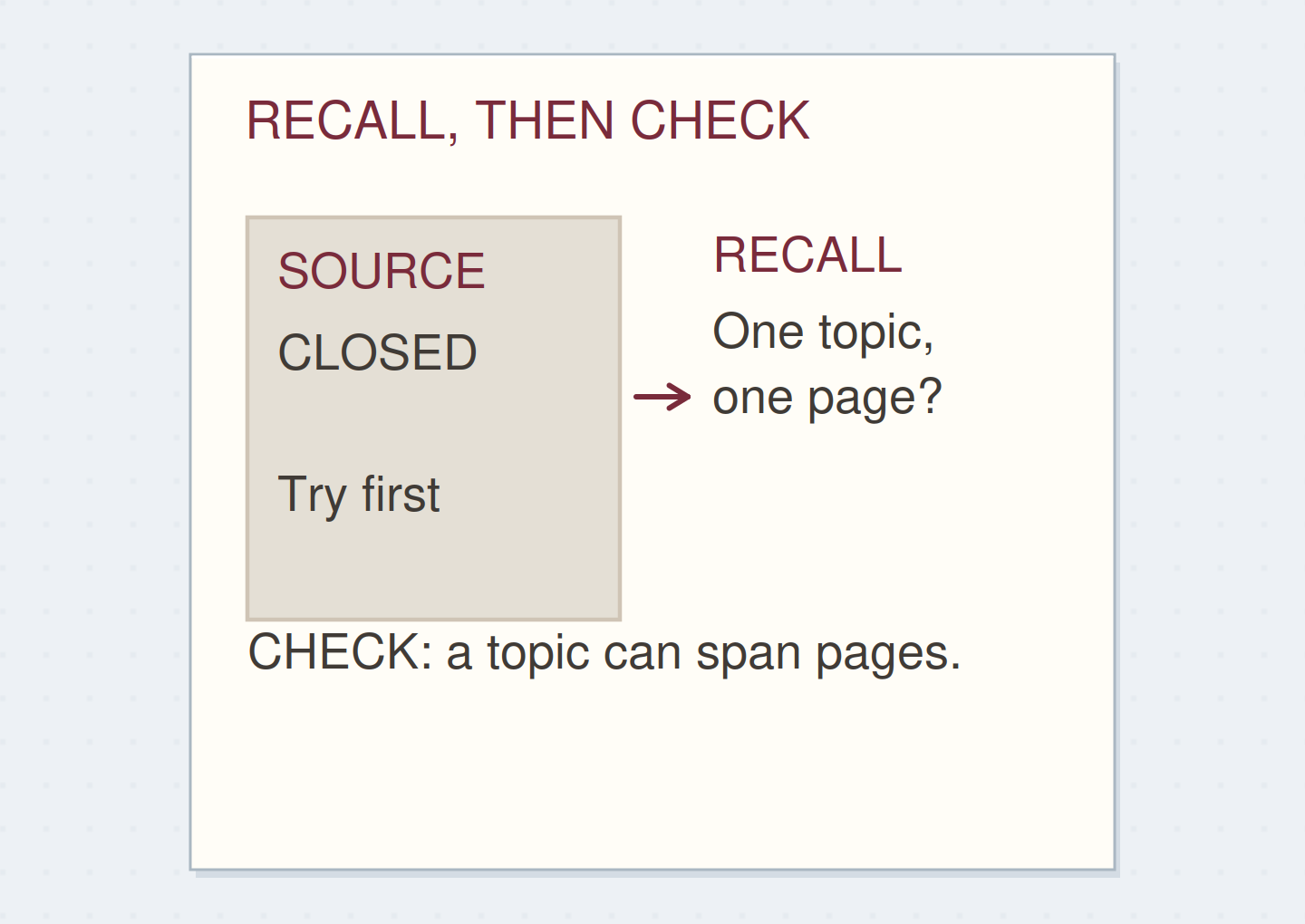
Decide whether your chosen question needs a reference, another observation, a conversation, or a harmless comparison. You can write “Read,” “Look,” “Ask,” or “Test” beside it as plain labels. The Right Question Institute's work distinguishes generating questions from improving and deciding how to use them; this personal notebook borrows only that broad separation, rather than reproducing its full Question Formulation Technique. Choose a question you can make progress on with the access and time you have. A question may remain parked because you don't have the right source, and that is a complete decision for now.
A specific, checkable question
Move the reveal control to compare the two written examples. Read what the changed detail allows you to understand.
The note before revision
A reaction to unnamed windows cannot guide a useful search.
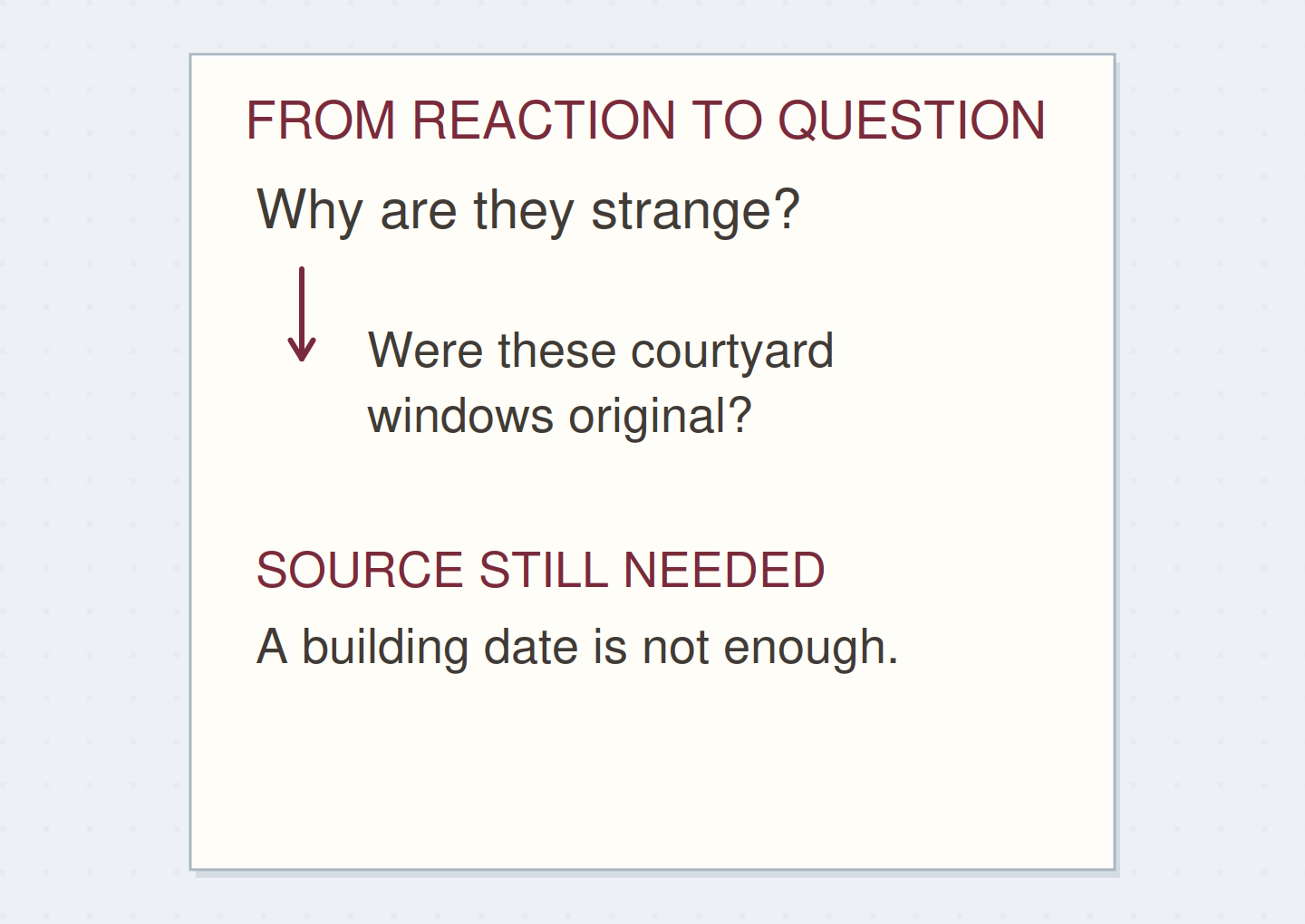
Refine an invented window question
Start with “Why are the library windows so strange?” Add the context “Side facing the courtyard; narrow panes above the shelves.” On review, revise it to “Were the courtyard windows part of the library's original design?” The next step could be “Look for the building history on the library's own website or ask the library about an available history.” Keep an answer line blank until you find evidence. The invented example shows how a vague reaction becomes a checkable question. It doesn't supply a fictional history or assume that the window shape had a single purpose you can infer by looking.
Draft: Keep a Question Without Falling Down Every Rabbit Hole
Edit the practice words to make a note you can use in your own notebook. Keep any uncertainty visible.
Question and contextWere the narrow courtyard windows part of the library’s original design?
Next source or observationLook for an official building history.
Answer or remaining uncertaintyUnresolved until a source addresses these windows specifically.
Your words have a place now.
The initial words are an invented practice example. Edit only the details you want to keep; your entry can stay short.
- Words on this card
- 36
Keep the answer attached to its support
When you find information, write a brief answer in your own words and record the source title, author or organization, and location. For a conversation, note the person's relevant role only when appropriate and distinguish recollection from documentation. If sources disagree, keep the disagreement visible rather than averaging their claims into one confident sentence. If the source answers a neighboring question but not yours, say so. A useful question entry can end with “Still unresolved; this source gives the date of the building, not the date of these windows.” You haven't failed to answer; you've learned what the source can actually support.
Release questions that have stopped mattering
When the page feels like a backlog, mark a question “Keep without action,” “No longer interested,” or “Needs access I don't have.” You don't need to delete the curiosity to release the work. If a question is too broad, choose one visible example and ask what you could reasonably learn about it. If searching keeps expanding the topic, return to the wording on the page and write what would count as enough information for this visit. That stopping condition can be modest: one reliable date, one defined term, or a clear statement that the answer is not currently available.
Leave a next step only when you want one
Close the entry when the question has a source-supported answer, a clearer uncertainty, or a deliberate decision to leave it alone. Add another question only if it is truly yours, rather than an automatic requirement to keep the chain going. A front-page list can point to entries you want to find again, but the notebook needn't become a full research system. On a later day, an old curiosity may regain its interest. Its context will still be there, ready to open a specific inquiry without requiring you to reconstruct what caught your attention in the first place.
Prepare to record answer or uncertainty
Move the steps and check the dependencies. Only the stated preparation relationships matter.
One workable order
- Capture the question and contextPreserve the subject before the moment is forgotten.
- Refine what you want to knowThe source search needs a clear information target.
- Check an appropriate sourceGather evidence that actually addresses the refined question.
- Record answer or uncertaintyThe result must reflect what the checked source supports.
Which check needs to come first?
The example shows one workable order. This order keeps the required checks before the decisions that rely on them; other unconnected steps can change places.
Where this idea began
Want to follow the idea further? These community discussions and maker references are a good place to start.
- An idea I am enjoying
Journalers describe collecting curiosities and retaining questions without interrupting the current writing flow.
- A Reddit journaling idea
A participant proposes recording interesting questions and titles to revisit, with comments about losing track of posts.
- Question Formulation Technique for Research — Right Question Institute
The method separates generating, refining, prioritizing, and reflecting on questions; the guide references only this broad distinction.