Gather a few things See what you’ll need
- A notebook
- A pen
- A short learning source
- A spare sheet to cover earlier notes
Ask for an explanation you can attempt
Choose one prompt that requires you to produce something, such as “How does a page index help me find a topic?” rather than “Do I understand indexes?” Write the source title and location in a small reference line, then close or cover it. Retrieval-practice educator Pooja Agarwal describes bringing information to mind as the central action of the method. This notebook applies that idea to a short written explanation. It doesn't require a timer or a target number of facts, and it doesn't promise that one successful recall means you will remember the topic permanently.
See what a learning attempt tells you
Choose a situation and notice how the example changes. Each choice gives a different useful next move.
Keep the produced answer visible.
The closed-source answer remembers that an index points to pages. Preserve it before checking so the record shows what you could explain without looking, rather than only what seemed familiar afterward.
Write before checking the source
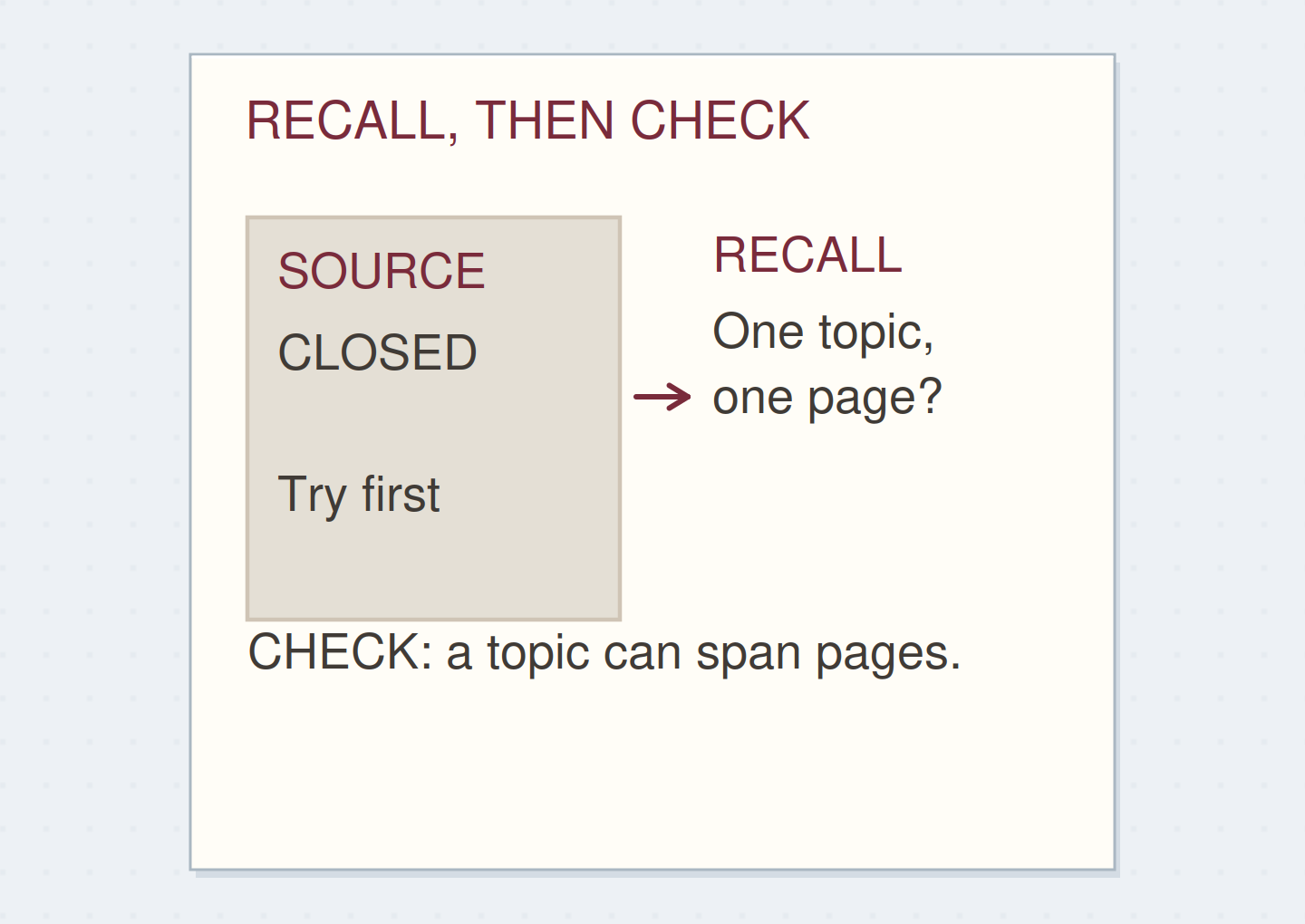
Answer the question in your own words while the source stays closed. You can use a sketch, a numbered explanation, or a few sentences. Mark uncertain parts as uncertain rather than filling them with confident guesses. If you remember only a fragment, write the fragment and a precise gap: “I remember that the index points to pages, but not how to handle a topic on several pages.” Keep your attention on producing what you know. Opening the source after each sentence turns the page into copied notes and makes it harder to tell what you could explain independently.
“Stop when the attempt has been checked and you can see what changed.”
Compare the attempt with reliable material
Now reopen the source. Use a second column or a separate “Checked” paragraph to correct errors, add missing steps, and identify anything you still cannot resolve. A different pen color is optional; written labels work just as well. Don't erase the original attempt, because it shows where the explanation needed attention. Record the page or section that supports the correction. If your source is unclear or contradictory, write a question and seek a more suitable explanation. Checking is part of the learning activity, not a reward reserved for a successful first attempt.
A produced and checked answer
Move the reveal control to compare the two written examples. Read what the changed detail allows you to understand.
The note before revision
Familiar-looking notes do not show what you can retrieve unaided.
Recall a notebook index method
Here is an invented learning example. Prompt: “How would I find notes about birds across one notebook?” Closed-source attempt: “Put Birds in the front index and write its page number.” After checking your source, the correction reads, “A topic can have several page numbers; add each relevant page or range under Birds rather than moving all entries together.” Your next prompt becomes, “How would I record two separate bird entries without reserving pages?” This example uses an ordinary notebook method so the exercise can focus on recall and checking. It doesn't test specialized knowledge or require a correct answer before you can continue.
Draft: Close the Notes Before You Write What You Remember
Edit the practice words to make a note you can use in your own notebook. Keep any uncertainty visible.
PromptHow would I find bird notes across one notebook?
Closed-source attemptPut Birds in the index with a page number.
Checked correctionAdd every relevant page under Birds; entries can stay where written.
Your words have a place now.
The initial words are an invented practice example. Edit only the details you want to keep; your entry can stay short.
- Words on this card
- 34
When the blank answer feels unhelpful
Reduce the size of the question. Instead of explaining an entire chapter, name one term and one example. If you still can't begin, briefly revisit the relevant material, close it again, and make a new dated attempt. Label that attempt “After a cue” so it doesn't pretend to be unaided recall. Avoid copying a model answer repeatedly just to fill the page. A useful rescue names the missing piece and gives you a way back into it. If you are studying for a course, keep your teacher's requirements in view; this notebook supports practice rather than replacing the work assigned.
Try again with the answer covered
On a later occasion, cover both your first answer and corrections, then respond to the same prompt or a closely related one. Vary the example so you aren't only remembering where a sentence sits on the page. Compare the new attempt with the checked explanation afterward. Record a remaining uncertainty or a change in the question. There's no need to calculate a personal mastery percentage from a few notes. If the topic now feels straightforward, move on to another small idea while keeping the original reference available for a future check when you need it.
Leave a corrected explanation and one next question
Stop when the attempt has been checked and you can see what changed. A final line might name the point you want to retrieve next time, or say that no further question is needed today. The blank spaces can remain blank. Don't turn the journal into a second set of complete lecture notes; its distinctive job is to show what you tried to recall and how you checked it. When you return, the source address and visible corrections will give you a clear starting point, even if the first attempt was only a few uncertain words.
Prepare to preserve a correction
Move the steps and check the dependencies. Only the stated preparation relationships matter.
One workable order
- Choose a small recall questionThe attempt needs a prompt you can answer.
- Close the source and answerIndependent recall comes before reopening the explanation.
- Check against the sourceNow compare the produced answer with reliable material.
- Preserve a correctionThe correction needs the check that supports it.
Which check needs to come first?
The example shows one workable order. This order keeps the required checks before the decisions that rely on them; other unconnected steps can change places.
Where this idea began
Want to follow the idea further? These community discussions and maker references are a good place to start.
- How to journal learning?
A bullet journal user asks for a workable structure for capturing and reflecting on learning across subjects.
- How to increase retention using retrieval practice
Teachers discuss using a brief closed-source recall activity, including a classroom brain dump.
- Retrieval Practice — Pooja K. Agarwal
The educator identifies bringing information to mind as the central retrieval-practice action.