Gather a few things See what you’ll need
- A notebook
- A pen or pencil
- The book you are reading
- A plain bookmark
Choose a moment rather than the whole book
Return to one detail that stayed with you: a character's choice, an unusual explanation, a repeated image, or a claim you aren't convinced by. Write a short heading naming that detail. “The borrowed umbrella” gives you a smaller place to begin than “My review.” If several moments compete, choose the one you can locate now. Put the others on a bookmark without promising to develop them. The aim is a usable response to something you actually read, so you needn't reach a verdict on the author or the entire book.
Choose what you want to answer
Choose a situation and notice how the example changes. Each choice gives a different useful next move.
Follow the action that raised your question.
The folded umbrella and the lack of a knock create a specific contrast. Record that action before deciding what it means, then keep your interpretation in a separate sentence.
Give the response an address
Write the title, author, date, and page or chapter. For an ebook, record a chapter and a short description of the passage if page numbers vary; for audio, add a timestamp and edition. Beside that address, summarize the moment in your own words. Keep quotation marks for words you have copied exactly. Rebecca Barrett-Fox's response-journal teaching places a source reference beside a reader's response; this page uses that basic distinction in a small personal entry. The identifying details let you check your impression later without copying a whole scene.
“Stop when the page contains a location, a moment, and a response you recognize as your own.”
Let your thought have its own paragraph
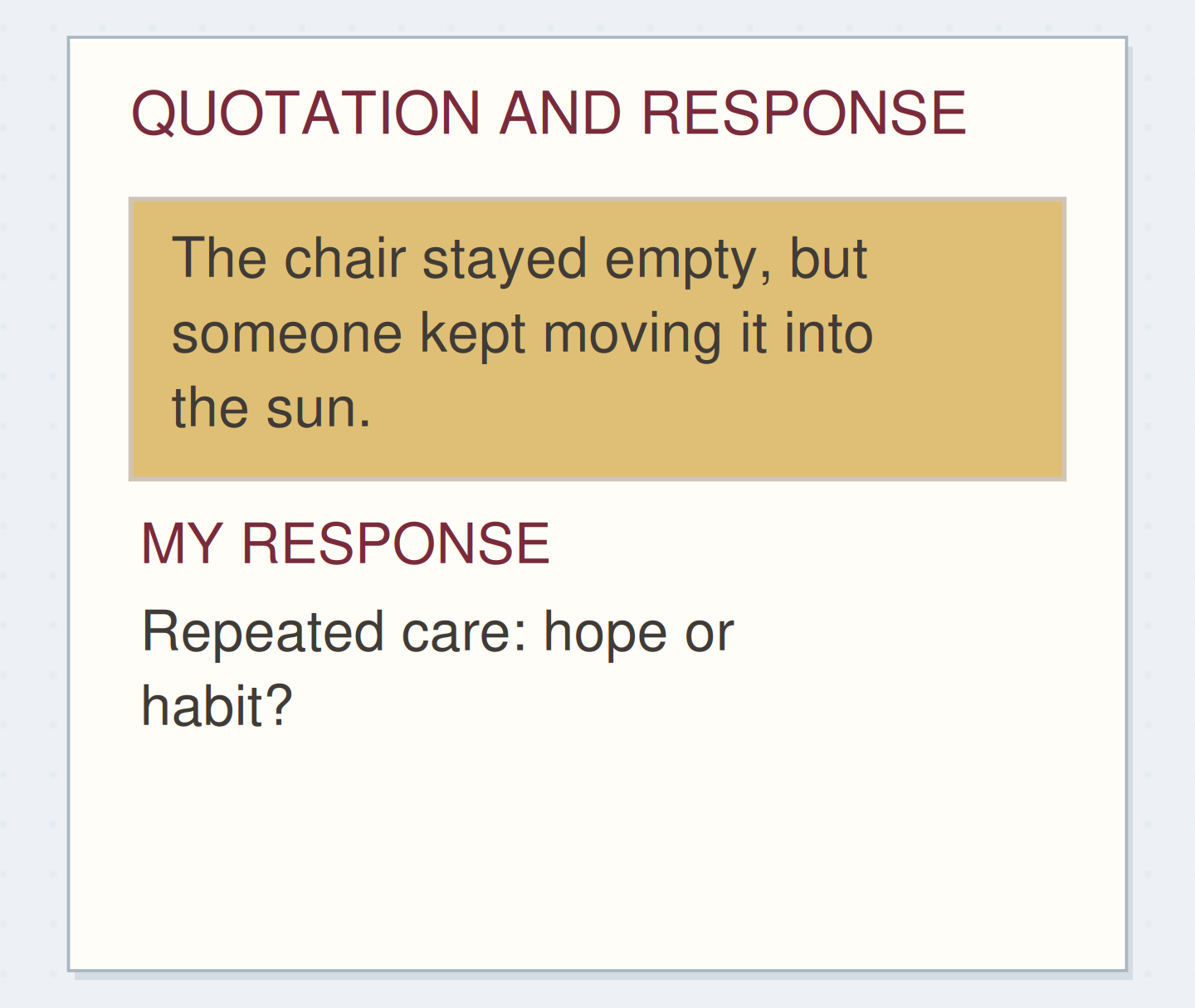
Under the source note, begin with a sentence that names your reaction and then gives a reason. “I believed her hesitation because she kept checking the empty doorway” says more than “The character felt realistic.” You can disagree, ask a question, connect another reading, or notice a craft choice. Personal disclosure is optional. A note about how a sentence works is a complete response even when it says nothing about your life. Leave a blank line between the source account and your reaction so another reading doesn't blur the author's words with yours.
Why I liked it
Move the reveal control to compare the two written examples. Read what the changed detail allows you to understand.
The note before revision
A bare preference leaves you without a scene to return to.
Try the borrowed-umbrella example
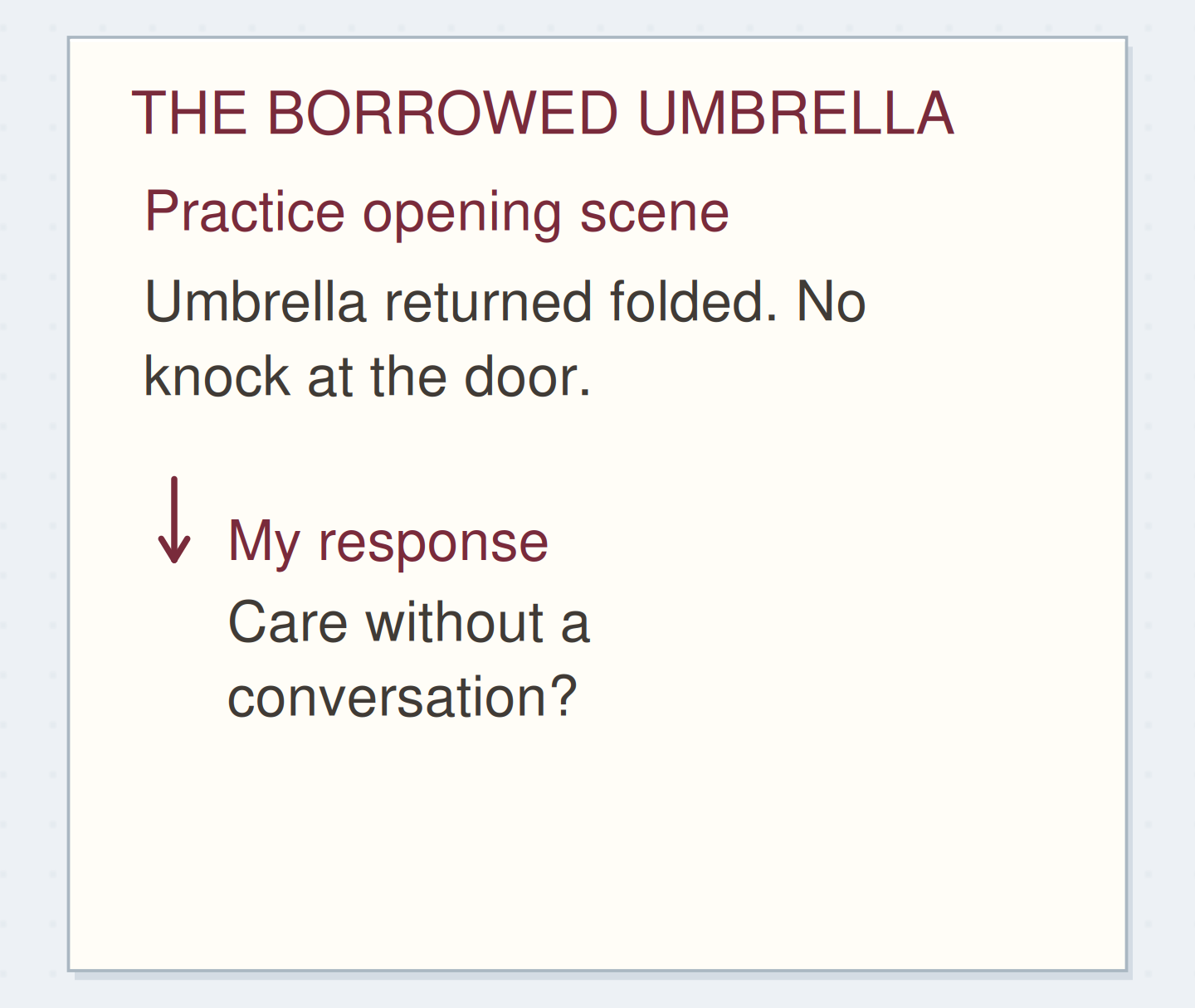
Here is an invented practice scene: a neighbor returns an umbrella neatly folded, but leaves it outside instead of knocking. Your source note could read, “Practice story, opening scene: the borrowed umbrella arrives back at the door without a conversation.” Your response might be, “I read this as an apology that isn't ready to be spoken. The careful folding suggests attention, while the empty doorstep keeps the neighbors apart.” Finish with, “Would I read it differently if the umbrella were left open?” That question returns you to the evidence instead of treating your first interpretation as settled fact.
Draft: Write the Part of the Book That Stayed With You
Edit the practice words to make a note you can use in your own notebook. Keep any uncertainty visible.
Source momentPractice opening: the umbrella returns folded, without a knock.
My responseThe careful folding suggests attention while the empty doorway keeps the neighbors apart.
QuestionWould an open umbrella change my reading?
Your words have a place now.
The initial words are an invented practice example. Edit only the details you want to keep; your entry can stay short.
- Words on this card
- 34
When everything becomes plot summary
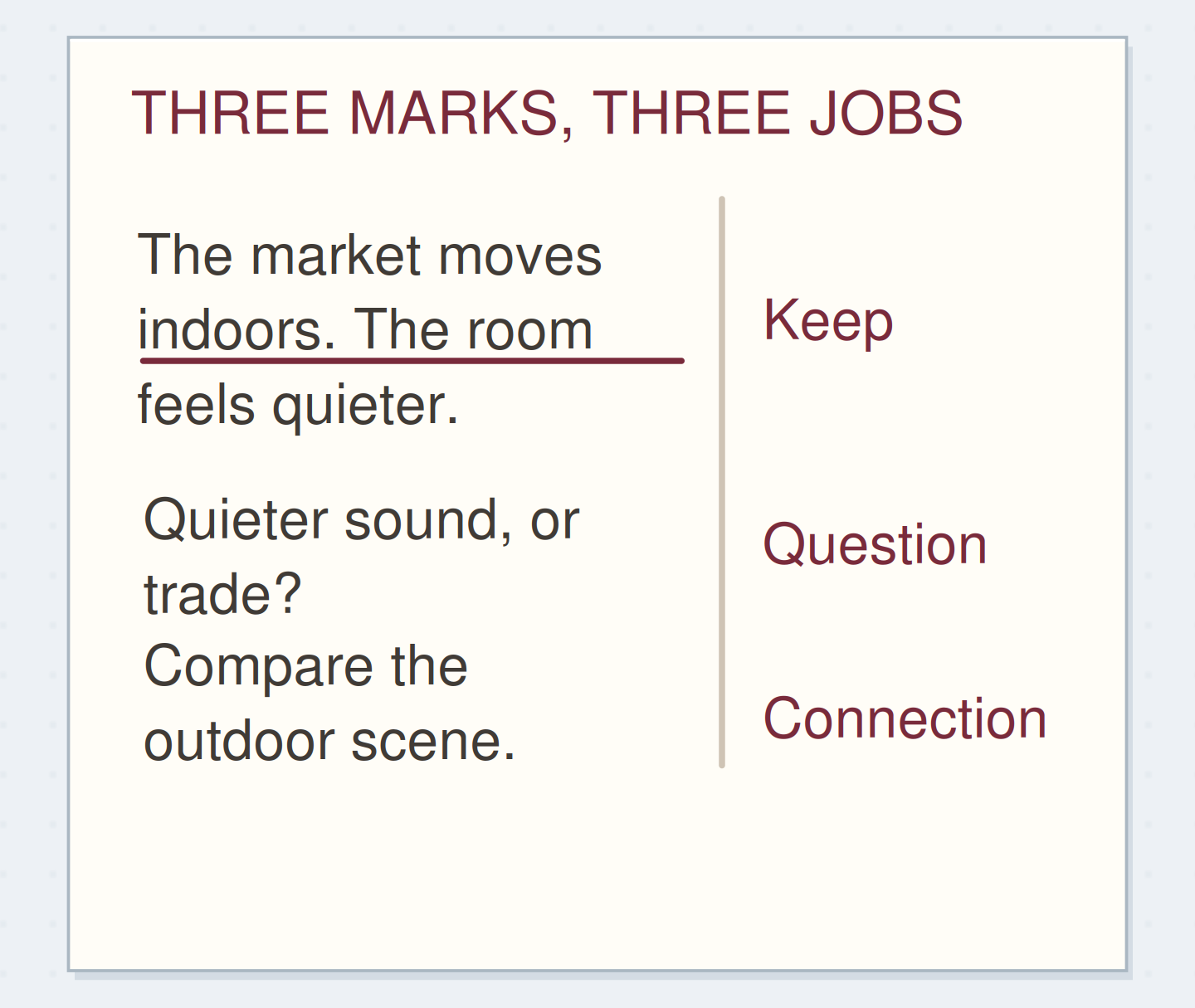
Read the entry and underline the sentence that belongs to you. If nothing qualifies, stop retelling and add “What caught me here was…” followed by one concrete reason. Keep enough summary to locate the moment, then cross through details your response doesn't use. If you genuinely have no reaction, write a question or leave the entry unfinished. You don't owe every chapter a paragraph. Equally, an enthusiastic page doesn't need a forced criticism for balance. A response is useful when it records your encounter accurately, including uncertainty or plain enjoyment.
Make room for your actual way of reading
When several books share a notebook, start each entry with its title and place a short page reference beside that title in a simple front list. Don't reserve twenty pages for a book whose entry length you can't predict. If you prefer loose reading notes, tuck one thin sheet beside the relevant chapter and transfer only what still interests you. A second reading can live below the first with a new date. Keep the older opinion legible; changing your mind is useful information about this reading, not a mistake that needs hiding.
End with one line you can return to
Stop when the page contains a location, a moment, and a response you recognize as your own. Add one closing sentence about what you would like to notice next, or write “Enough for this reading” if there is no next question. On a later visit, read your response before reopening the passage, then check whether the evidence still supports it. A small correction in the margin is sufficient. You now have a record of why this bit of reading mattered, without needing to finish a review or decorate a complete spread.
Prepare to check the source account
Move the steps and check the dependencies. Only the stated preparation relationships matter.
One workable order
- Find the selected sceneYour response needs a specific moment to refer to.
- Record its locationThe source should remain findable after the book closes.
- Write your responseKeep your interpretation separate from the source account.
- Check the source accountVerify the details before treating the finished note as an accurate account.
Which check needs to come first?
The example shows one workable order. This order keeps the required checks before the decisions that rely on them; other unconnected steps can change places.
Where this idea began
Want to follow the idea further? These community discussions and maker references are a good place to start.
- Does anyone here have a journal exclusively for making notes on books?
Readers discuss keeping summaries, quotations, and personal responses in reading notebooks.
- For those who journal about books they read
The discussion asks how to organize quotations, concepts, and responses across several books.
- The Response Journal — Rebecca Barrett-Fox
The author distinguishes a source passage, a page or time reference, and a reader’s response.