Gather a few things See what you’ll need
- A notebook
- A pen or pencil
- The book you are reading
- A plain bookmark
Choose an exercise 4 things to try as you read
Try the borrowed-umbrella example
In this invented practice scene, a neighbor returns an umbrella neatly folded but leaves it outside instead of knocking. Source note: “Practice story, opening scene: the borrowed umbrella arrives back at the door without a conversation.”
Response: “I read this as an apology that isn’t ready to be spoken. The careful folding suggests attention, while the empty doorstep keeps the neighbors apart.” Then ask, “Would I read it differently if the umbrella were left open?” The question keeps the interpretation open to evidence.
Write your versionDraft: Write the Part of the Book That Stayed With You
Draft: Write the Part of the Book That Stayed With You
Edit the practice words to make a note you can use in your own notebook. Keep any uncertainty visible.
Source momentPractice opening: the umbrella returns folded, without a knock.
My responseThe careful folding suggests attention while the empty doorway keeps the neighbors apart.
QuestionWould an open umbrella change my reading?
Your words have a place now.
The initial words are an invented practice example. Edit only the details you want to keep; your entry can stay short.
- Words on this card
- 34
ONE WORKED EXAMPLE
The instruction she follows too precisely
In an invented story, a child is told to keep a gate closed. She ties it with three careful knots, then waits beside it for her brother to return.
Before
The draft calls her “disobedient” because the brother cannot enter, but skips the detail that she has followed the instruction about the gate.
After
Source note: practice story, gate scene; three knots hold the gate shut while she waits. Response: “The careful fastening makes me read her as anxious to obey, even though it creates another problem.” Question: what would change if she walked away after tying it?
What changed—and what to check
The response revises a broad character verdict by attending to the action and its context. Its question identifies evidence that could alter the interpretation.
Try this check. Underline the interpretation and check that the scene detail supports it without making it the only possible reading.
Choose a moment rather than the whole book
Choose a character’s decision, unusual explanation, recurring image, or claim you question. A heading such as “The borrowed umbrella” gives you a clear entry point. If several moments compete, start with one you can locate and leave the others on a bookmark. The entry can examine that moment without delivering a verdict on the whole book.
Compare the optionsChoose what you want to answer
Choose what you want to answer
Choose a situation and notice how the example changes. Each choice gives a different useful next move.
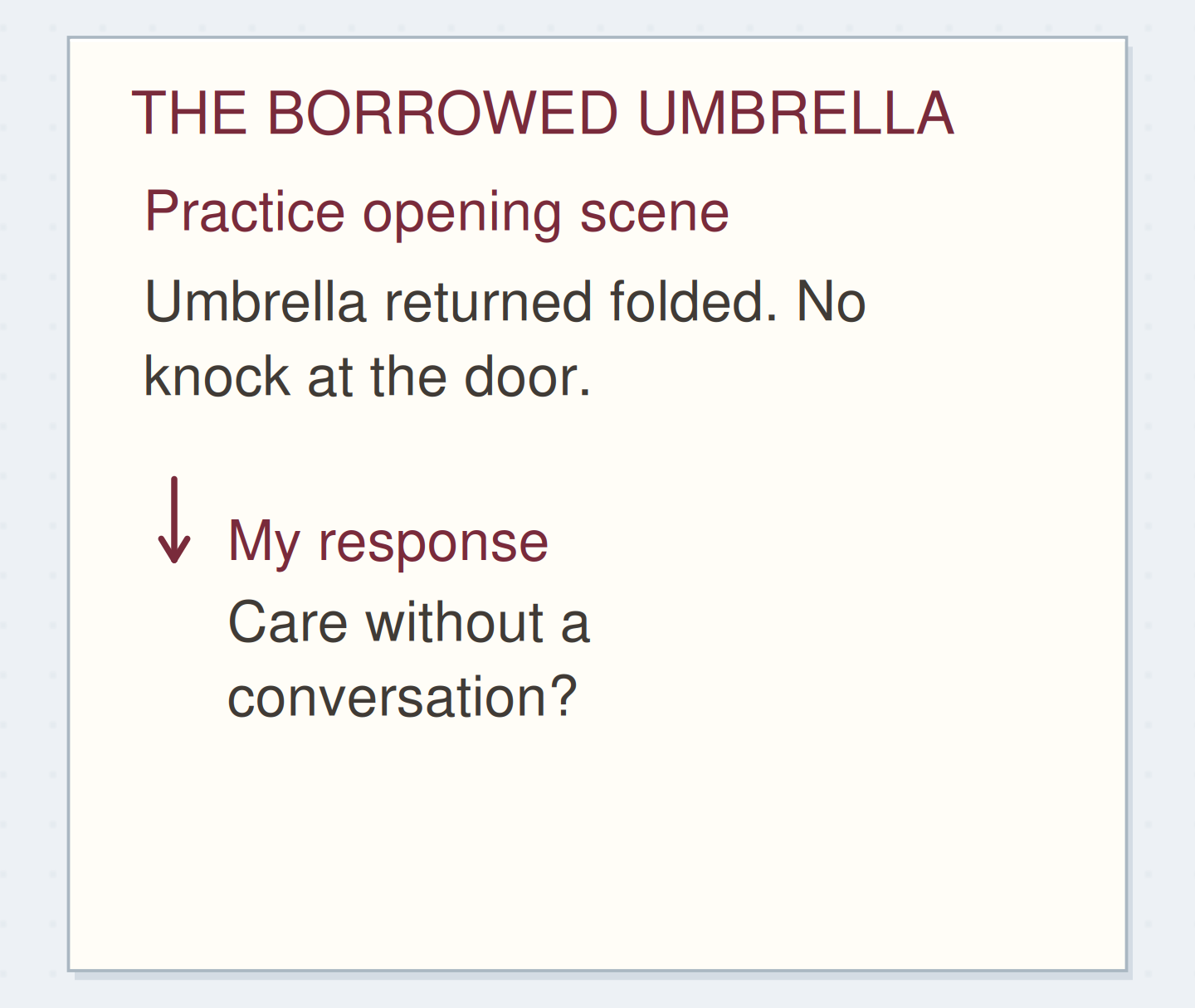
Read the words in this example
- THE BORROWED UMBRELLA
- Practice opening scene
- Umbrella returned folded. No
- knock at the door.
- My response
- Care without a
- conversation?
- Folded umbrella; no knock.
Follow the action that raised your question.
The folded umbrella and the lack of a knock create a specific contrast. Record that action before deciding what it means, then keep your interpretation in a separate sentence.
Give the response an address
Record title, author, date, and page or chapter. For changing ebook pages, use chapter and passage description; for audio, timestamp and edition. Summarize the moment in your words, reserving quotation marks for exact copies. Rebecca Barrett-Fox’s response-journal teaching places a source reference beside the reader’s response; this entry uses that distinction to keep your interpretation checkable.
Let your thought have its own paragraph
Give your response a separate paragraph and something in the passage to lean on: “I believed her hesitation because she kept checking the empty doorway.” Enjoyment, doubt, disagreement, and a craft observation can all work. The useful distinction is between what the passage says and what you make of it, not between a positive and a negative reaction.
See the differenceWhy I liked it
Why I liked it
Read the whole example before and after the change. The tinted lines show revised wording.
Tinted lines contain wording that differs between the two examples.
Before — A bare preference
- A FIRST REACTION
- MY RESPONSE
- I liked it.
- WHAT IS MISSING
- Which detail made me feel that way?
After — A response with a reason
- A RESPONSE WITH A REASON
- SCENE
- Umbrella returned folded; no knock at the door.
- MY RESPONSE
- I liked its hesitant kindness: the umbrella is folded, but the neighbors never speak.
Read the whole example before and after the change.
A bare preference gives you no detail to return to. The revised note names the reader’s response—hesitant kindness—and connects it to the careful folding and the absent conversation.
GO A LITTLE FURTHERWhen everything becomes plot summary
When everything becomes plot summary
Underline the sentence that belongs to your response. If every sentence retells events, add “What caught me here was…” and name a detail that explains why. Then shorten any plot summary your response does not use. Keep enough to locate the moment; you do not need to retell the chapter before you are allowed an opinion.
GO A LITTLE FURTHERMake room for your actual way of reading
Make room for your actual way of reading
With several books in one notebook, title each entry and add its notebook-page reference to a front list. Let entries grow as needed rather than reserving twenty pages per book. Loose notes can live on one thin sheet beside the relevant chapter. Add a second reading under a new date and keep the earlier opinion legible.
GO A LITTLE FURTHEREnd with one line you can return to
End with one line you can return to
Leave yourself one thing to notice on returning, or write “Enough for this reading.” Next time, read your response and reopen the passage at its recorded location. If your interpretation changes, add a new dated note beside it. The earlier response can show how your reading developed without needing to be erased.
Try a what-ifThe same book shows different page numbers
The same book shows different page numbers
Consider this page before choosing your next move.
A friend opens another ebook edition and cannot find the passage using the page number in your notebook. You can still locate it in your copy.
Compare the three choices
What would make the reference more useful across editions?
- Use the percentage shown in your own ebook as the only locator.
Your reading percentage may narrow the search, but editions can include different amounts of front and back matter. It may not identify the same passage in your friend’s copy.
- Estimate the page in the other edition.
A guessed page may send the reader elsewhere and gives false confidence about the location.
- Add the chapter and a short passage description.
Those anchors can survive changing ebook pagination. Keep the title, author, and your own edition information alongside them.
Use a passage address that suits the format, and add another anchor when pagination can change.
What would you try?
Choose an option to see what it would do. You can explore all three.
Something for a future page?
The Washi Tape ShopAffiliate links: we may earn a commission if you buy through these links.
Where this idea began
The method references explain the underlying ideas. Community links show the questions and experiences that helped shape this guide; they are not a popularity ranking. The worked examples here are our own.
- Background mention — search excerpt onlyDoes anyone here have a journal exclusively for making notes on books?
This link provides background context. The full discussion was not reviewed, so it is not evidence that this exact method is popular or effective.
- Background mention — search excerpt onlyFor those who journal about books they read
This link provides background context. The full discussion was not reviewed, so it is not evidence that this exact method is popular or effective.
- Method referenceThe Response Journal — Rebecca Barrett-Fox
The author distinguishes a source passage, a page or time reference, and a reader’s response.