Gather a few things See what you’ll need
- A source text
- A notebook
- A pen
- A bookmark or page marker
Choose an exercise 4 things to try as you read
Answer a sentence written for this exercise
Try this invented line: “The chair stayed empty, but someone kept moving it into the sun.” Attribute it to “Original practice sentence in this guide.”
A response might read: “I notice the repeated care in ‘kept moving.’ The empty chair suggests someone is absent, but the action leaves room for their return. I wonder whether moving the chair is hopeful or simply familiar.” This is an interpretation of the available language, not knowledge of a complete story.
Write your versionDraft: Keep Your Thought Beside the Quotation
Draft: Keep Your Thought Beside the Quotation
Edit the practice words to make a note you can use in your own notebook. Keep any uncertainty visible.
Source and quotationOriginal practice sentence: The chair stayed empty, but someone kept moving it into the sun.
My responseKept moving makes the care feel repeated.
What remains openIs the movement hopeful or familiar?
Your words have a place now.
The initial words are an invented practice example. Edit only the details you want to keep; your entry can stay short.
- Words on this card
- 36
ONE WORKED EXAMPLE
Remembering the gist without inventing a quote
You remember an image of an empty chair being moved into sunlight, but you cannot find the exact wording today. You still want to keep the question it raised for you.
Before
Quotation marks make your remembered sentence look exact, and the note gives no clue that you reconstructed it after reading.
After
The page says “My paraphrase: someone keeps moving an empty chair into the sun.” Below: “My response: is this an act of hope or a familiar routine?” A source-location note remains marked “wording to check.”
What changed—and what to check
The label lets you keep the response now while showing that the sentence is your reconstruction and still needs source verification.
Try this check. Check every quoted line against its source, or remove quotation marks and label any unverified reconstruction as your paraphrase.
GO A LITTLE FURTHERChoose a line you can actually answer
Choose a line you can actually answer
Choose a line that raises a question, disagreement, connection, or interest in wording. If its sound appeals, identify the rhythm or sounds you notice. Read around it first: a line’s meaning may depend on the conversation or an unreliable speaker. Keep a selection short enough to copy accurately and respond to specifically.
Compare the optionsFind the response behind the copied line
Find the response behind the copied line
Choose a situation and notice how the example changes. Each choice gives a different useful next move.
Read the words in this example
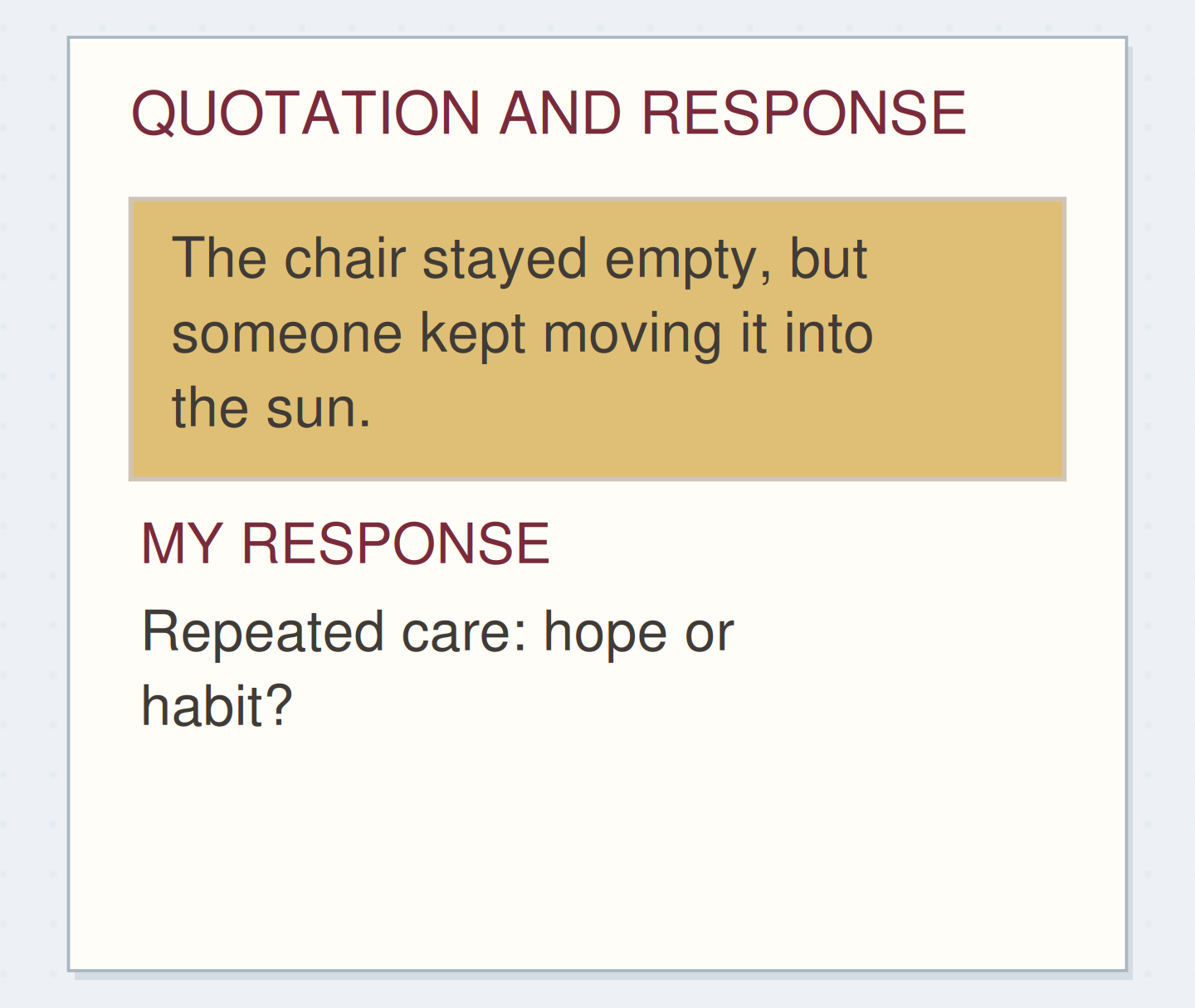
- QUOTATION AND RESPONSE
- The chair stayed empty, but
- someone kept moving it into
- the sun.
- MY RESPONSE
- Repeated care: hope or
- habit?
- Kept moving suggests care.
Notice what the verb adds to the line.
Kept moving suggests repeated attention rather than a single act. Put that observation in your own response so the quotation remains a starting point instead of replacing the thought you wanted to keep.
“Keep the earlier interpretation and note whether new context, experience, or closer attention changed it.”
Record enough context to find it again
Record author, title, and page or another stable location. If a character speaks the line, name that speaker; dialogue does not automatically state the author’s position. For an online source, keep the page title and URL with the entry or in a linked source list.
Check the wording against the source. If you only remember the gist, label it “My paraphrase” and leave it outside quotation marks until you can verify an exact line.
Give your response equal standing
Leave generous space beneath the quotation for “My response.” A vertical split is optional if both columns suit your handwriting. Rebecca Barrett-Fox’s response-journal structure connects a passage and source location with a reader’s engagement; this entry borrows that distinction. Begin “This makes me ask…” or “The word that changes it for me is…” to name admiration, doubt, or disagreement.
See the differenceWords plus response
Words plus response
Read the whole example before and after the change. The tinted lines show revised wording.
Tinted lines contain wording that differs between the two examples.
Before — The note before revision
- THE NOTE AS WRITTEN
- CURRENT NOTE
- Beautiful words
- WHAT IS MISSING
- A usable detail or clear limit.
After — The note with a clearer record
- THE NOTE AS WRITTEN
- REVISED NOTE
- Repeated movement suggests care.
- WHY IT HELPS
- Words plus response
Read the whole example before and after the change.
Calling a sentence beautiful leaves your response unwritten. Your note identifies repeated movement as the detail that suggested care.
GO A LITTLE FURTHERWhen the borrowed words occupy the whole page
When the borrowed words occupy the whole page
If a quotation has already filled the page, give your response the next page and cross-reference both. A crowded margin is not the only place your thought can go.
For “So true,” ask when, for whom, or in what example. If no response comes today, say so briefly or leave the space open. Copying a line you enjoy and answering that line are different uses of the notebook.
GO A LITTLE FURTHERLet a later reading sit alongside the first
Let a later reading sit alongside the first
Add a dated paragraph when your reading changes: “I now read the moving chair as routine.” Keep the earlier interpretation and note whether new context, experience, or closer attention changed it. Identify any translation or edition used. When sharing publicly, favor your explanation and a brief excerpt over long source passages or private writing.
GO A LITTLE FURTHERClose the note when both voices are clear
Close the note when both voices are clear
Check that you can distinguish the source’s words from yours without relying on color alone. Keep the source location beside the quotation and a clear “My response” label where your writing begins.
When you return, read your response first. If it explains why you kept the line, the page is ready to use; an index reference under the book title can help you find it without recopying it.
Try a what-ifWhich context belongs beside the quotation?
Which context belongs beside the quotation?
The speaker inside a work matters to how a copied line reads.
A line was spoken by a character who later turns out to be unreliable. You want your note to preserve the line without misrepresenting its source.
Compare the three choices
Which context belongs beside the quotation?
- Only the author’s name
The author identifies the work, but leaves the line looking like a direct statement of the author’s own position.
- The work, location, and character speaker
Those details preserve attribution and give your response room to consider the speaker’s reliability.
- Your interpretation in place of the speaker
Your interpretation belongs in the response, but cannot replace the information about who says the borrowed words.
Identify the voice inside the work as well as the person who created the work.
What would you try?
Choose an option to see what it would do. You can explore all three.
Something for a future page?
The Washi Tape ShopAffiliate links: we may earn a commission if you buy through these links.
Where this idea began
The method references explain the underlying ideas. Community links show the questions and experiences that helped shape this guide; they are not a popularity ranking. The worked examples here are our own.
- Background mention — search excerpt onlyFor those who journal about books they read
This link provides background context. The full discussion was not reviewed, so it is not evidence that this exact method is popular or effective.
- Background mention — search excerpt onlyDoes anyone else journal about the books they are reading?
This link provides background context. The full discussion was not reviewed, so it is not evidence that this exact method is popular or effective.
- Method referenceThe Response Journal — Rebecca Barrett-Fox
The author distinguishes a source passage, a page or time reference, and a reader’s response.