Gather a few things See what you’ll need
- Two short texts or passages
- A notebook
- A pencil
- A ruler if useful
Choose a question both passages can answer
Start with a concrete feature such as who is allowed to speak, how a place is introduced, or what happens before a character answers. “How does each passage make the room feel crowded?” is easier to investigate than “Which author writes better?” Choose passages short enough to hold in mind together. Write the comparison question at the top of the page before gathering details. If one text has nothing relevant to say about the question, either choose another passage or change the question. Forcing a match can hide the thing that made the texts interesting in the first place.
Give both passages the same question
Choose a situation and notice how the example changes. Each choice gives a different useful next move.
Compare who becomes distinct first.
Passage A names people before their conversation; Passage B initially keeps its sources of sound anonymous. This supports a comparison of introductions, without claiming that one whole book cares more about individuals.
Build a table around evidence
Draw two broad columns headed with the text titles and locations. Leave a smaller area below for your comparison. Add one row at a time: detail, what you think it does, and any uncertainty. You don't need equal numbers of quotations. A short paraphrase with a page reference often leaves more room for your interpretation. Annotation guidance from the University of North Carolina encourages noticing patterns and explaining connections in your own words. Use that principle here, while keeping each observation attached to the text that actually contains it rather than to a general impression.
“Stop when you have a shared question, an address for each passage, and a sentence explaining a relationship supported by both.”
Look for the same feature twice
Read the first passage with your question in view and record one relevant detail. Read the second and look for comparable evidence, including the possibility that the feature is absent. Don't treat absence as a flaw automatically. If one writer names three people and another describes three sounds, that difference may be the point. Keep “the passage says” separate from “I read this as.” When evidence is thin, write “In this paragraph” rather than “This author always.” Your comparison is strongest when the size of its claim matches the amount you have actually examined.
A supported contrast
Move the reveal control to compare the two written examples. Read what the changed detail allows you to understand.
The note before revision
A ranking gives neither passage a shared comparison question.
Compare two invented market scenes
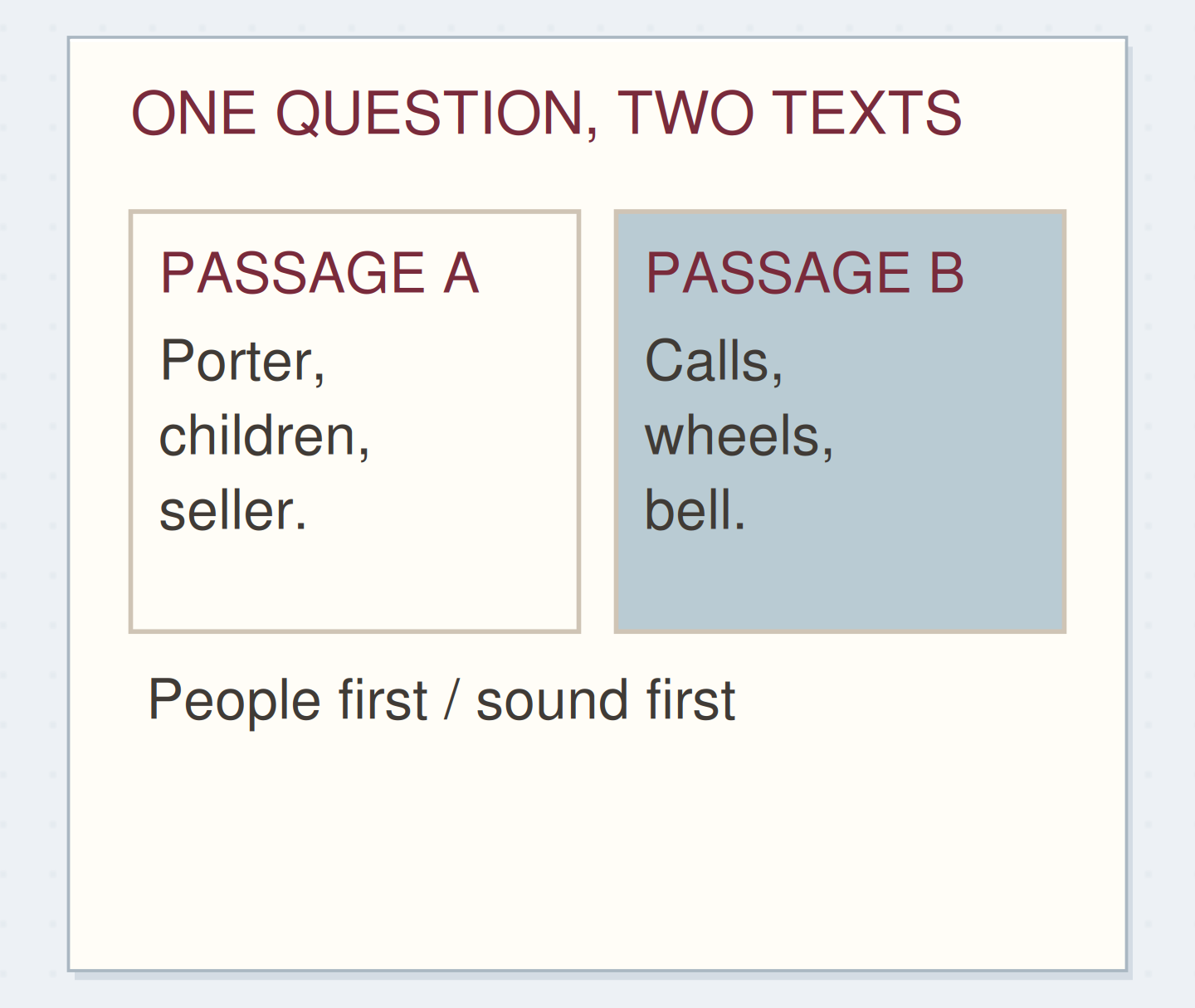
Try these practice summaries: in Passage A, a market scene lists a porter, two children, and a seller before describing their conversation. In Passage B, the scene begins with overlapping calls, a rattling cart, and a bell; no person is named. Under “How is the crowd introduced?” write “people first” for A and “sound first” for B. Your comparison could be, “A gives me individuals to follow; B gives me a crowded sound before I know who is present.” Both create a crowd through different choices. These are invented examples, not summaries of published books.
Draft: Put Two Passages Beside the Same Question
Edit the practice words to make a note you can use in your own notebook. Keep any uncertainty visible.
Shared questionHow is a crowd introduced?
Passage A and B evidenceA names a porter, children, and seller. B gives calls, wheels, and a bell.
My comparisonA gives me individuals first; B gives me a sound before its sources.
Your words have a place now.
The initial words are an invented practice example. Edit only the details you want to keep; your entry can stay short.
- Words on this card
- 41
Repair an uneven comparison
If one column is full and the other nearly empty, inspect the question before finding more material. You may have chosen an event that happens in only one text. Narrow the feature, pick a better counterpart, or let the imbalance remain with a clear explanation. If the page becomes two separate summaries, add a sentence beginning “Where A does this, B…” and check that both halves use evidence already on the page. You can also write “These passages aren't comparable in the way I expected.” That is a useful result, and it keeps you from manufacturing agreement or opposition.
Add a complication before a verdict
Reread each passage for a detail that doesn't fit your first contrast. Perhaps Passage A also begins with a sound, or Passage B later gives one speaker a distinctive voice. Add that complication in a separate line rather than erasing your initial observation. A comparison can describe emphasis without claiming that the texts use entirely separate techniques. For a book club, turn the complication into a question others can answer from the same passages. For private notes, add a reference to another page only when it could genuinely change your reading of the two selected moments.
Keep one supported comparison
Stop when you have a shared question, an address for each passage, and a sentence explaining a relationship supported by both. Leave the rest of the spread empty if your thought is complete. Later, you can add a dated response after reading further, especially if a new chapter changes what the first passage seemed to promise. You don't need to turn the page into an essay. A small comparison that names its evidence and its limits is already a useful conversation between two readings, and it gives you something specific to notice next time.
Prepare to write the bounded comparison
Move the steps and check the dependencies. Only the stated preparation relationships matter.
One workable order
- Choose the shared questionThe evidence search needs a common feature.
- Locate both passagesYou need both texts available for the comparison.
- Record evidence from eachThe comparison must rest on details from both passages.
- Write the bounded comparisonConclude only after you have evidence to compare.
Which check needs to come first?
The example shows one workable order. This order keeps the required checks before the decisions that rely on them; other unconnected steps can change places.
Where this idea began
Want to follow the idea further? These community discussions and maker references are a good place to start.
- For people who journal while they read: what do you write down?
Readers mention recurring themes, character details, and links to other reading as useful note subjects.
- How do you annotate your books?
Readers discuss permanent marks, separate notebook references, and how rereading changes earlier annotations.
- Annotating Texts — UNC Learning Center
The guidance supports purposeful marginal questions, concise summaries, and connections in the reader’s own words.