Gather a few things See what you’ll need
- Two short texts or passages
- A notebook
- A pencil
- A ruler if useful
Choose an exercise 4 things to try as you read
Choose a question both passages can answer
Choose a feature both passages can address: who speaks, how a place is introduced, or what happens before an answer. “How does each passage make the room feel crowded?” gives evidence a clearer job than ranking authors. Keep passages short enough to consider together. If one does not fit, change the passage or question rather than forcing a match.
Compare the optionsGive both passages the same question
Give both passages the same question
Choose a situation and notice how the example changes. Each choice gives a different useful next move.
Read the words in this example
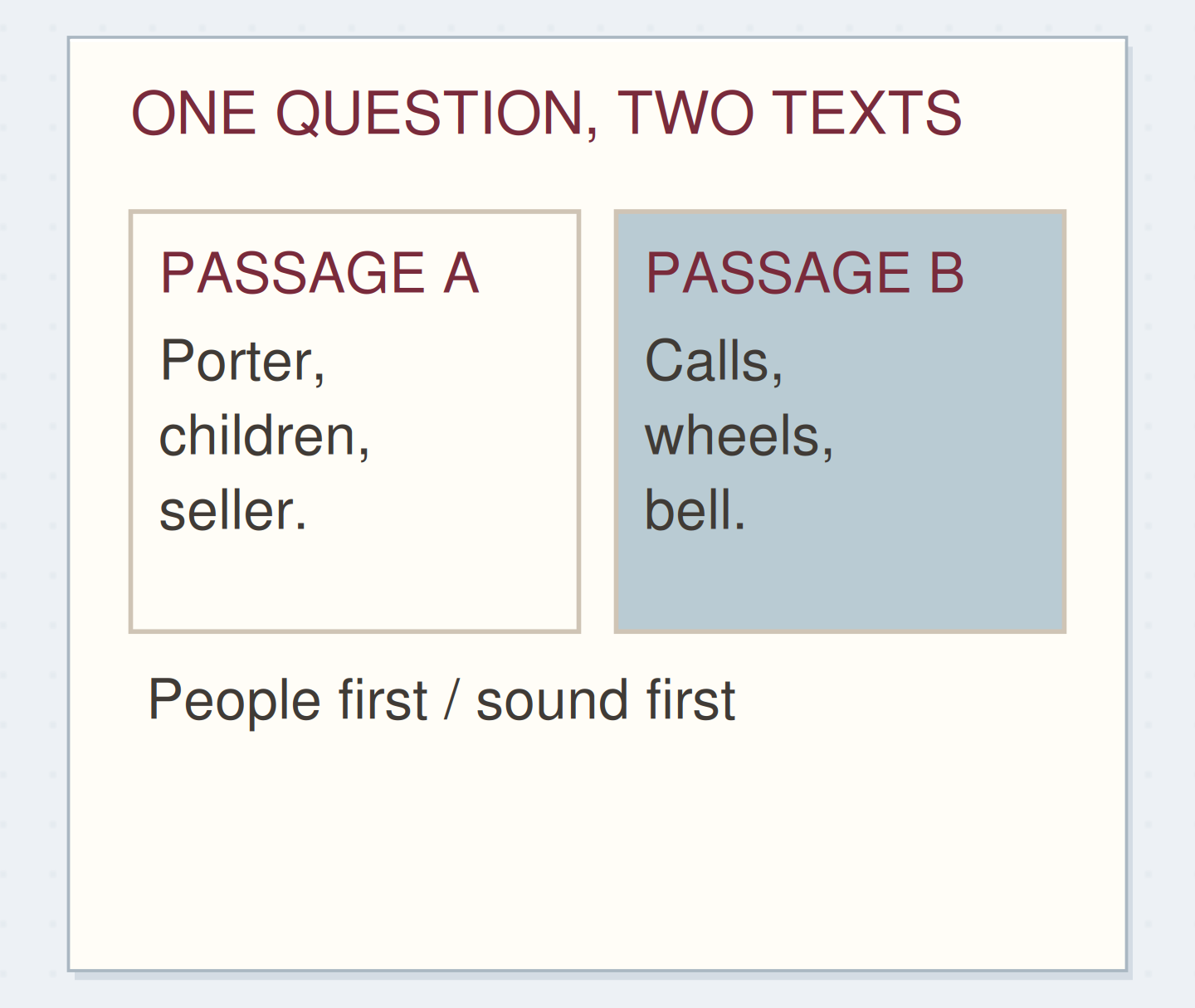
- ONE QUESTION, TWO TEXTS
- PASSAGE A
- Porter,
- children,
- seller.
- PASSAGE B
- Calls,
- wheels,
- bell.
- People first / sound first
- A names people; B begins
- unnamed.
Compare who becomes distinct first.
Passage A names people before their conversation; Passage B initially keeps its sources of sound anonymous. This supports a comparison of introductions, without claiming that one whole book cares more about individuals.
ONE WORKED EXAMPLE
Two ways into the market
You have chosen two short market passages and want more than a general note that both contain a crowd. One begins with named people; the other opens with sound.
Before
“They are both about busy markets” catches the topic, but it does not show what each passage lets you notice first or why that difference matters.
After
Under “How is the crowd introduced?” A records the porter, children, and seller; B records calls, cart wheels, and a bell. Below: “A gives me individuals to follow first; B makes the crowd audible before naming its people.”
What changed—and what to check
A shared question gives each recorded detail a job in the comparison. The conclusion stays close to the two openings you actually selected.
Try this check. Point to one detail in each passage that supports its half of the comparison beneath your columns.
Build a table around evidence
Head two broad columns with the text titles and passage locations, then leave a few lines below them for your comparison. Under each title, keep the detail beside what you think it does. A short paraphrase can save room; use quotation marks only for words you have copied exactly. Keep uncertainty alongside the reading it belongs to.
“Use “in this paragraph” when that is the extent of your evidence.”
Look for the same feature twice
Read each passage for the same feature, noting relevant absence as well as presence. Naming three people and naming three sounds may create a useful contrast without either approach being deficient. Separate what the passage says from your reading. Use “in this paragraph” when that is the extent of your evidence.
See the differenceA supported contrast
A supported contrast
Read the whole example before and after the change. The tinted lines show revised wording.
Tinted lines contain wording that differs between the two examples.
Before — The note before revision
- THE NOTE AS WRITTEN
- CURRENT NOTE
- A is better
- WHAT IS MISSING
- A usable detail or clear limit.
After — The note with a clearer record
- THE NOTE AS WRITTEN
- REVISED NOTE
- A names people; B begins with sound.
- WHY IT HELPS
- A supported contrast
Read the whole example before and after the change.
A ranking gives neither passage a shared comparison question. People and sound become two specific ways of introducing the crowd.
Compare two invented market scenes
These market scenes are invented. Passage A lists a porter, two children, and a seller before their conversation. Passage B opens with overlapping calls, a rattling cart, and a bell, naming no person. Under “How is the crowd introduced?” write “people first” for A and “sound first” for B.
A supported comparison is: “A gives me individuals to follow; B gives me a crowded sound before I know who is present.”
Write your versionDraft: Put Two Passages Beside the Same Question
Draft: Put Two Passages Beside the Same Question
Edit the practice words to make a note you can use in your own notebook. Keep any uncertainty visible.
Shared questionHow is a crowd introduced?
Passage A and B evidenceA names a porter, children, and seller. B gives calls, wheels, and a bell.
My comparisonA gives me individuals first; B gives me a sound before its sources.
Your words have a place now.
The initial words are an invented practice example. Edit only the details you want to keep; your entry can stay short.
- Words on this card
- 41
GO A LITTLE FURTHERRepair an uneven comparison
Repair an uneven comparison
If one column stays empty, inspect the question before adding material. Choose a better counterpart, narrow the feature, or explain the imbalance. If the page becomes two summaries, add “Where A does this, B…” using existing evidence. “These passages aren’t comparable in the way I expected” is also a valid result.
Add a complication before a verdict
Go back once with your first contrast in mind. Does A also include a sound? Does B eventually give a speaker a distinctive voice? Those details need not undo the comparison. They may change “A uses people and B uses sound” into “A introduces people first; B begins with sound.” The order can be the interesting difference.
GO A LITTLE FURTHERKeep one supported comparison
Keep one supported comparison
Read just the comparison and its two supporting details. If the relationship holds, give the note a title you would recognize in discussion, such as “Who arrives first: people or sound?” Keep both passage addresses beside it. A later reading can add a dated qualification underneath.
Try a what-ifA later sentence unsettles your neat contrast
A later sentence unsettles your neat contrast
A complication can make the comparison better.
You wrote that Passage A presents people and Passage B presents sound. On rereading, you find that A also mentions shouting, after introducing three people.
Compare the three choices
What would best fit the details now?
- Remove the shouting from your notes
The inconvenient detail is part of the passage. Leaving it out would make the comparison tidier at the cost of accuracy.
- Compare what each passage introduces first
Order still differs in the passages described. “People first” and “sound first” accommodate the shouting instead of denying it.
- Conclude that the passages are identical
Sharing sound does not erase every difference. Check whether sequence or emphasis explains the contrast you noticed.
A shared feature may change an absolute contrast into a difference of order or emphasis.
What would you try?
Choose an option to see what it would do. You can explore all three.
Something for a future page?
The Washi Tape ShopAffiliate links: we may earn a commission if you buy through these links.
Where this idea began
The method references explain the underlying ideas. Community links show the questions and experiences that helped shape this guide; they are not a popularity ranking. The worked examples here are our own.
- Background mention — search excerpt onlyFor people who journal while they read: what do you write down?
This link provides background context. The full discussion was not reviewed, so it is not evidence that this exact method is popular or effective.
- Community discussionHow do you annotate your books?
Readers discuss permanent marks, separate notebook references, and how rereading changes earlier annotations.
- Method referenceAnnotating Texts — UNC Learning Center
The guidance supports purposeful marginal questions, concise summaries, and connections in the reader’s own words.