Gather a few things See what you’ll need
- A small notebook
- A pencil permitted by the venue
- An eraser if allowed
- A museum object or an official collection image
Let one feature hold your attention
Pick an object you can look at without blocking a route or standing uncomfortably. Notice what drew you first: a bent handle, a repeated shape, a small patch of color, or the direction of a figure's gaze. Write that feature as your page heading. You don't need to choose the most famous object in the room. A manageable detail can sustain more careful looking than a whole gallery. If the space is crowded, make a brief note and return when practical, or use an authorized collection image later rather than trying to draw around other visitors.
Choose the relationship you want to keep
Choose a situation and notice how the example changes. Each choice gives a different useful next move.
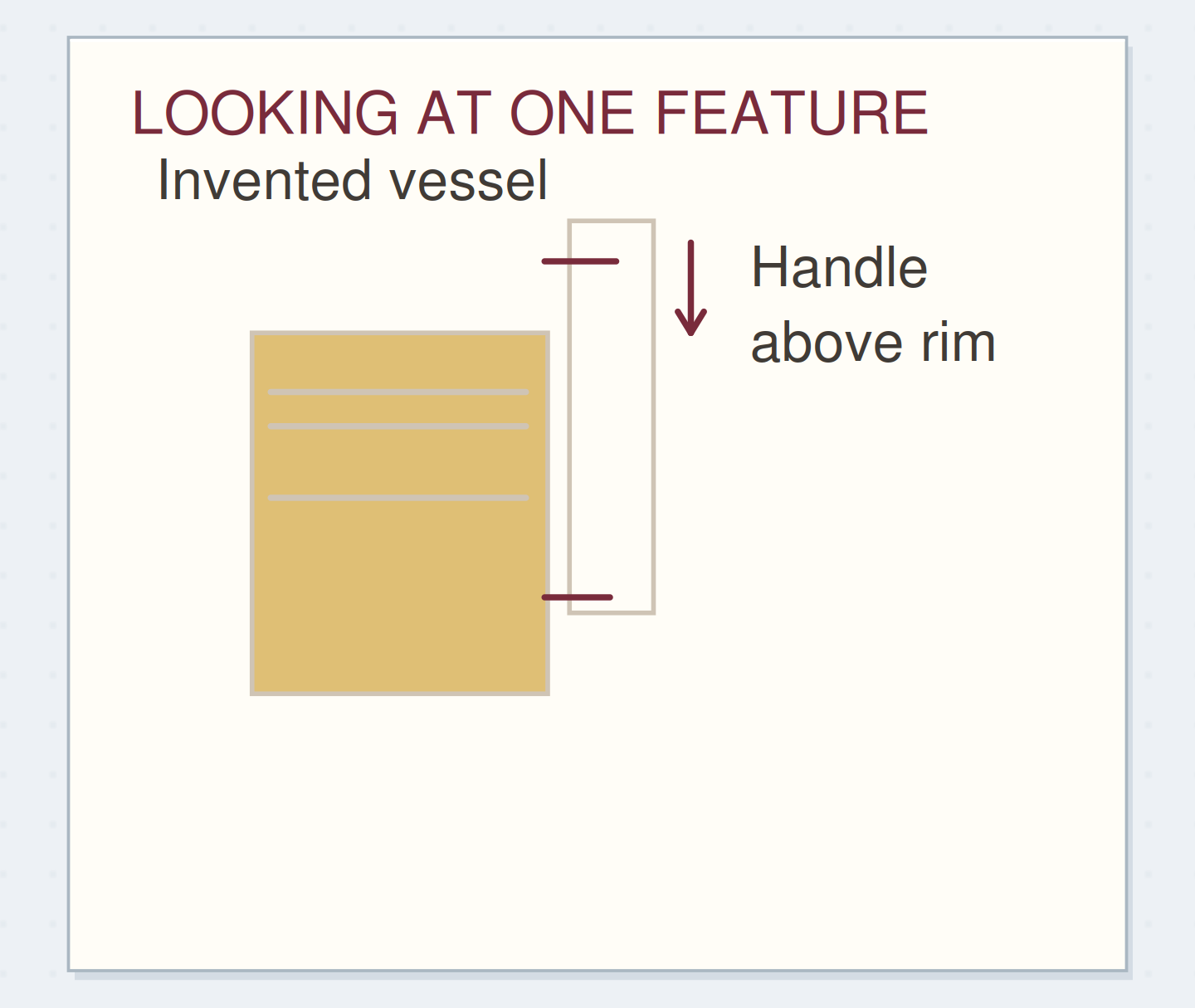
Draw the relative height that your words describe.
The practice vessel has a handle rising above its rim. A small outline and a height label preserve that relationship without requiring a polished drawing or an invented history of the object.
Record before borrowing an explanation
Spend a moment describing what is visible before reading the label in detail. Project Zero's See, Think, Wonder routine distinguishes close observation, interpretation, and questions. Use that distinction here without treating your first impression as a test. “The handle joins the body at two points” is an observation; “It was carried often” is an interpretation that needs evidence. Put tentative ideas in their own paragraph. You can still read the label first if access or your interests make that useful; simply record that its information was already part of your encounter with the object.
“Finish when you can point to the feature that made you pause and distinguish it from the information you learned afterward.”
Draw the detail your words need
Make a small outline of the feature you chose and label the relationship you want to remember. For a vessel, two rectangles and a curved-looking arrangement of short lines may be enough to place a handle, rim, and repeated band. The sketch can remain visibly approximate. Write “three bands near rim” if the drawing can't show them clearly. Museum sketchbook community discussions include making line notes in the gallery and adding color later; that is an option when materials or space are limited. Mark later additions so they aren't mistaken for observations made in front of the object.
Only facts the source supports
Move the reveal control to compare the two written examples. Read what the changed detail allows you to understand.
The note before revision
An unsupported age and purpose have been assigned to the practice object.
Study an invented handled vessel
Imagine a practice object with a tall handle and three narrow bands near the rim. Your page says, “I see the handle rising above the rim. The bands repeat at uneven distances. I think the tall handle changes where the eye goes first. I wonder whether the spacing was deliberate.” Beside a small outline, write “Handle higher than rim” with a leader line. Label this as an invented example. In a real museum, add the object's title or description, maker if given, date information, institution, and collection number when available. Don't invent missing history to make the page feel finished.
Draft: Bring One Museum Object Home in Your Notes
Edit the practice words to make a note you can use in your own notebook. Keep any uncertainty visible.
Object and sourceInvented practice vessel; add a real museum label reference for your own object.
Visible featureHandle above rim; three narrow bands with uneven spacing.
Interpretation or questionWas the spacing deliberate?
Your words have a place now.
The initial words are an invented practice example. Edit only the details you want to keep; your entry can stay short.
- Words on this card
- 34
Add what the institution actually tells you
After your own looking notes, record a few relevant facts from the label or official collection page and identify that source. A date range should remain a range. “Maker unknown” should stay unknown. If the label changes your interpretation, add “After reading the label…” and explain what shifted. Keep your original observation visible when it is still accurate. You can also note a disagreement or an unanswered question without presenting yourself as more certain than the evidence permits. The page becomes more useful when your looking, the institution's information, and your interpretation can each be traced separately.
When drawing anxiety takes over the visit
If you keep erasing, replace the drawing with a written description of three relationships: higher than, closer to, repeated beside, or darker than. You are trying to keep a feature, not produce a replica. If you feel obliged to document every room, choose one object and stop the notebook work there. If the label is unreadable or you forget an attribution, mark what is missing and check the official collection later if possible. Don't fill the gap with a remembered name that merely seems likely. A partial record with an honest source gap is preferable to a polished misidentification.
End with a detail you would seek again
Finish when you can point to the feature that made you pause and distinguish it from the information you learned afterward. Add one closing line about what you would look for on a return visit: another handle shape, a repeated motif, or the effect of viewing distance. Then close the notebook and continue the visit without recording if you wish. At home, a new dated paragraph can connect the object to something else you have seen. The page has done its work when the specific object remains recognizable in your notes, even if your sketch stays unfinished.
Prepare to review observation and interpretation
Move the steps and check the dependencies. Only the stated preparation relationships matter.
One workable order
- Choose an accessible objectThe study needs a subject you can observe comfortably.
- Record a visible featureYour interpretation should have an observed detail to refer to.
- Record relevant label informationKeep the institution’s information separately identified.
- Review observation and interpretationCheck the finished note after its visual and sourced information are both present.
Which check needs to come first?
The example shows one workable order. This order keeps the required checks before the decisions that rely on them; other unconnected steps can change places.
Where this idea began
Want to follow the idea further? These community discussions and maker references are a good place to start.
- Sketching at the Victoria and Albert Museum
A sketcher describes drawing an object and its label at the museum, with watercolor added at home.
- See, Think, Wonder — Project Zero
The routine distinguishes visible observation, interpretation supported by details, and remaining questions.