Gather a few things See what you’ll need
- A source text
- A notebook
- A pen
- A bookmark or page marker
Choose a line you can actually answer
Pick a passage that provokes a specific reaction: a question, a disagreement, a connection, or interest in its wording. If you only like its sound, that is a useful starting point; identify which sound or rhythm you notice. Read the sentences around it before copying. A line can change meaning when lifted out of a conversation or when spoken by an unreliable character. Prefer a short selection you can keep accurate. Don't lengthen it merely to fill the available space, and don't expect the page to represent everything the source is trying to do.
Find the response behind the copied line
Choose a situation and notice how the example changes. Each choice gives a different useful next move.
Notice what the verb adds to the line.
Kept moving suggests repeated attention rather than a single act. Put that observation in your own response so the quotation remains a starting point instead of replacing the thought you wanted to keep.
Record enough context to find it again
Write the author, title, and page or other stable location above the quotation. Include the speaker when a character says it, so the sentence doesn't quietly become the author's own position. For an online source, keep the page title and URL in your paper reference or a clearly connected source list. If you only remember the gist, label it “My paraphrase” instead. A quote is a claim about exact wording, so check it against the source. The small effort of recording its address is more useful than giving the line an elaborate border.
“Finish when the page shows which words came from the source and which thought came from you.”
Give your response equal standing
Leave a generous space below the quotation and label it “My response.” A vertical split can work too, but narrow columns often tempt you to shrink your handwriting. Rebecca Barrett-Fox's response-journal structure connects a source passage and location with a reader's own engagement; this entry borrows that distinction without adopting a classroom assignment. Your paragraph might begin “This makes me ask…” or “The word that changes it for me is…” You don't have to agree with a quotation to keep it. The page becomes clearer when admiration, uncertainty, and disagreement can each be named.
Words plus response
Move the reveal control to compare the two written examples. Read what the changed detail allows you to understand.
The note before revision
Calling a sentence beautiful leaves your response unwritten.
Answer a sentence written for this exercise
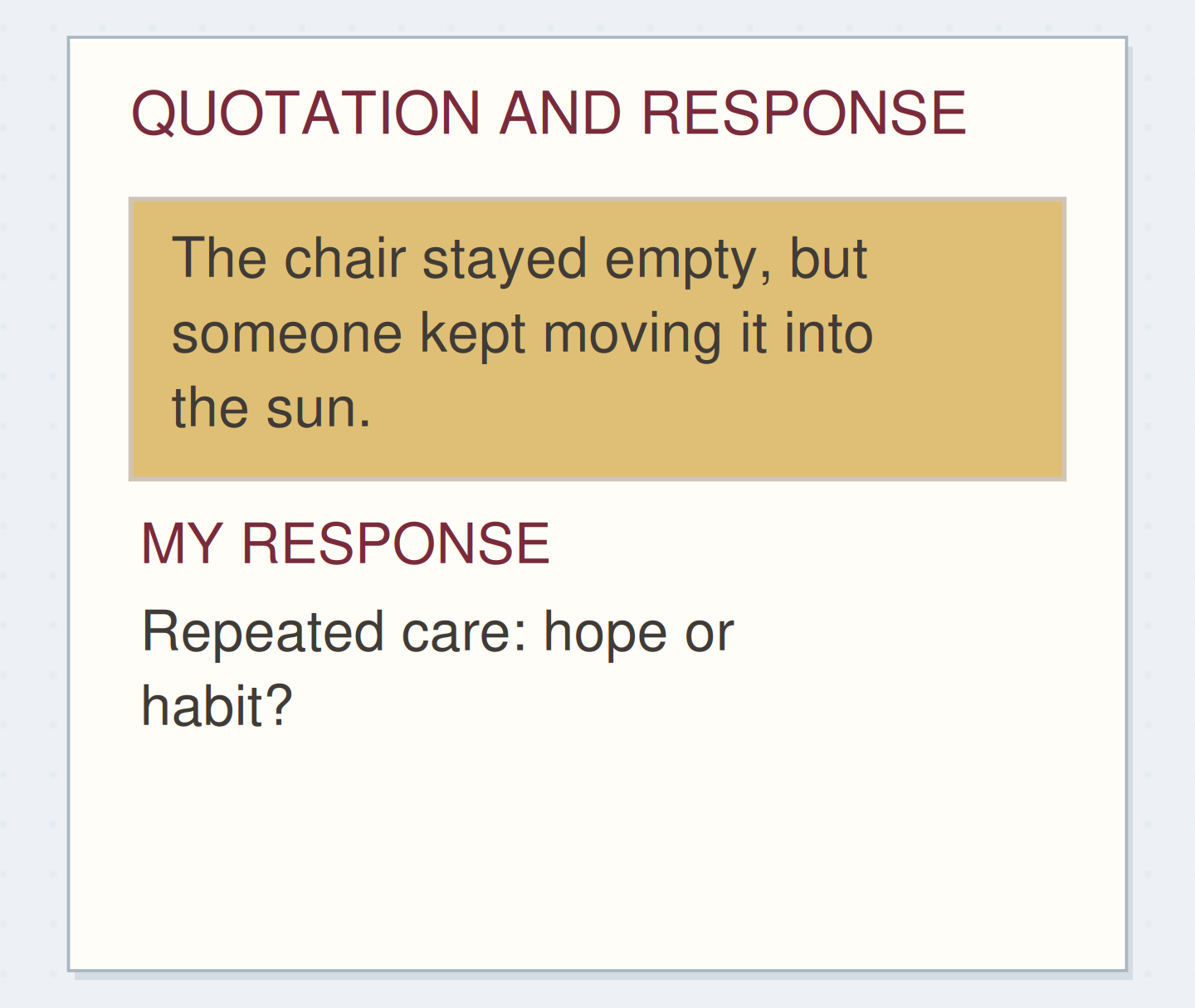
Use this invented line if you don't have a book nearby: “The chair stayed empty, but someone kept moving it into the sun.” Label the source “Original practice sentence in this guide,” so it never acquires a false attribution. A response could be, “I notice the repeated care in ‘kept moving.’ The empty chair suggests someone is absent, but the action leaves room for their return. I wonder whether moving the chair is hopeful or simply familiar.” The example notices language and offers a reading. It doesn't claim to know a complete story from one sentence.
Draft: Keep Your Thought Beside the Quotation
Edit the practice words to make a note you can use in your own notebook. Keep any uncertainty visible.
Source and quotationOriginal practice sentence: The chair stayed empty, but someone kept moving it into the sun.
My responseKept moving makes the care feel repeated.
What remains openIs the movement hopeful or familiar?
Your words have a place now.
The initial words are an invented practice example. Edit only the details you want to keep; your entry can stay short.
- Words on this card
- 36
When the borrowed words occupy the whole page
If you've copied a long passage and have no room to respond, write your thought on the next page and give both pages a clear cross-reference. Don't squeeze it around the edges as though it matters less. If the response is only “So true,” add a condition: true when, true for whom, or true in which example? You can also decide the line doesn't need commentary today. Mark that honestly, and return only if a response arrives. Copying can be enjoyable in itself; this particular method simply asks you to distinguish copying from responding.
Let a later reading sit alongside the first
When your opinion changes, add a new dated paragraph underneath. “I now read the moving chair as routine” can coexist with the earlier idea of hope. Check whether your changed reading comes from more context in the source, another experience, or a closer look at the wording. That distinction makes the later note useful. If you quote from a translation or different edition, record which version you used. When sharing a page publicly, favor your own explanation and a brief excerpt rather than reproducing long sections of someone else's work or private writing.
Close the note when both voices are clear
Finish when the page shows which words came from the source and which thought came from you. One quotation and three thoughtful sentences can do that work. Add a last line only if it gives you a useful question for the next chapter or discussion. You can file the entry under the book title without copying it again into another collection. When you return, read your response first and see whether you still understand why you chose the line. If you do, the note has kept the encounter you wanted to save.
Prepare to check which voice is which
Move the steps and check the dependencies. Only the stated preparation relationships matter.
One workable order
- Locate the original wordingExact quotation requires access to the source.
- Check and label the quotationKeep the source address and checked words together.
- Write your own responseThis should answer the selected passage rather than stand in for it.
- Check which voice is whichReview the complete pair before sharing or filing it.
Which check needs to come first?
The example shows one workable order. This order keeps the required checks before the decisions that rely on them; other unconnected steps can change places.
Where this idea began
Want to follow the idea further? These community discussions and maker references are a good place to start.
- For those who journal about books they read
The discussion asks how to organize quotations, concepts, and responses across several books.
- Does anyone else journal about the books they are reading?
Readers describe keeping thoughts and selected quotations alongside other journal entries.
- The Response Journal — Rebecca Barrett-Fox
The author distinguishes a source passage, a page or time reference, and a reader’s response.