Gather a few things See what you’ll need
- A small notebook
- A pen
- A dictionary or reliable language reference
- The source where you met the word
Keep the word with its original situation
Write the word clearly and note where you encountered it: a book page, a lesson, a conversation you can describe without exposing private remarks, or a labeled media segment. Add a short context phrase in your own words, or a brief exact excerpt if the wording matters. Context helps you choose among possible meanings. For example, “draft” in a writing lesson differs from a draft coming through a window. Don't copy the first dictionary meaning before checking whether it matches the source. If you heard the word and aren't sure of its spelling, mark that uncertainty until you verify it.
Choose the missing piece in this word entry
Choose a situation and notice how the example changes. Each choice gives a different useful next move.
Keep the sense that matches the sentence.
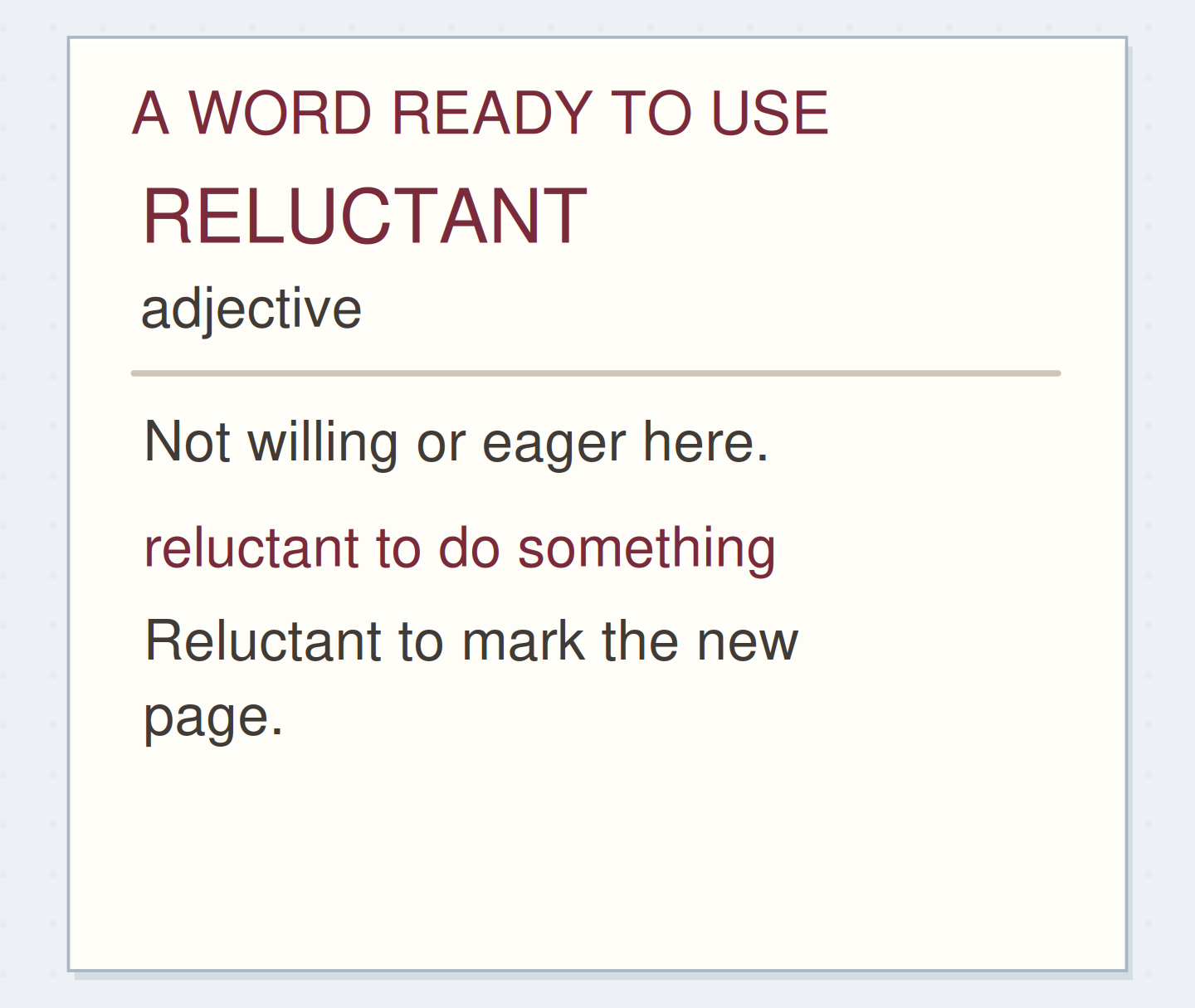
Reluctant describes being unwilling or not eager in this practice context. A relevant meaning is more useful than copying every possible dictionary detail before you know which one the source uses.
Check the meaning that belongs here
Use a reliable dictionary, teacher, or suitable language reference to confirm the relevant meaning. Write an explanation you understand, with a translation if that is useful. Keep the part of speech and an important grammatical pattern when they affect use. Oxford Online English's vocabulary-notebook tutorial distinguishes meaning, form, and pronunciation information; you can select the pieces that this word actually needs. A verb may need its accompanying preposition, while a noun may need a note about how it is used in context. Avoid copying a whole dictionary entry when one well-chosen meaning will serve your purpose.
“Finish when you have a checked spelling, a meaning that fits the source, and a usable example or a clearly marked question.”
Try the word in a new situation
Write a sentence that belongs to you and makes the meaning visible. Keep it simple enough to check. A sentence containing the word without a meaningful context may show spelling but not use. If you aren't sure about the wording, label it “My attempt” and check it with a teacher or reliable example before treating it as a model. You can add pronunciation notes using a system you already understand or a reference to audio. There is no need to invent phonetic notation. Leave a little space for a useful correction or word partnership you discover later.
A word ready to try
Move the reveal control to compare the two written examples. Read what the changed detail allows you to understand.
The note before revision
A translation alone may leave the word’s grammatical pattern unknown.
Build an entry for reluctant
An original practice entry could read, “Reluctant, adjective. Context: a character agrees to speak but hesitates first. Meaning here: not willing or eager to do something. Useful pattern: reluctant to do something. My sentence: I was reluctant to write on the new notebook's first page, so I began on a scrap.” Check the meaning and pattern in a reliable reference when making your own entry. You could add a contrast with “eager” if that helps you use it. The sentence demonstrates a situation rather than merely stating “Reluctant is a word I learned today.”
Draft: Give a New Word a Sentence You Can Use
Edit the practice words to make a note you can use in your own notebook. Keep any uncertainty visible.
Word and contextReluctant; a character hesitates before agreeing to speak.
Checked meaning or patternAdjective: not willing or eager here. Pattern: reluctant to do something.
My sentenceI was reluctant to mark the new page, so I began on a scrap.
Your words have a place now.
The initial words are an invented practice example. Edit only the details you want to keep; your entry can stay short.
- Words on this card
- 42
When the collection grows faster than you use it
Choose a few entries that you actually want to say or recognize and let the others remain a passive record. You don't need to rewrite the entire notebook into categories. If a word keeps escaping you, examine the entry: is the meaning clear, does the sentence fit, and have you tried retrieving it without looking? Language-learning community discussions often describe forgetting notebooks that contain only lists. Use that practical concern to make the next review active. If several meanings become tangled, give them separate examples instead of forcing them into a single translation that doesn't work in every situation.
Cover the answer and change the example
Fold a spare sheet over the word or its explanation and try to bring the missing part to mind. Then uncover and check. On another visit, write a new sentence so you aren't only recalling the entry's position on the page. If you meet the word again, record a short new context, particularly when its meaning or grammatical use differs. Don't assign yourself a fixed number of exposures after which you must remember it. The notebook can show what still needs checking without treating forgetting as a failure or claiming that a particular review schedule fits everyone.
Leave one entry ready for a return
Finish when you have a checked spelling, a meaning that fits the source, and a usable example or a clearly marked question. Date any later correction so you can understand what changed. You can group entries by topic if that helps, or keep them chronologically with a simple index. The format matters less than finding the words you actually intend to revisit. Stop collecting when the page has done enough for today's reading or listening. A vocabulary notebook should give you a route from meeting a word to trying it, while leaving time to keep meeting language beyond the page.
Prepare to revisit with the answer covered
Move the steps and check the dependencies. Only the stated preparation relationships matter.
One workable order
- Keep the word’s contextContext helps select the relevant meaning.
- Check the meaning and patternVerify the sense and form before treating them as a model.
- Write and check a new sentenceTry the checked meaning in a different situation.
- Revisit with the answer coveredA useful review depends on a checked entry already existing.
Which check needs to come first?
The example shows one workable order. This order keeps the required checks before the decisions that rely on them; other unconnected steps can change places.
Where this idea began
Want to follow the idea further? These community discussions and maker references are a good place to start.
- How are you cataloguing and learning vocabulary?
The thread describes neglected word lists, phrase-based entries, and covering one side of notes during review.
- I write words in a notebook but cannot remember them
The reader asks how to move beyond collecting vocabulary toward useful review.
- Expand Your English with a Vocabulary Notebook — Oxford Online English
The tutorial distinguishes meaning, grammatical form, pronunciation, and later review of vocabulary entries.