Gather a few things See what you’ll need
- A book or article
- A pencil
- A narrow scrap bookmark
- A notebook
Choose three jobs your reading needs
Use Question for something you want to understand, Keep for a detail you want to find again, and Connection for a relationship with another passage or idea. Write the meanings on a scrap bookmark. These labels are practical choices for this exercise, not an official annotation standard. If you're reading for sentence craft, you might replace Connection with Technique. Choose the jobs before assigning colors; otherwise the attractive pens can decide the system. Leave a category out if you haven't needed it. Two useful labels are easier to maintain than eight labels you keep forgetting.
Give this mark a useful job
Choose a situation and notice how the example changes. Each choice gives a different useful next move.
Use Keep for the detail you need to locate.
Marking the market move gives you a route back to the event. Add the reason in a few words, so the mark is more useful than a color whose meaning you have forgotten.
Decide where your marks can safely live
For a book you own and are comfortable marking, put a tiny label in the margin and underline only the relevant words. For borrowed books or pages you want untouched, record the page number and label on a separate slip. A plain bookmark avoids testing adhesives on someone else's paper. If your note will exceed the available margin, put its longer version in a notebook and add that notebook page number to the slip. Test your pen on your own spare paper first if show-through would make the reverse difficult to read.
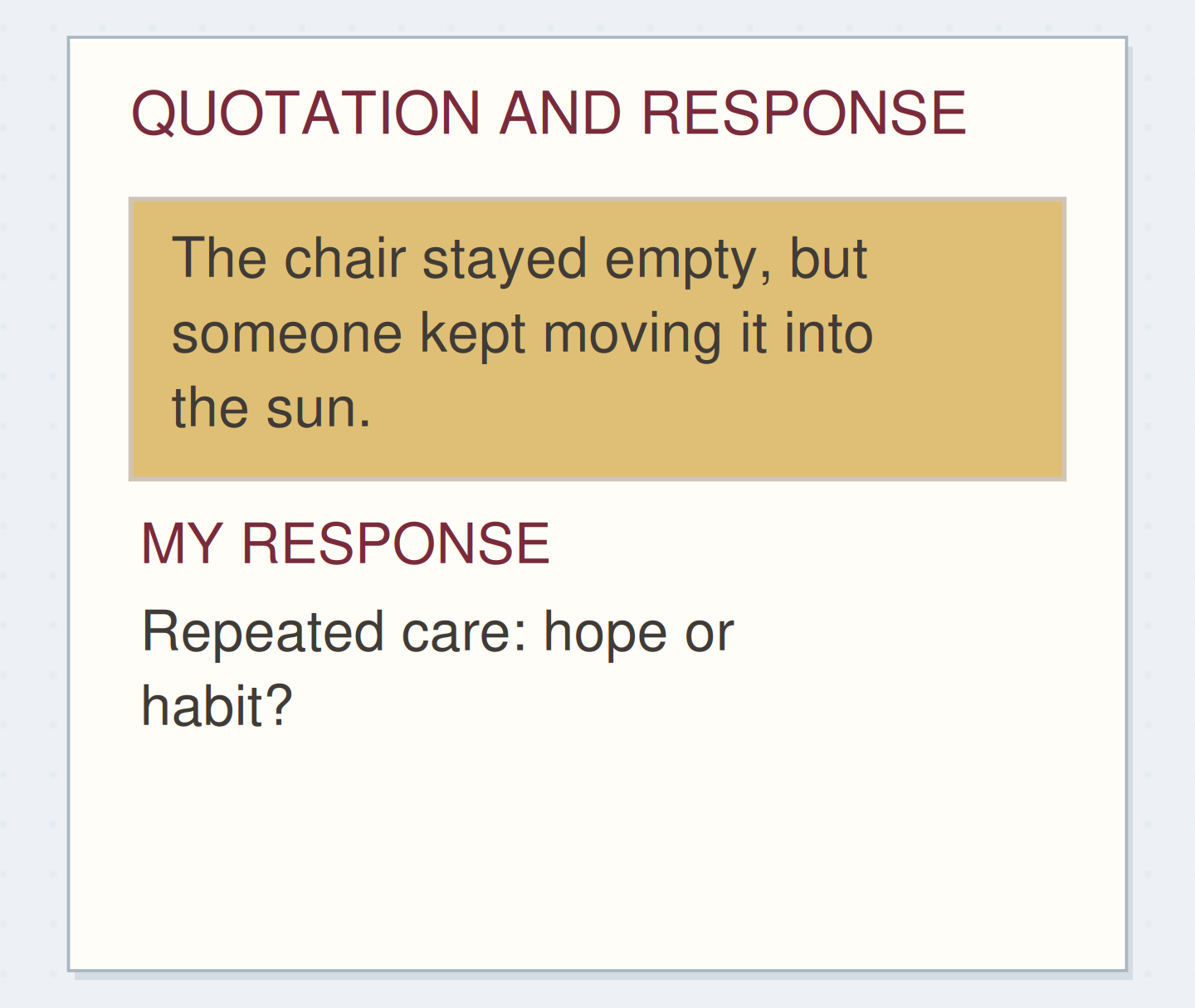
“Your annotation session can end after one useful mark.”
Add the reason beside the label
A label tells you the kind of attention; the accompanying words tell you why. “Question: whose account is this?” has a future use that “Question” alone lacks. The University of North Carolina's annotation guidance suggests comments, questions, and summaries in your own words. Here, make the explanation short enough that you can return to reading promptly. Wait until the end of a paragraph before deciding what deserves a mark. That small delay gives you context and prevents the first apparently important sentence from claiming the whole page's attention.
One useful label
Move the reveal control to compare the two written examples. Read what the changed detail allows you to understand.
The note before revision
Repeated underlining does not tell you why a passage mattered.
Mark an invented paragraph three ways
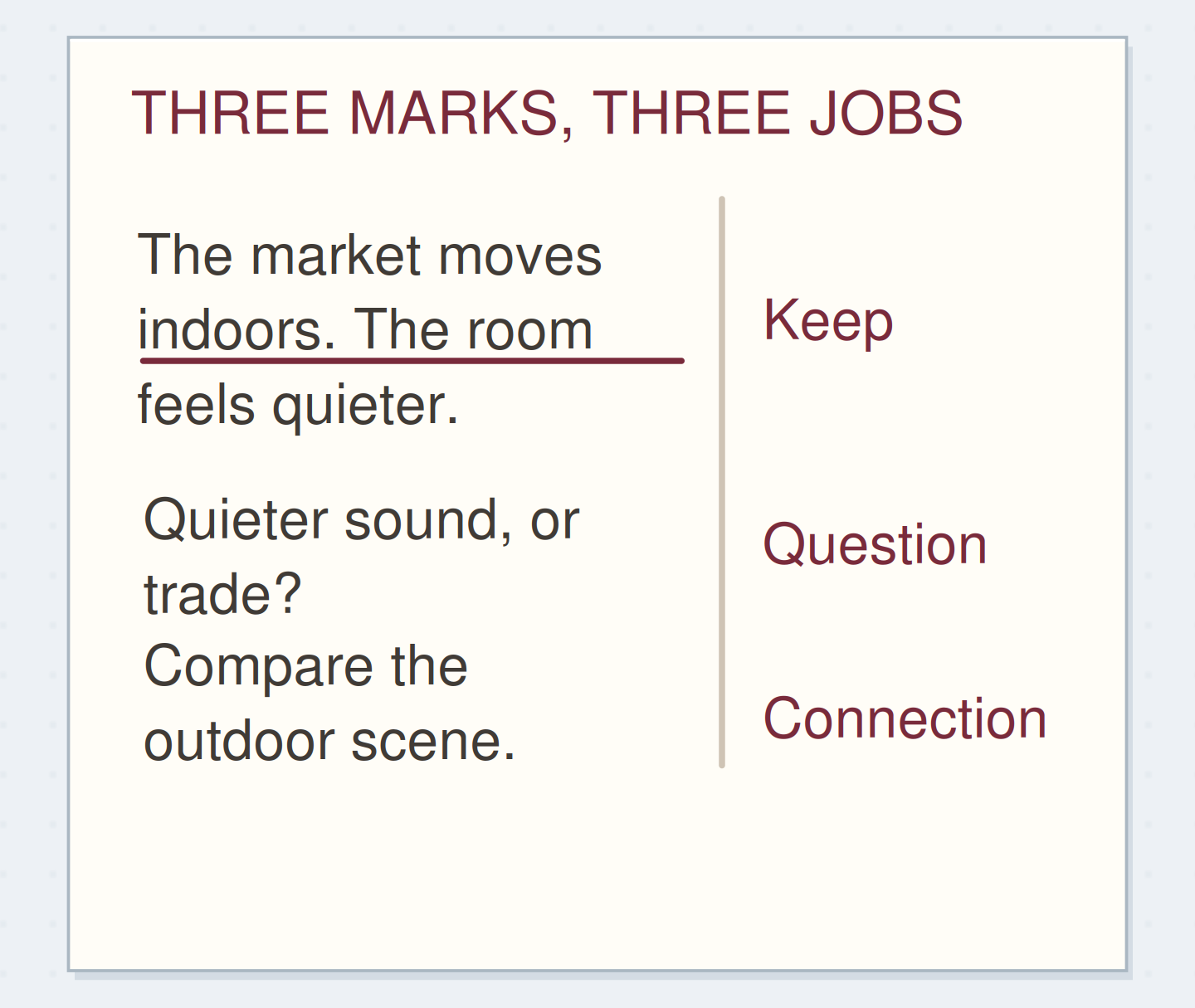
Imagine a practice paragraph in which a village moves its market indoors during a wet month, and a stallholder says the new room feels quieter. You could write “Keep: market moves indoors” beside the event. “Question: quieter in sound or in trade?” identifies an ambiguity. “Connection: compare the crowded outdoor scene” sends you toward another part of the invented story. You would not need all three annotations every time. Try each in the interactive example, then choose the one that gives this particular reading somewhere useful to go. The mark should earn its place.
Draft: Give Each Book Mark a Clear Job
Edit the practice words to make a note you can use in your own notebook. Keep any uncertainty visible.
Book and locationPractice paragraph, market scene.
Mark and reasonQuestion: does quieter mean sound or trade?
Return actionRead the next paragraph for context.
Your words have a place now.
The initial words are an invented practice example. Edit only the details you want to keep; your entry can stay short.
- Words on this card
- 25
Reduce a key that has become work
If you spend more time choosing a category than reading the sentence, merge the overlapping labels. Connection and Theme may be doing the same job for your current book. Circle one existing note you genuinely want to revisit, explain its reason in ordinary words, and let that note guide the revised key. You can keep earlier marks as they are and date the new key on your bookmark. There's no need to recolor a chapter. If even the small key interrupts your enjoyment, use a single “Return here” note and write your thoughts afterward.
Turn one mark into something useful
At a natural stopping place, pick a marked passage and read the reason before rereading the text. Answer the question if you can, develop the connection, or copy the location into a reading response. You may decide that a marked detail no longer matters. Leave it alone rather than building a second project around cleaning every page. For multiple books, keep a separate key slip with each only when its categories differ. A key that travels consistently can serve several books, but a text about gardening may call for different questions from a novel.
Prepare to use the mark to revisit
Move the steps and check the dependencies. Only the stated preparation relationships matter.
One workable order
- Choose a mark’s purposeThe mark needs a job before you apply it.
- Read the paragraphContext is needed before selecting a passage.
- Add a mark and reasonThe reason explains why that passage deserves a return.
- Use the mark to revisitA return depends on a mark and a findable reason already existing.
Which check needs to come first?
The example shows one workable order. This order keeps the required checks before the decisions that rely on them; other unconnected steps can change places.
Keep the key only as long as it helps
Your annotation session can end after one useful mark. Check that you can say what the mark asks your future self to do: find, question, compare, or develop. If you can't, add a brief reason or remove the obligation to revisit it. At the end of the book, keep the bookmark if its references remain useful, or recycle it after transferring a favorite response. The result is a readable route back into selected passages. An untouched page is just as valid as a marked one when nothing on it needs that route.
Where this idea began
Want to follow the idea further? These community discussions and maker references are a good place to start.
- How do you annotate your books?
Readers discuss permanent marks, separate notebook references, and how rereading changes earlier annotations.
- Annotating Texts — UNC Learning Center
The guidance supports purposeful marginal questions, concise summaries, and connections in the reader’s own words.