Gather a few things See what you’ll need
- A notebook
- A pencil
- Two spare paper samples
- A ruler
- A pen you already use
Choose something the page can answer
Ask one narrow question, such as “Which of these two papers shows less of this pen on the reverse under the same viewing conditions?” Write what you will compare and how you will look at it. “Which paper is best?” has too many possible meanings. Decide which features you will hold the same, including the pen, sample sentence, writing pressure as far as practical, and lighting. These choices don't create a perfect laboratory test, but they make the comparison easier to interpret. Science Buddies' notebook guidance emphasizes preserving procedures and observations; apply that record-keeping principle at this small craft scale.
Match your conclusion to the test
Choose a situation and notice how the example changes. Each choice gives a different useful next move.
Keep the result tied to this attempt.
Sample B looks clearer under the desk lamp in the invented observation. Record the pen, viewing setup, and unequal pressure limitation before choosing whether this small comparison is enough for your practical purpose.
Identify samples before the marks look alike
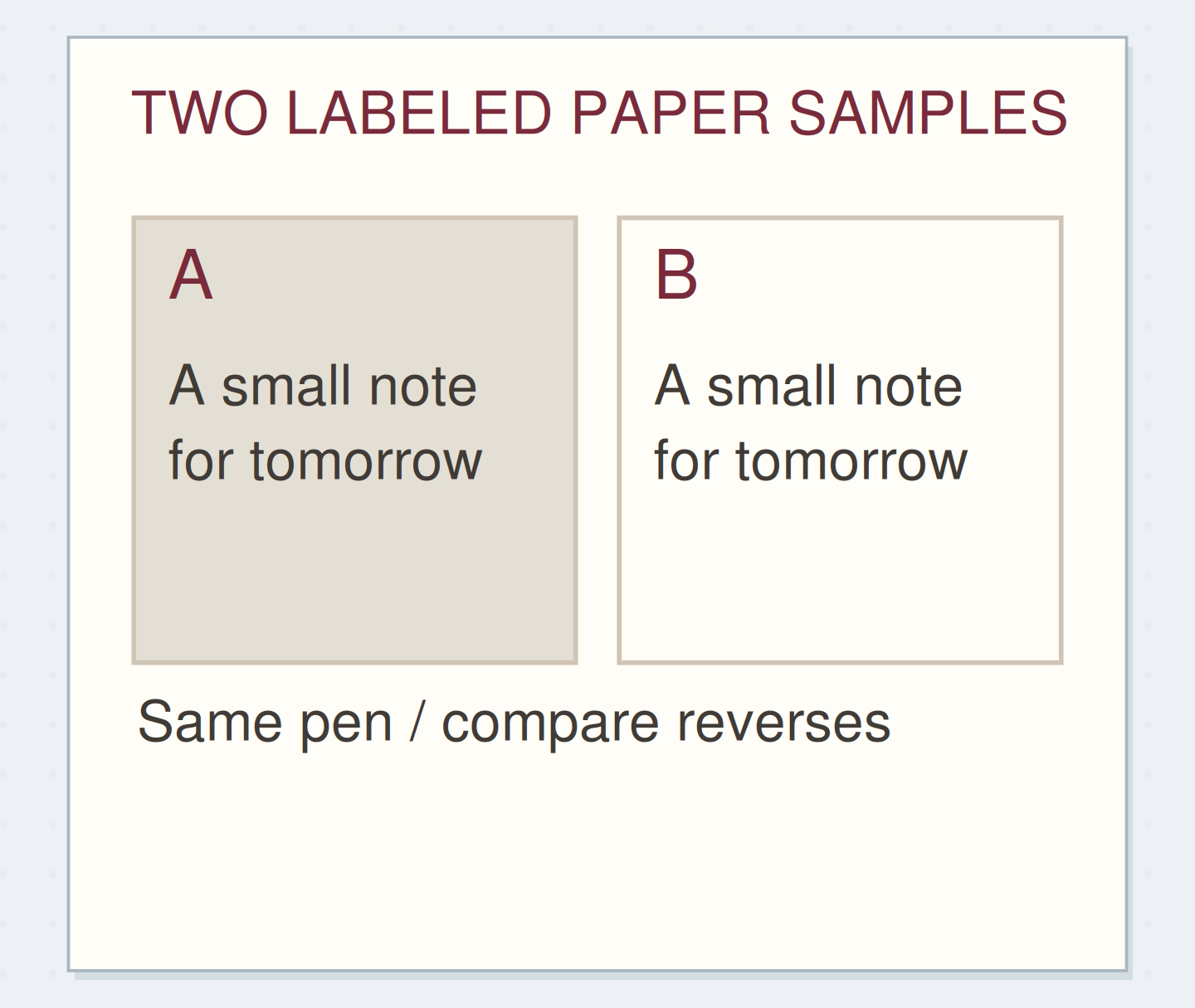
Write A and B in a corner of each sample and describe each paper in your notebook using whatever information you actually have. “Loose cream sheet from desk drawer, thickness unknown” is a valid label. Don't invent a paper weight or brand. Draw a small table with columns for sample, what you did, and what you observed. If you will repeat the comparison, add an attempt number before beginning. Labeling first prevents a pleasing or surprising result from becoming detached from its material. Keep samples separate from the journal page until you have checked whether the pen marks transfer.
“End when you can state what the test suggests for your purpose, or explain why it hasn't answered the question.”
Follow the same simple action on both samples
Write the same short sentence on each scrap with the same pen, then let the marks dry before turning the paper over. View both reverses against the same background and light. Record what is visible in ordinary language; you don't need a numerical score. Note if your pressure changed, one sample was folded, or a blot affected the comparison. If an attempt goes wrong, keep that fact rather than quietly replacing it with the result you expected. A notebook should record the method you used, including a deviation, so the next attempt can make a more informed comparison.
A result with its conditions
Move the reveal control to compare the two written examples. Read what the changed detail allows you to understand.
The note before revision
A broad paper verdict goes beyond a single comparison.
Read an invented paper test
Try this practice record: “Question: which reverse looks clearer under the desk lamp? A and B each received ‘A small note for tomorrow’ in the same pen. Observed: A shows the outline of several words; B shows a faint gray area but few distinct letter shapes. Limitation: A was written with heavier pressure on the first word.” The conclusion might be, “B looked clearer in this attempt; repeat with more similar pressure.” That is different from declaring B universally better. The invented outcome illustrates how a result and a limitation can share the same page without canceling each other.
Draft: Keep a Small Test Clear Enough to Repeat
Edit the practice words to make a note you can use in your own notebook. Keep any uncertainty visible.
Question and samplesWhich reverse is clearer under the desk lamp? Samples A and B labeled first.
What I didSame pen and practice sentence on both scraps.
Result and limitationB looked clearer; A had heavier pressure on the first word.
Your words have a place now.
The initial words are an invented practice example. Edit only the details you want to keep; your entry can stay short.
- Words on this card
- 42
Keep an inconclusive result useful
If the samples look alike, write that you couldn't distinguish them under these conditions. You can stop there or choose a clearer viewing question. If you changed several things at once, describe the attempts as different versions without assigning the outcome to one factor. Don't add more trials automatically to make the page look scientific. Repeat only when the remaining uncertainty matters to the choice you want to make. If a measurement is approximate, mark it as approximate and keep the same unit. A careful sentence about a small limit is more useful than an unsupported decimal or a forced winner.
Change the plan visibly for the next attempt
Date the next entry and refer to the previous attempt. State what you are keeping and what you are changing before doing it. For the paper example, you might keep both samples and the pen while deliberately using a lighter, more similar pressure. If you switch pens too, call that a new question. Keep the original observations legible. You can summarize a series afterward, but preserve the individual records that support it. When a practical choice is settled, test the selected material in the actual journal context if that matters, because a loose scrap doesn't reproduce every condition of a bound notebook.
Close with a choice or a clear uncertainty
End when you can state what the test suggests for your purpose, or explain why it hasn't answered the question. “Use B for this pen on this page, after a final reverse check” is a practical outcome; “No clear difference” is another. Label and keep only samples that you may need for the decision. The notebook doesn't need a formal report or a claim of discovery. It needs a traceable question, an honest account of what you did, and a result whose wording fits the evidence you actually collected during this small comparison.
Prepare to write a limited conclusion
Move the steps and check the dependencies. Only the stated preparation relationships matter.
One workable order
- Define the comparisonThe test needs a question and conditions.
- Label both samplesIdentify samples before their results become hard to distinguish.
- Run and record the testFollow the planned comparison and preserve deviations.
- Write a limited conclusionThe conclusion must follow the recorded observations.
Which check needs to come first?
The example shows one workable order. This order keeps the required checks before the decisions that rely on them; other unconnected steps can change places.
Where this idea began
Want to follow the idea further? These community discussions and maker references are a good place to start.
- Experiment on the best pocket notebook
A notebook user proposes explicit comparison categories for real notebook trials.
- Paper lab notebooks: day-by-day logs or organized by experiment?
The question highlights the need to connect individual records with the experiment they belong to.
- Science and Engineering Project Laboratory Notebooks — Science Buddies
The guide emphasizes dated procedures, observations, deviations, and records sufficient to revisit a test.