Gather a few things See what you’ll need
- A notebook
- A pencil
- A simple garden or container sketch
- An optional dated photo
Make a small map you can use again
Sketch the garden area with plain boxes and familiar landmarks. Assign short names such as “Steps pot,” “Gate bed,” and “Window tray.” Mark where your chosen subject sits, and use the same address on each entry. If containers move, update the map with a date rather than assuming their conditions stayed the same. A plant name can be added if you know it, but don't let identification uncertainty stop you from describing a clearly located subject. Garden-journal discussions often ask how to organize observations; a stable address helps you find related entries without reserving pages for every possible plant.
Give each garden note the right heading
Choose a situation and notice how the example changes. Each choice gives a different useful next move.
Keep the visible leaf detail as an observation.
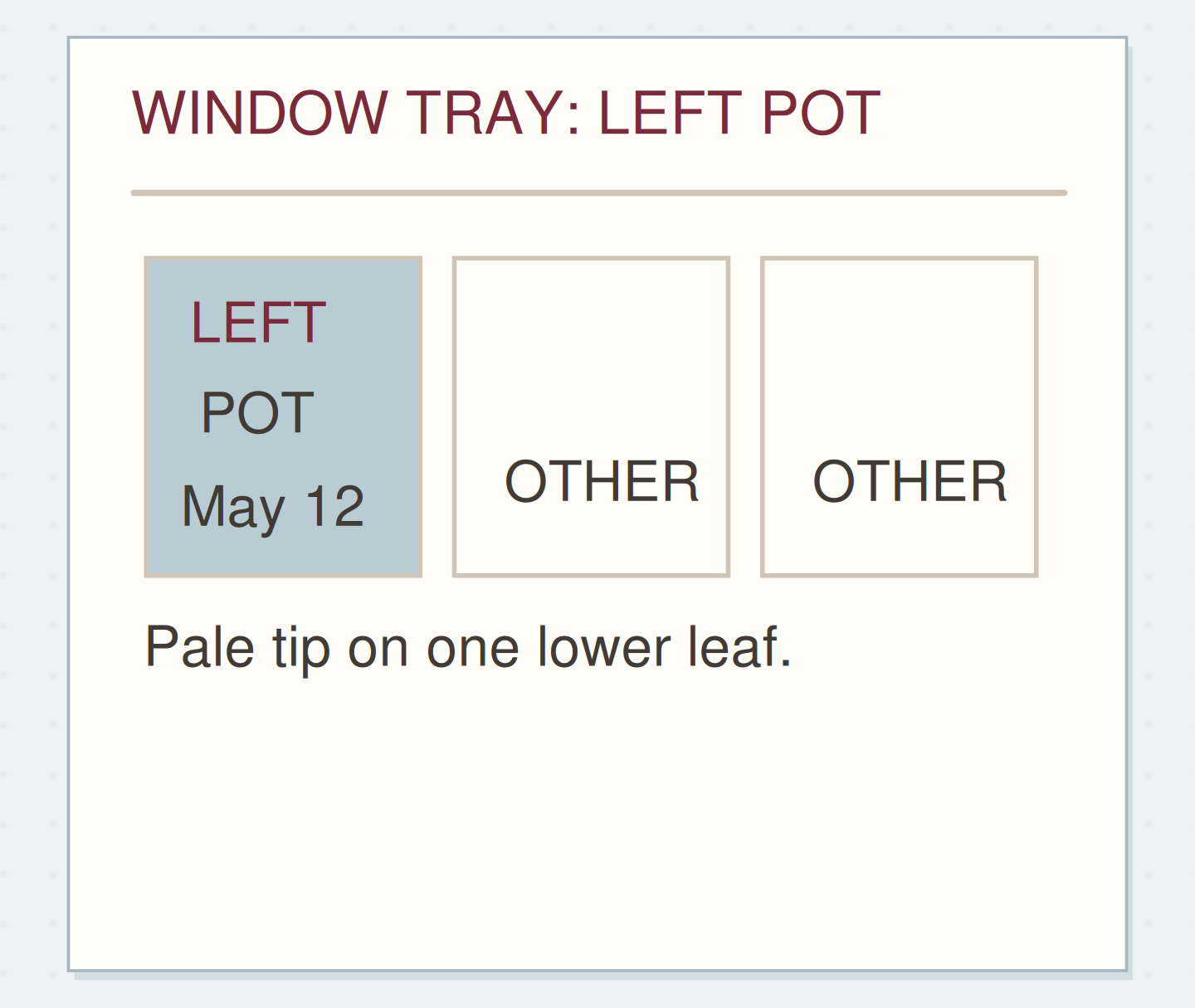
The pale patch is at the tip of one lower leaf in the practice container. Locate that leaf in your sketch so a future comparison does not drift to a different part of the plant.
Keep three kinds of note apart
Use “Observed,” “Did,” and “Question” as separate headings. Under Observed, describe what you saw: new leaves, visible buds, holes, a change in color, or an insect's presence. Under Did, record an action you actually took, with the date and details you would need to understand it later. Under Question, place possible explanations and things to look up. UF/IFAS garden-journal guidance includes records of growth, sightings, and later reflection; this page uses those broad record types while keeping practical care decisions outside the tutorial. You can leave any heading blank when it has nothing to hold.
“Finish an entry when its subject, date, observation, and any relevant action are clear.”
Choose a repeatable feature
Pick one feature that you can check without damaging the plant: the number of visibly open flowers on a particular stem, the outline of a leaf, or the position of new growth. Define the checked area in your words or sketch. “Two open flowers on the front stem” is clearer than “Doing well.” If you estimate rather than count, label the estimate. Note anything that makes viewing difficult, such as dense leaves or poor light. Photos can supplement your writing, but include a reference to the image so the relevant detail isn't lost among many similar pictures.
A change and an open question
Move the reveal control to compare the two written examples. Read what the changed detail allows you to understand.
The note before revision
A move and a leaf change are presented as cause and effect.
Record a window-tray change
An invented entry might read, “May 12, Window tray, left container. Observed: three small leaves at the center; one lower leaf has a pale patch at its tip. Did: moved the container from the outer shelf yesterday. Question: was the pale patch visible before the move?” A small sketch can place the affected leaf, and a later entry can refer to it. The notebook does not conclude that moving the container caused the patch. It records an action and an observation close in time, then keeps the causal question open until there is suitable evidence.
Draft: Keep Garden Notes You Can Compare Later
Edit the practice words to make a note you can use in your own notebook. Keep any uncertainty visible.
Subject and dateMay 12, Window tray, left container.
Observed and didThree small central leaves. Pale tip on one lower leaf. Container moved yesterday.
QuestionWas the pale patch visible before the move?
Your words have a place now.
The initial words are an invented practice example. Edit only the details you want to keep; your entry can stay short.
- Words on this card
- 34
When the page becomes a list of diagnoses
Read the entry and identify any sentence that names a cause you haven't checked. Rewrite it as an observation plus a question: “Three leaves have dark edges; what could explain this?” If you later consult a reliable source or knowledgeable adviser, record the source and what information they used. Don't apply a confident label just because a photograph online looks similar. If you missed several weeks, begin with today's visible state and mark the gap. A notebook is useful without continuous coverage. You can also reduce a burdensome garden record to one subject and one question for the next few visits.
Put dates beside the thing that changed
When reviewing, gather entries with the same map address and feature. Check whether the container moved, the area was altered, or the viewpoint changed. Compare your actual descriptions before writing a conclusion. “More open flowers in my second check” is supported by two counts made in the same area; “This method works best” requires more than a single before-and-after note. Keep practical ideas in a clearly labeled future note, and consult appropriate guidance for decisions that need it. A useful record can suggest what to investigate without pretending that your observations alone establish a care recommendation.
Leave a question you can answer by looking
Finish an entry when its subject, date, observation, and any relevant action are clear. Choose one small thing to check next time, such as whether the pale patch reaches the same part of the leaf. A page about one container can end there. You don't need to log every watering or photograph every plant unless those records serve your purpose. At the end of the season, keep the map and a few dated comparisons you would want to find again. The notebook can preserve a changing garden while remaining an ordinary, manageable place for notes.
Prepare to write a question from the record
Move the steps and check the dependencies. Only the stated preparation relationships matter.
One workable order
- Identify the container or bedObservations need a stable address for comparison.
- Inspect the chosen featureLook before recording its present condition.
- Record observation and actions separatelyThe comparison should not confuse an action with a cause.
- Write a question from the recordA causal question should use the observations and actions you actually recorded.
Which check needs to come first?
The example shows one workable order. This order keeps the required checks before the decisions that rely on them; other unconnected steps can change places.
Where this idea began
Want to follow the idea further? These community discussions and maker references are a good place to start.
- Does anyone keep a garden journal?
The post asks how to organize insects, bloom dates, growth, and other garden observations.
- Garden journal inspiration
Participants describe garden sketches that capture current layouts and records kept separately from ordinary schedules.
- How to Start a Garden Journal — UF/IFAS Extension
The guide includes recording visible growth, wildlife sightings, and later comparisons; health claims are not used.