Gather a few things See what you’ll need
- A notebook
- A pencil
- A safely observable plant or view
- A plain reference photo or location sketch
Make sure you can find the same subject
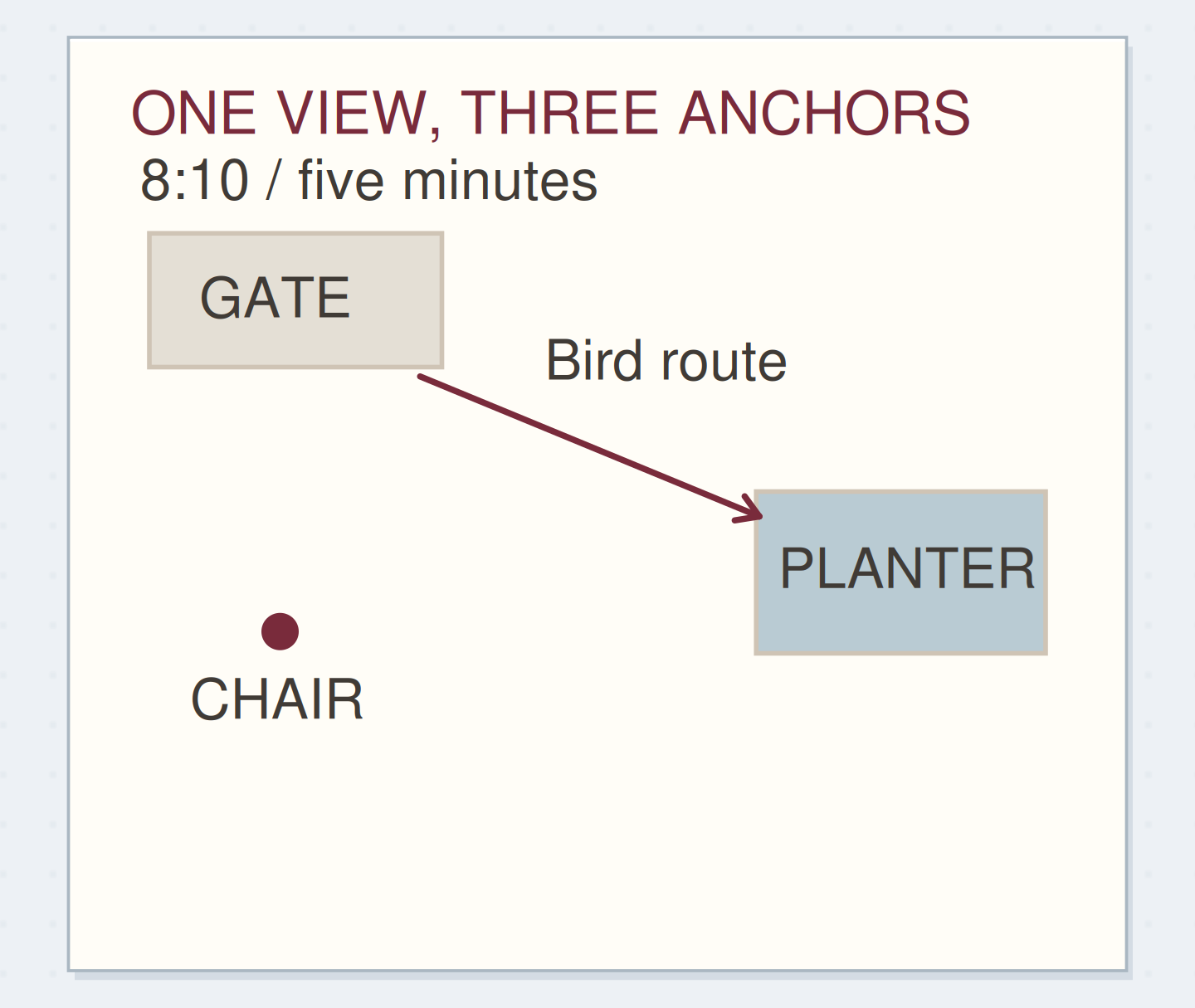
Choose a plant you can observe safely without disturbing it. Give it a location description or sketch that distinguishes it from similar plants nearby. “Shrub left of the bench, nearest the path” is more useful than “the flowering bush.” A correct species name is helpful, but a clearly described unknown plant can still be followed in a personal notebook. Keep identification guesses marked as guesses. If you later identify it using a reliable source, add the name and source with a date. Don't silently replace the original uncertainty and make it seem you knew all along.
Choose the record your visit supports
Choose a situation and notice how the example changes. Each choice gives a different useful next move.
Record presence only where it was visible.
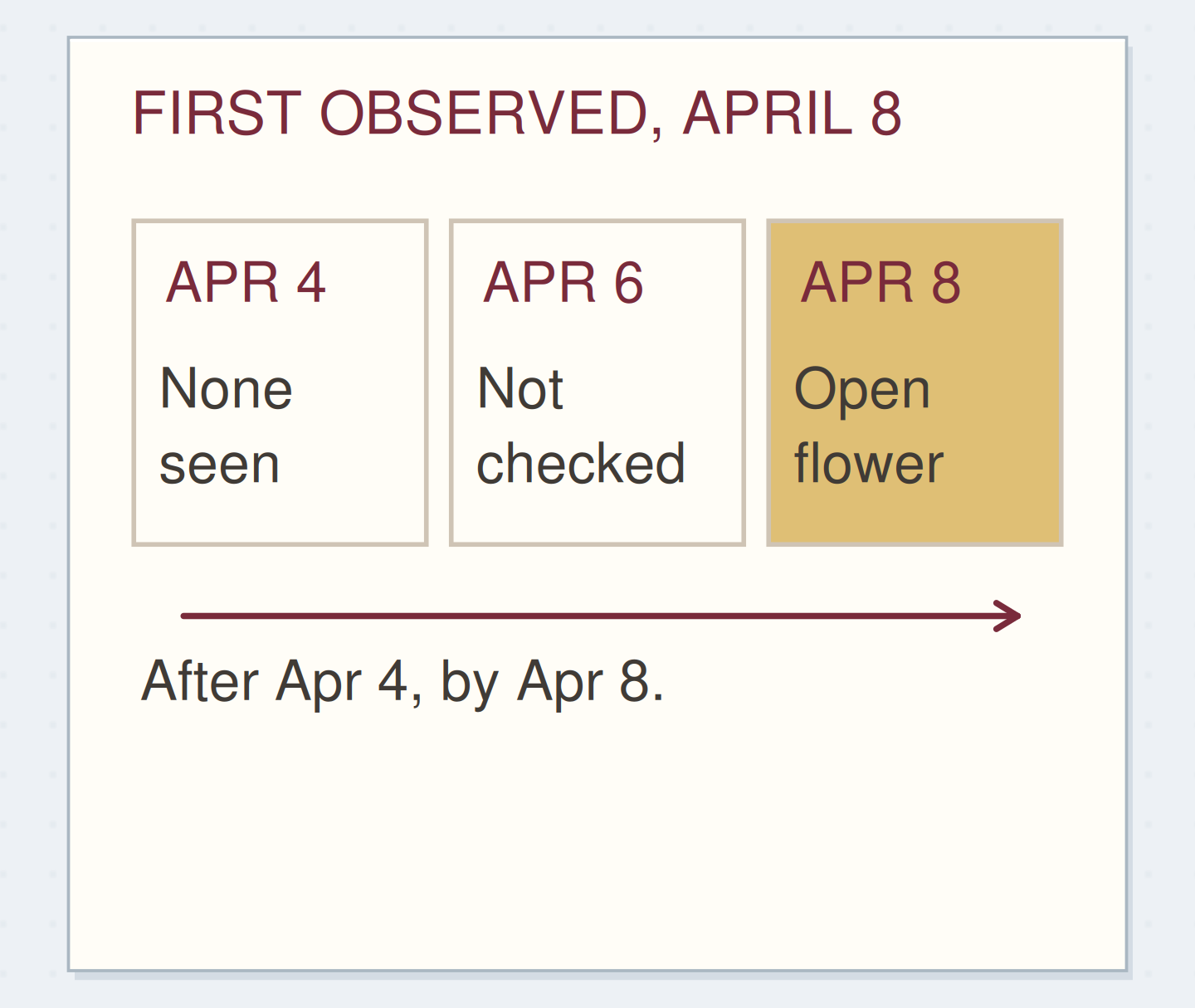
On April 8 the practice branch has an open flower. This supports first observed by that visit, while the actual opening could have occurred during the unobserved interval since the earlier check.
Decide exactly what you will check
Choose a visible feature such as open flowers on a particular branch or leaves emerging from a marked location in your sketch. Write a plain definition before your first comparison. For this practice, “At least one flower visibly open on the branch beside the bench” is narrower than “spring has arrived.” The USA National Phenology Network uses defined phenophases and distinguishes observed presence, absence, uncertainty, and not checking. Borrow that care in record keeping; if you participate in its project, follow its actual species definitions and reporting instructions rather than treating this informal notebook as a substitute.
“Finish when the feature has stopped serving your question or when you no longer want to follow it.”
Keep four different kinds of entry
Use the words Present, Not seen on checked area, Uncertain, and Not checked. The distinctions matter. A missed visit is not evidence that a flower was absent, and a view blocked by leaves may make the answer uncertain even though you visited. Add the date and the area you examined. If you change the definition or observe another branch, note it explicitly. A short written row can hold these distinctions more clearly than a colored square. Don't fill empty dates for symmetry, and don't turn an uncertain observation into a confident answer just to complete the line.
First observed April 8
Move the reveal control to compare the two written examples. Read what the changed detail allows you to understand.
The note before revision
The first sighting date is presented as the actual opening date.
Read a change as an interval
Here is an invented practice record: on April 4, no open flower was seen on the checked branch; April 6 was not checked; on April 8, one open flower was visible. Your conclusion can read, “First observed open on April 8; opening happened sometime after the April 4 check and by the April 8 check.” That is different from “The first flower opened April 8.” If April 4 had an obstructed view, you would have a weaker starting boundary. The page records the limits of your visits along with the change, and that honesty makes later comparisons more useful.
Draft: Record When a Familiar Plant Changes
Edit the practice words to make a note you can use in your own notebook. Keep any uncertainty visible.
Subject and featureBranch beside bench; visibly open flowers.
Dated observationsApril 4: none seen on checked branch. April 6: not checked. April 8: open flower seen.
What the dates supportFirst observed April 8; opening occurred after April 4 and by April 8.
Your words have a place now.
The initial words are an invented practice example. Edit only the details you want to keep; your entry can stay short.
- Words on this card
- 44
When you miss the beginning entirely
If your first visit finds the plant already flowering, begin there: “Flowers present at first observation.” You haven't failed the season, and there is no need to estimate the unseen start from memory. Follow a different visible change if that interests you, or keep recording the same feature until the observation no longer serves your question. If you discover that you compared two plants, label the affected entries and restart a clear series. Keep an unusual sighting as an observation rather than using it to declare a seasonal pattern. One notebook page cannot establish a cause for change.
Bring context to a later season
When another season comes around, look for the same subject and definition before lining up dates. Note changes in access, viewpoint, or the plant itself. A cut-back branch or a moved container changes what you are comparing. Weather notes may add context, but similar dates or conditions don't prove a causal relationship. You can write “Earlier in my observations this year” with the recorded limits attached. If you want a broader climate or ecological interpretation, seek appropriate long-term evidence. Your own record can remain valuable as a precise account of the subject you actually watched.
Close the series with its limits intact
Finish when the feature has stopped serving your question or when you no longer want to follow it. Add a short statement naming the observation period, the clearest change, and any gap that matters. Keep the original rows rather than replacing them with one confident date. A final sentence such as “My visits show flowering by April 8; I didn't observe its start directly” is a complete result. You can begin a new feature on another page. The notebook doesn't need to become a year-round obligation to preserve a useful piece of seasonal change.
Prepare to describe the event interval
Move the steps and check the dependencies. Only the stated preparation relationships matter.
One workable order
- Identify the same subjectRepeats must concern a recognizable plant or checked area.
- Define the visible featureThe presence or absence record depends on what you are checking.
- Make dated checksRecord actual visits, uncertainty, and gaps.
- Describe the event intervalAn interval requires the dated checks that bound it.
Which check needs to come first?
The example shows one workable order. This order keeps the required checks before the decisions that rely on them; other unconnected steps can change places.
Where this idea began
Want to follow the idea further? These community discussions and maker references are a good place to start.
- Nature journaling — Permies art forum
A participant describes a nature or farm notebook used to keep track of seasonal timings.
- Does anyone keep a garden journal?
The post asks how to organize insects, bloom dates, growth, and other garden observations.
- Nature’s Notebook Documentation — USA National Phenology Network
The program distinguishes yes, no, uncertain, and not-checked records against defined phenophases.