Gather a few things See what you’ll need
- A notebook
- A pencil
- An accessible window or sheltered observation spot
- A clock
- An existing thermometer if available
Choose a small view and a sensible purpose
Decide whether you want to compare the same view across days or record changes during a single afternoon. These need different kinds of entries. For a repeated view, choose a window or sheltered spot you can revisit. For one changing afternoon, use several times on one page. Write your purpose in a line, such as “How does the visible sky change between breakfast and lunch?” Keep observation within ordinary, safe conditions. You don't need to go outside during difficult weather, approach exposed places, or use this notebook to decide whether a trip is safe.
Keep the source of a weather note visible
Choose a situation and notice how the example changes. Each choice gives a different useful next move.
Keep a local sighting with its time.
Raindrops against the gate are directly visible during the noon check. Record the observation and viewpoint, but do not treat that time as the start of rain when the interval was unobserved.
Put time and viewpoint before the description
Write the date, local time, and observation position. “9:15, kitchen window facing the courtyard” gives the note an address. If glass, a roof, or nearby buildings hide part of the sky, say which part you can see. GLOBE's cloud-observation guidance distinguishes observation conditions and supports careful descriptions of what is visible. Here, avoid copying the formal program's categories unless you are following its instructions. A plain statement such as “Cloud covers most of the visible sky” is more honest than estimating total sky coverage from a narrow gap between buildings.
“Close the entry with one accurate sentence about what changed or stayed similar in your view.”
Use three labels for three sources
Under “Observed,” write what you directly see or hear: drops striking the sill, pavement darkening, or branches moving intermittently. Under “Measured,” record a value only if you have a reading, including its unit and source. Under “Reported,” note information from a forecast or weather station and identify it. A phone temperature isn't a measurement made by looking out your window. “Feels cooler than yesterday” is a personal comparison, not a thermometer reading. Keeping the labels separate lets you enjoy ordinary observation without adding false precision or quietly converting a prediction into something that already happened.
A sighting with its time
Move the reveal control to compare the two written examples. Read what the changed detail allows you to understand.
The note before revision
An observation time has become an unsupported claim about when rain began.
Keep two moments from an invented day
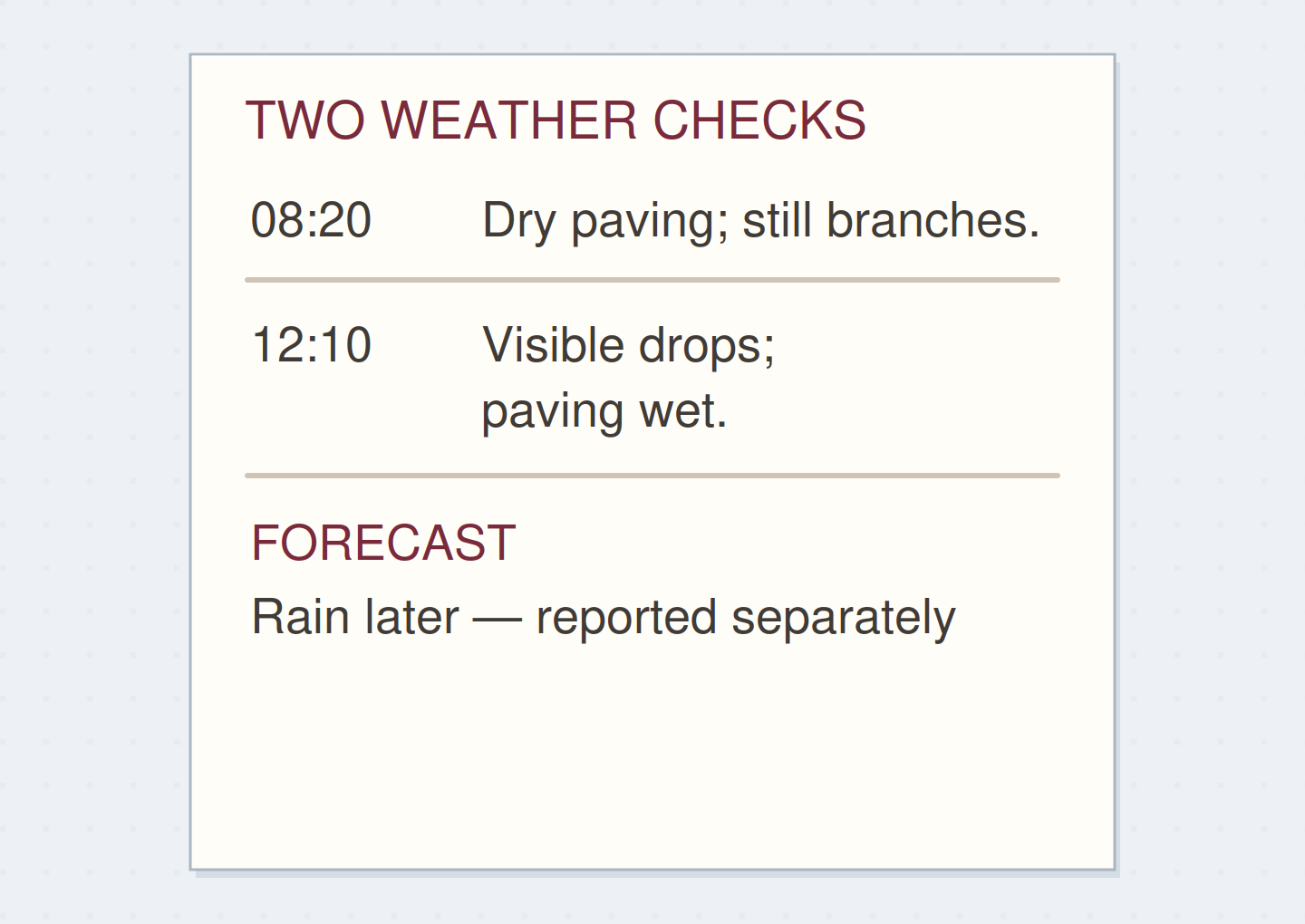
Try this practice entry: “08:20, courtyard window. Observed: pale sky between roofs; paving dry; small branches still. 12:10, same window. Observed: raindrops visible against the dark gate; paving wet; branches moving in short bursts.” A separate line could say “Reported: forecast checked at breakfast mentioned rain later.” Your closing note is “Rain was visible during the second check.” It is not “Rain began at 12:10,” because you weren't watching the entire interval. If you have no measured temperature, leave that category out. The record becomes clearer by preserving what you didn't observe as well as what you did.
Draft: Write Down the Weather You Actually Observe
Edit the practice words to make a note you can use in your own notebook. Keep any uncertainty visible.
Time and viewpoint12:10, courtyard window.
Observed hereDrops visible against the dark gate; paving wet.
Reported elsewhereBreakfast forecast mentioned rain later; separate from my observation.
Your words have a place now.
The initial words are an invented practice example. Edit only the details you want to keep; your entry can stay short.
- Words on this card
- 27
Replace vague summaries with visible clues
If you write “bad weather,” ask what made you choose that phrase. Perhaps the light was dim, rain interrupted an outdoor plan, or wind moved the bin lid. Keep the description you can support and put your personal response separately if you want it. If you miss the observation time, label a later recollection as remembered rather than inserting it among direct notes. You can also narrow an overambitious chart to two details you genuinely enjoy checking. Missing entries need no repair; they simply leave a gap in what this notebook can say about the day.
Ask what the records allow you to conclude
Place two entries beside each other and check the time and viewpoint before interpreting a difference. A morning view and an evening view may differ for several reasons. Write “During these checks” when describing a pattern from a handful of visits. Cloud appearance, animal behavior, and a few local observations do not make this notebook a reliable forecasting system. Keep official forecasts as identified references if they interest you, and compare them without treating your notes as safety guidance. You can enjoy noticing weather while being precise about the small portion of it your page captures.
End at the last observation you made
Close the entry with one accurate sentence about what changed or stayed similar in your view. You can stop after one check, after two contrasting moments, or when the observation no longer holds your attention. Leave the last time visible so the page doesn't imply continuous coverage. If a drawing helps, use a simple outlined window and a few notes; elaborate weather icons aren't required. On another day, reuse the same headings only if they still fit. The notebook's purpose is to preserve a local observation you can understand later, not to produce a complete daily weather report.
Prepare to compare the notes
Move the steps and check the dependencies. Only the stated preparation relationships matter.
One workable order
- Name time and viewpointThese conditions locate the observation.
- Observe what is visibleThe local description must come from a real check.
- Label any outside reportKeep forecasts distinguishable before comparing them with observations.
- Compare the notesInterpret only after both the observation and report sources are clear.
Which check needs to come first?
The example shows one workable order. This order keeps the required checks before the decisions that rely on them; other unconnected steps can change places.
Where this idea began
Want to follow the idea further? These community discussions and maker references are a good place to start.
- Journaling Type Help/Prompts
A reader asks how to observe sky, weather, animals, and plant changes, with suggestions including color-based observations.
- Taking Cloud Observations — GLOBE Observer
The official guidance supports recording visible sky conditions and attending to observation location and constraints.