Gather a few things See what you’ll need
- A notebook or sheet of paper
- A pencil
- A comfortable place to listen
- A clock if you want to mark the interval
Give the listener a fixed place
Choose a comfortable, permitted spot where you can remain aware of your surroundings. You can listen through an open or closed window and note the difference. Put a small circle labeled “Me” near the center of the page. Mark the direction you're facing with a landmark such as “gate” at the top. The page doesn't need true north to be useful, but it needs a stable orientation. Write the date and approximate start time. If you turn or move, either keep the original map direction or start a new map with a clearly labeled viewpoint.
Locate a sound without inventing its source
Choose a situation and notice how the example changes. Each choice gives a different useful next move.
Place the heard direction and leave identity open.
The practice chirp seems to come from the upper right of the listener. Keep the word chirp until identification is supported; the map can show direction without naming a bird you did not see.
Make marks for sounds, not assumed objects
Listen first, then place a short label where the sound seems to come from. “Repeated chirp” is enough when you haven't identified a bird; “low hum” is more honest than naming an unseen machine. Add nearer sounds closer to your center and more distant impressions farther away, while labeling the map “Approximate directions and distances.” Buildings and echoes can make direction uncertain. When you're unsure, write “direction unclear” beside the sound instead of putting it confidently in a corner. Your map is a record of listening, not a survey of everything physically present in the area.
“Stop when your map has a viewpoint and a few understandable labels.”
Show repetition without drawing every occurrence
Choose a simple notation you can explain in words. You might write “steady” beside a continuing hum, “three bursts” beside repeated tapping, and “once” beside a brief clang. A moving sound can have a short arrow only if you actually heard its direction change. Write a small key if your marks need one. Avoid counting beyond what you can track comfortably; “several” is a valid description. A short interval lets you keep changes manageable. You can finish after a few sounds rather than treating silence or a sparse page as an unsuccessful observation.
A sound with limits
Move the reveal control to compare the two written examples. Read what the changed detail allows you to understand.
The note before revision
An unseen sound has acquired both a bird identity and a precise location.
Map an invented courtyard listen
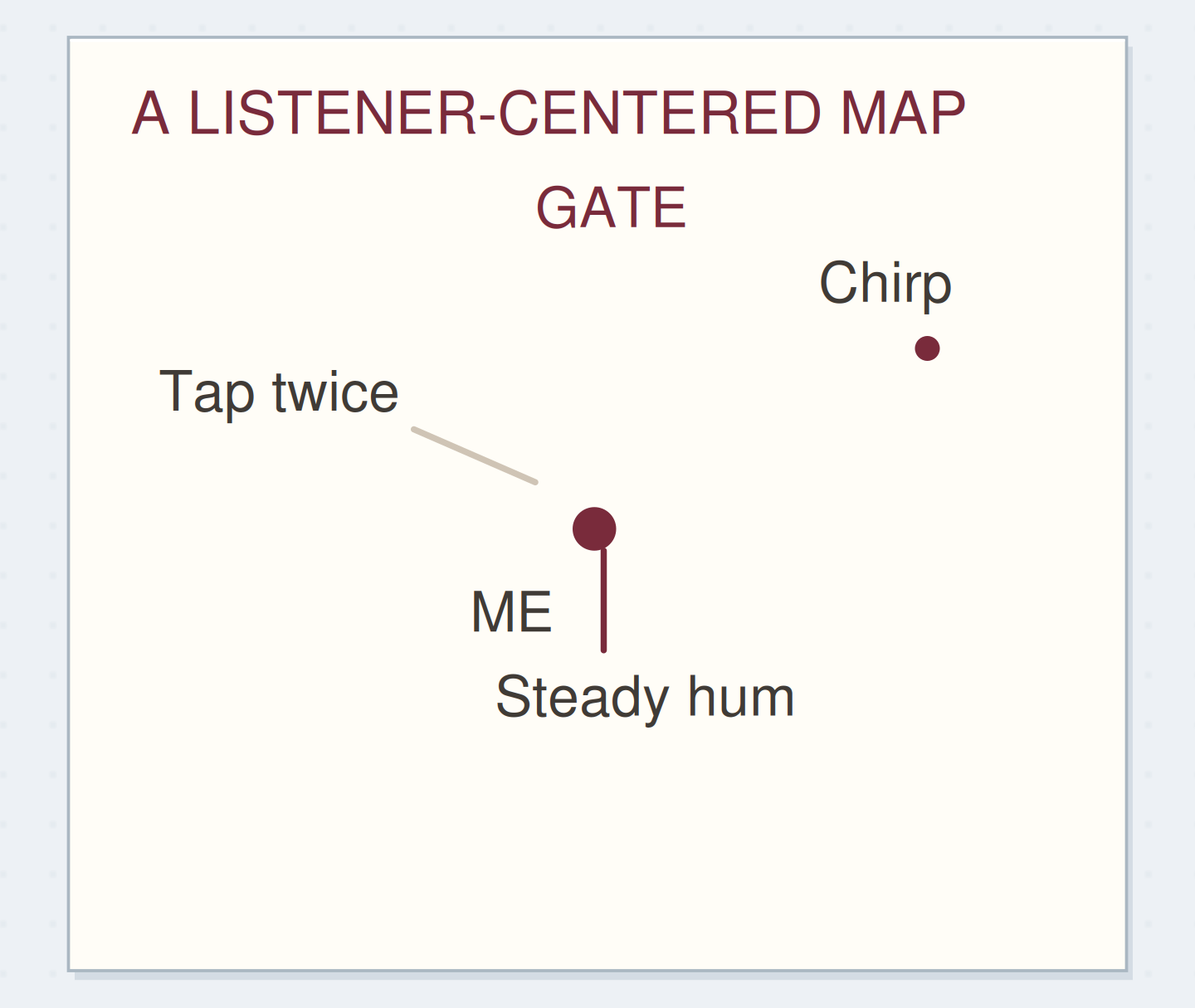
Picture a practice page with “gate” at the top and “Me” in the center. Near the left edge is “metal tap, twice.” At the upper right is “chirp, repeated.” Below the center is “low hum, steady; source unseen.” Your closing line reads, “Three-minute listen from bench; directions estimated.” None of the labels requires a species name or a claim about the machine making the hum. The placement explains what a plain list would lose: where each sound seemed to sit around you. If the tap echoes, add “direction uncertain” instead of drawing a false path to the gate.
Draft: Make a Page of the Sounds Around You
Edit the practice words to make a note you can use in your own notebook. Keep any uncertainty visible.
Listening position and intervalBench facing gate, three-minute practice listen.
Sounds and directionsChirp upper right; metal tap twice to left; steady hum behind.
LimitsDirections approximate; hum source unseen.
Your words have a place now.
The initial words are an invented practice example. Edit only the details you want to keep; your entry can stay short.
- Words on this card
- 30
Keep uncertainty when sounds overlap
If several sounds arrive together, record the one you can follow and leave the rest as “overlapping sounds.” You don't have to separate them by force. If a passing vehicle masks a quieter sound, write that down rather than assuming the quieter source stopped. If you discover that a label was wrong, cross it out lightly and add the corrected description with a note about what changed your mind. A sound you heard only once can remain unidentified. For people who hear differently, the page can focus on available sounds, felt vibration, or another chosen sensory observation without imitating someone else's map.
Compare listening conditions as well as sounds
Try another map from the same position if you want to see what changes. Note the time, weather if relevant, and whether doors or windows were open. A different background hum may affect what you can hear. Compare only what you recorded: “The chirp was noted on one visit” is safer than claiming that birds were absent on the other. If you're listening with someone else, compare pages after making your own marks. Different maps can reveal different attention or hearing without requiring one person's version to be declared the correct account of the place.
End with the sound you would recognize again
Stop when your map has a viewpoint and a few understandable labels. Add one sentence about a sound you could now recognize, or a question about an unknown source that you may investigate another time. Don't approach private areas or disturb wildlife to solve it. Close the page with the actual listening interval, then let the listening continue without recording if you prefer. The finished map doesn't need to be full. Its value is that it preserves a small arrangement of sounds from one position and makes clear which parts you heard, estimated, or couldn't place.
Prepare to read the map’s relationships
Move the steps and check the dependencies. Only the stated preparation relationships matter.
One workable order
- Mark your listening positionDirection notes need a stable origin.
- Listen for a soundRecord only a sound you actually heard.
- Place and label the soundKeep direction uncertainty visible in the map.
- Read the map’s relationshipsInterpret the arrangement only after sounds are located and labeled.
Which check needs to come first?
The example shows one workable order. This order keeps the required checks before the decisions that rely on them; other unconnected steps can change places.
Where this idea began
Want to follow the idea further? These community discussions and maker references are a good place to start.
- What are you up to this weekend?
Participants discuss listening to surrounding natural sounds without playing audio during a walk.
- Sound Map — Joseph Cornell, Sharing Nature
The activity places a listener at the center and records sounds by apparent direction and distance.