Gather a few things See what you’ll need
- A notebook or loose sheet
- A pen
- A pencil for rough notes
Choose where the occasion begins and ends
Name the date, people, and setting. Decide whether you are keeping an entire afternoon or one part of it, such as the walk home or lunch afterward. A clear boundary prevents a small entry from spreading into the whole history of a friendship.
If the visit happened some time ago, write the date range you know and the date you are recording it. You can use “the weekend Maya stayed, early May” when the exact day is uncertain. Add a location that future you will recognize without including unnecessary private address details.
Use arrival, detour, and afterthought
Write three small headings: We began, The unexpected part, and I still remember. They follow the experience without requiring a dramatic story. The unexpected part might be a closed café, a forgotten umbrella, or the discovery that both visitors brought the same cake.
On a single page, leave the largest space for the unexpected part because it often contains the action. A small sketch of the table or route can sit beside it. If there was no detour, replace that heading with “What we did together.” The structure should accommodate the occasion.
Follow the visit past the original plan
The changed plan creates a setting for one particular gesture.
The café establishes where the occasion began.
A visit page does not need the whole history of the friendship.
“The visit entry is finished when it recalls the people, the setting, and one moment that made this occasion particular.”
Keep the closed-café afternoon
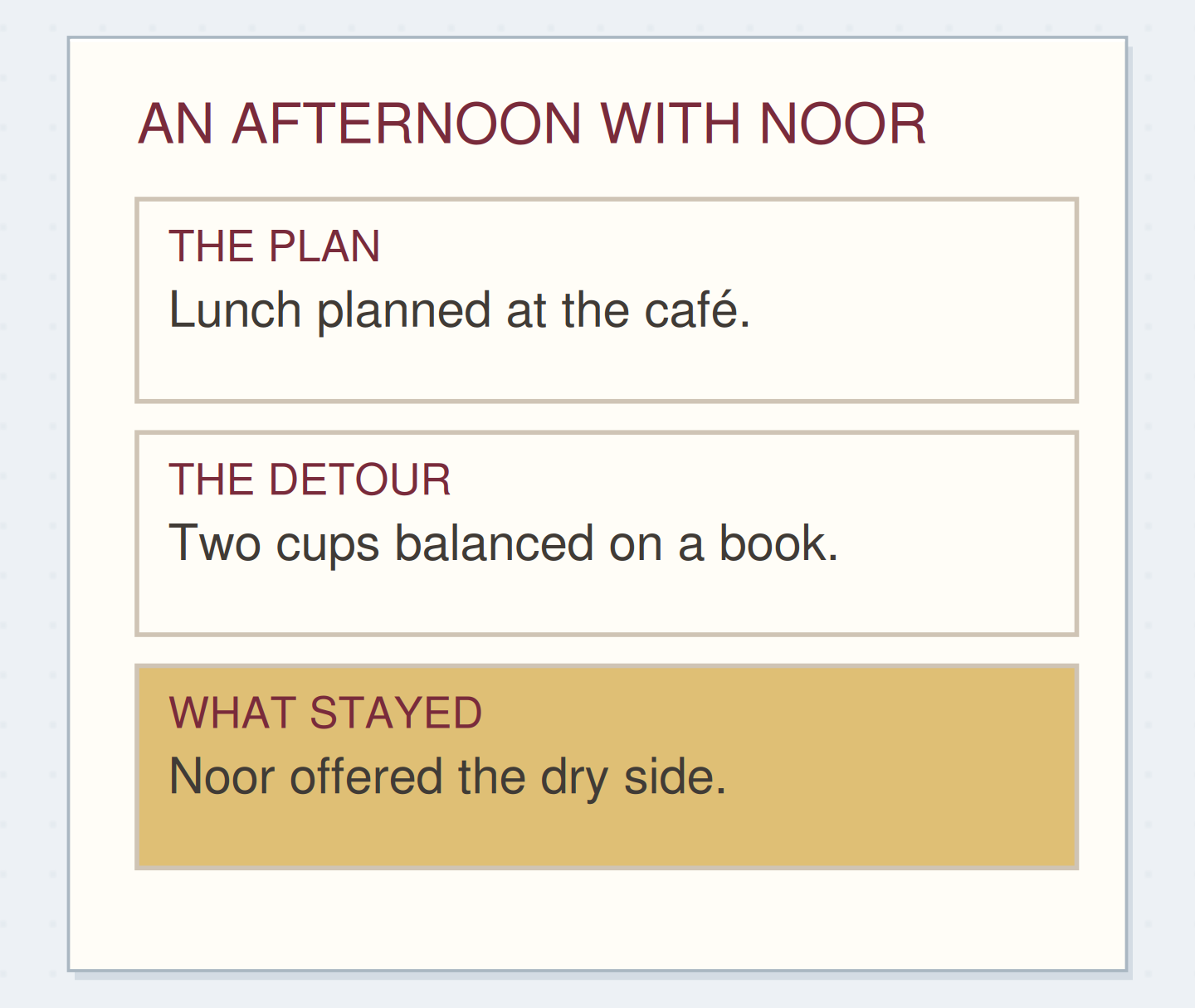
In this fictional example, you meet Noor at the café, find a handwritten closed sign, and take takeaway tea to the covered steps by the library. The entry says: We began with a plan for lunch. The unexpected part was balancing two hot cups on a book while we unfolded the sandwiches. I still remember Noor offering the dry side of the step.
The closed sign explains the detour, but the offered seat carries the personal memory. You could keep a tiny sketch of the steps instead of a receipt. The page needs enough information to restore the encounter, not evidence of every purchase.
Write an outing’s particular moment
Edit the example into a record of your own. Leave out anything you do not know.
Who and where:Noor and me, outside the closed café
What changed:We took tea to the covered library steps.
What stayed:Noor offered me the dry side.
Your words have a place now.
A small local visit can make a complete memory page.
- Words on this card
- 28
Make space for another recollection
If the other person wants to contribute, ask for the part they remember most. Write their sentence separately with their name or chosen initial and the date they shared it. They may remember the wind, a joke, or something you overlooked. Different emphases can coexist.
Avoid turning the request into a test of whether they enjoyed the visit as much as you did. You can make a complete entry from your own recollection. If you plan to share the page publicly, check before including someone else’s private words or a recognizable image of them.
Give a vague compliment something to stand on
When the draft says “nice, fun, lovely,” ask what made you choose those words. Was the conversation unhurried? Did someone remember how you take your tea? Did the group laugh at a small accident? Keep one action that supports the feeling rather than adding more adjectives.
If the occasion was mixed, you can write that plainly. “The walk was good; we were both tired by the end” may be enough. A memory page does not need to become either a glowing review or a full analysis of the relationship.
Show what “lovely” refers to
Move the reveal to see which information changes the record.
Before the revision
The compliment is true but hard to picture.
Connect the parts worth keeping elsewhere
A memorable meal can have its own page, with a reference in the visit entry. A phrase someone repeated may belong in the family-phrases archive. Keep the visit as the small record that connects those pieces, rather than copying every detail into each format.
If you host often, make a simple dated list of visits with page numbers. Do not turn it into a scorecard for who visited whom or who owes a reply. The index is there to help you find stories, not to manage the friendship.
Choose what should live on another page
Try the form that matches the evidence or space you have.
A memorable meal can have its own caption.
Keep the visit entry as the connecting record.
End at the detail you want back
The visit entry is finished when it recalls the people, the setting, and one moment that made this occasion particular.
Read it once and add any missing name or place. A short ending such as “We kept talking at the doorway” may already be enough. Then stop. You do not need to ask everyone for a contribution or decorate the page until it looks like a special event; the afternoon itself supplied the material.
Where this idea began
Want to follow the idea further? These community discussions and maker references are a good place to start.
- Dad’s Family Journals
The author records events, outings, and ordinary family days across several notebooks.
- StoryCorps: Great Questions
Its question bank includes family stories, remembered people, and specific life experiences.