Gather a few things See what you’ll need
- A received postcard
- A notebook
- A pen
- Scrap paper for a reply
- An optional removable holder
Start with one received message
Choose a card you want to remember or answer. Read the whole message before deciding which part belongs in your journal. You might keep the complete card in a removable holder, copy one short line with context, or summarize the message in your own words.
Write the received date and the sender’s name or a private shorthand you will recognize. If the card has a different written or posted date, label it separately. Those dates describe different parts of the journey; you do not need to collapse them into a single day.
Make a place for the conversation
Give the page three parts: They wrote, I wanted to answer, and I sent. The first keeps the thread of the received message. The second is a short draft or idea. The third records what actually went into your reply, with its sending date if you know it.
Leave addresses and other practical mailing details in the place you normally manage correspondence. They are not needed to make the memory page readable. If you keep the original card here, choose an arrangement that lets you read the writing and enjoy the picture without peeling it apart.
Follow a detail across a postcard exchange
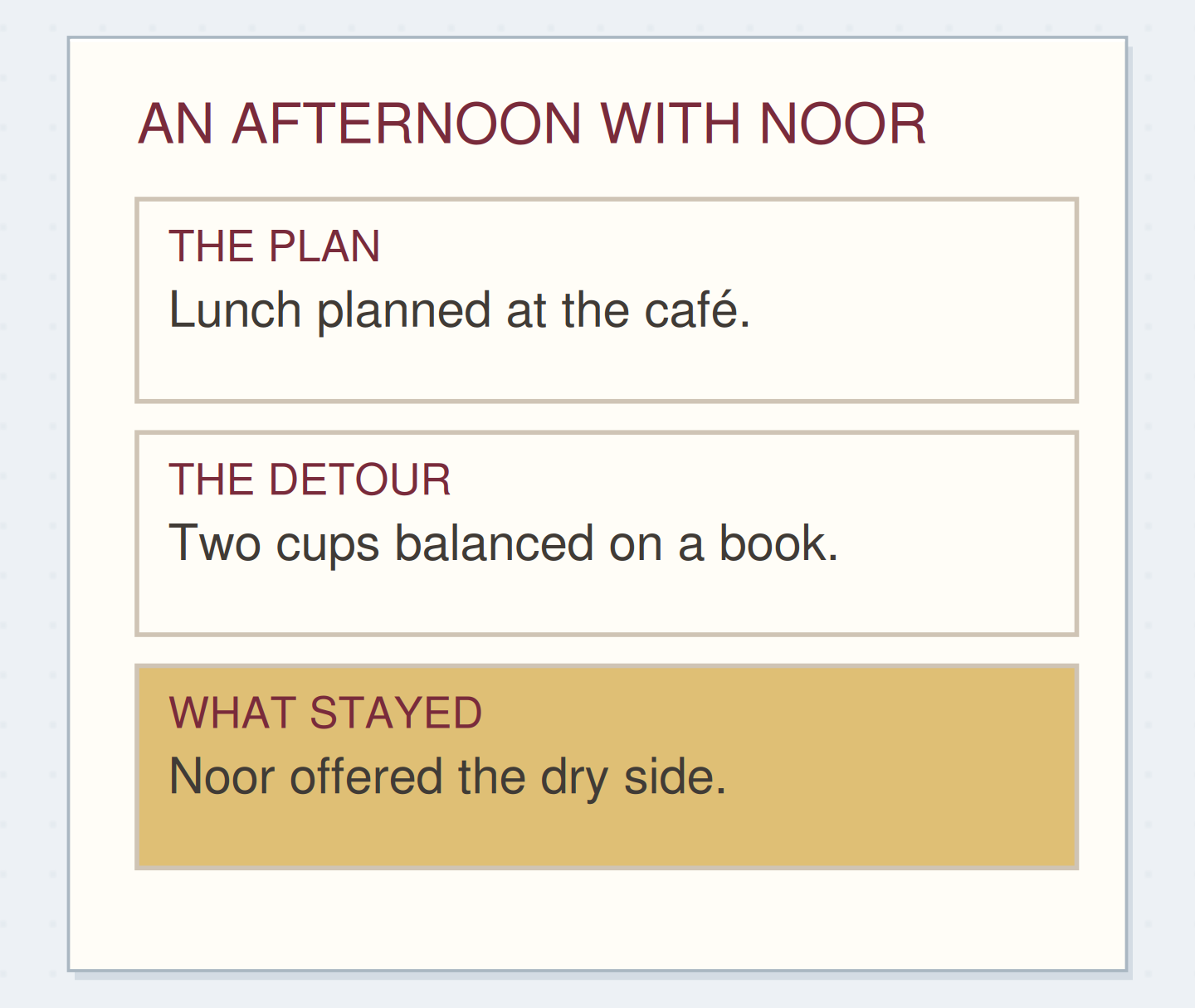
The record separates the received words, your reply idea, and the actual sending.
A breakfast visitor begins the shared subject.
Keep the sender’s message distinct from your interpretation.
“The correspondence page is complete when it shows what arrived and what you actually did in response.”
Follow a breakfast detail into a reply
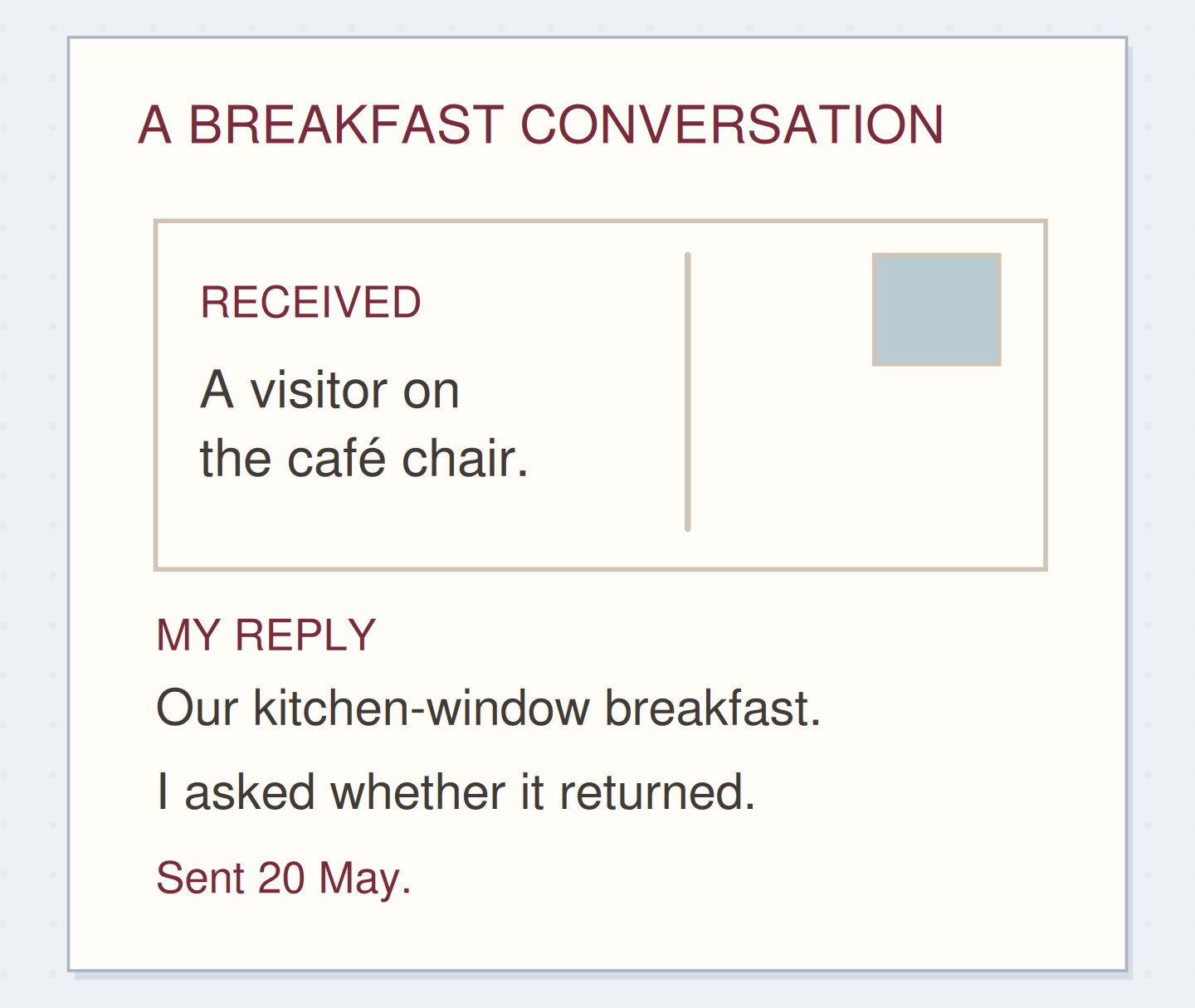
In a fictional exchange, Jo writes that a small bird keeps landing on the café’s empty chair while she eats breakfast. Your note says: “Wanted to answer with our kitchen-window breakfast.” The reply summary reads: “Told Jo about the neighbor who waters the plants in slippers; asked whether the chair visitor returned.”
The shared subject gives the reply somewhere to begin. You do not need an equally exotic place or a more entertaining story. A small ordinary detail can answer another ordinary detail, which is what makes the exchange feel like a conversation.
Keep the thread of a postcard conversation
Edit the example into a record of your own. Leave out anything you do not know.
They wrote:A small bird kept landing on the café’s empty chair.
My reply:I wrote about our kitchen-window breakfast and asked whether it returned.
Status:Sent 20 May.
Your words have a place now.
The record can end honestly even if you choose not to reply.
- Words on this card
- 29
Draft enough, then use the card
Write two or three sentences on scrap paper if you need to judge the available space. Start with the detail you are answering, add something from your own day, and finish with a question only if you want one. Short sentences usually fit more naturally than a miniature formal letter.
Do not let the journal draft become a substitute for the card unless you decide not to send it. When you do send it, mark the record accordingly. If you keep the words unsent, label them “draft, not sent” so a later reader does not mistake an imagined exchange for a completed one.
When the reply is very late
Begin with where the conversation stands now. A brief “I kept thinking about your breakfast visitor” reconnects to the message without requiring a long apology. You can acknowledge the delay plainly, then write the thing you actually wanted to share.
If you no longer want to reply, the received card can still have a finished memory entry. Record why its words stayed with you and leave the sending field unused or marked “no reply recorded.” A correspondence journal should not quietly become a guilt list of unfinished social obligations.
Reconnect without making a false sending record
Move the reveal to see which information changes the record.
Before the revision
An unfinished draft does not need a polished excuse before it can move forward.
Preserve access to the message
Before attaching the card, test its place in the open notebook and check both sides. A paper corner, tuck, or separate envelope can keep it removable. A copy may be easier if the original is thick, fragile, or already stored with a larger correspondence collection.
If you share an image of the journal, choose what to show with the sender’s privacy in mind and ask before publishing private words. For your own record, a plain summary is often enough. The page’s purpose is to retain the connection, not to display every line of someone else’s message.
Check access before keeping the card
Move the checks ahead of the actions that depend on them. Other choices can stay flexible.
One workable order
- Read both sidesThe message and printed image may both matter.
- Choose what the journal will holdYou might keep the original, a copy, or a summary.
- Test access in the open notebookA holder must let you read the part you want to retain.
- Keep the card or copy in its chosen placeFinal placement follows the access check.
Which check needs to come first?
The example shows one workable order. This order protects the actual reading route, not an arbitrary decorating preference.
End with the exchange as it stands
The correspondence page is complete when it shows what arrived and what you actually did in response.
Add a page reference if another card continues the conversation. Keep the earlier entry intact rather than rewriting it into a seamless story. The dates, pauses, and small returns are part of the exchange. One card and one honest response record can be enough to make a page worth revisiting.
Where this idea began
Want to follow the idea further? These community discussions and maker references are a good place to start.
- What to write on a box of postcards?
The writer asks for postcard subjects within an ongoing exchange of handwritten words.
- Postcrossing: What should I write on a postcard?
Official prompts include local daily life, meals, memories, and a connection with the recipient.