Gather a few things See what you’ll need
- A small notebook or folded sheet
- A pen
- A loose-paper envelope
- Your travel notes
Before leaving, keep your expectations
Write the destination, approximate dates, and three things you are curious about. These are not bookings or instructions; keep practical travel information wherever you normally manage it. The memory page records your starting point: what you imagine, what you hope to notice, and what you do not yet know.
For an illustrative two-day coastal trip, you might write: “I expect the harbor to be quiet. I want to find out why the houses are painted blue. I’m looking forward to eating outside.” Leave those sentences intact after the trip, even if the experience turns out differently.
During the trip, carry a small capture space
Use a pocket notebook or one folded sheet with a dated section for each day. Give yourself three short prompts: one scene, one phrase, and one surprise. You can use fewer. A plain pen and a place to keep loose papers are enough; bulky supplies add decisions when you may already be tired.
At a natural pause, write fragments that future you can understand. “Red stool, bakery” is thin evidence. “Red stool too low for the counter; owner brought another cushion” gives you something to develop later. Add the place name while you can still check the sign.
Let each stage do a different job
Follow one expectation into notes and then a remembered story.
The expectation belongs to the person about to leave.
Keep it intact even if the trip turns out differently.
“The trip journal can end when it holds a few scenes that bring this particular journey back.”
Watch one expectation change
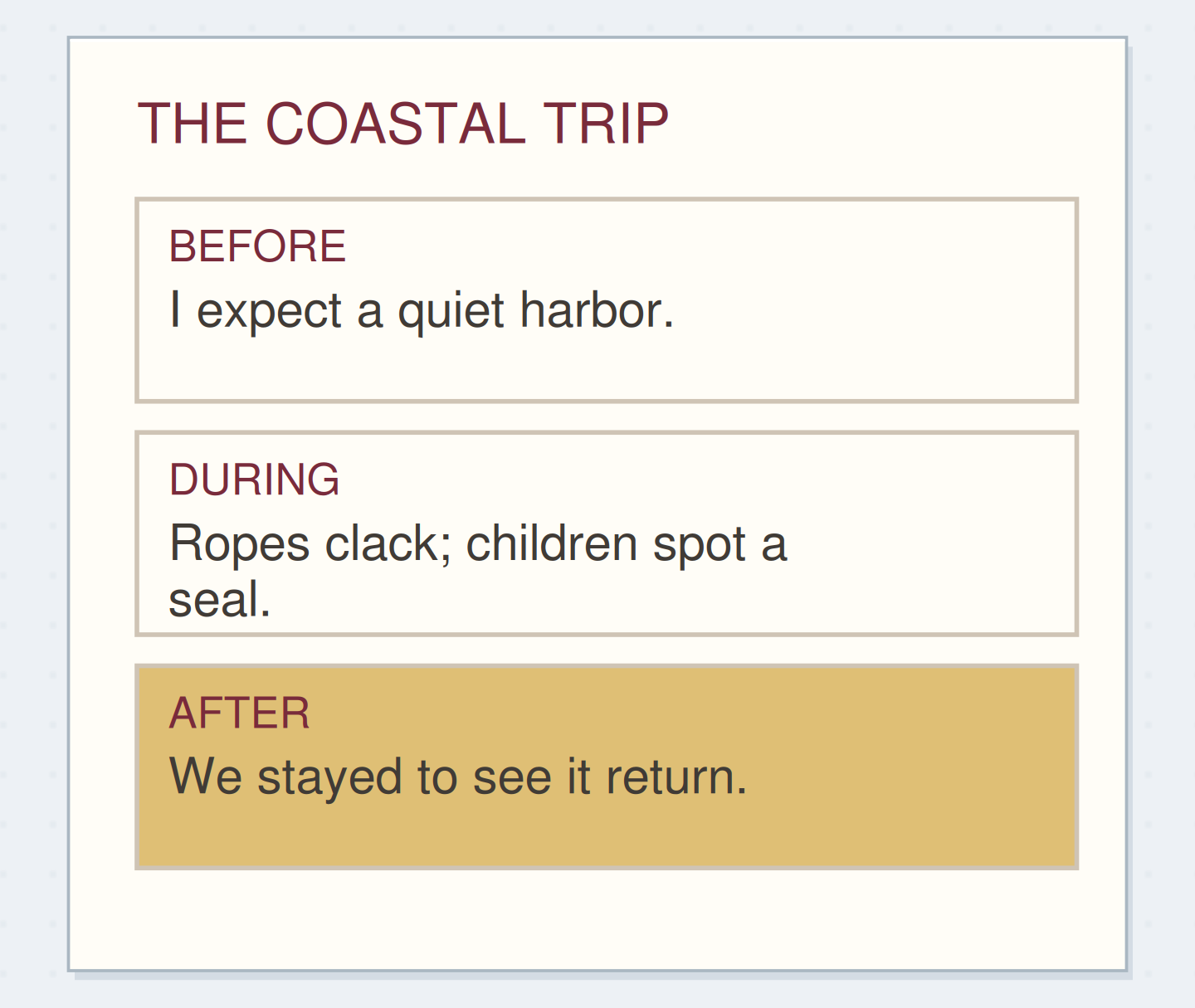
Before: “The harbor will be quiet.” During: “Saturday, after lunch: ropes clacking against masts; children arguing over who saw the seal.” After: “The harbor was the noisiest place we visited. We stayed because everyone kept waiting for the seal to return.” This is one story told from three useful positions.
Keep the original fragments beneath the finished paragraph or refer to their notebook page. The fuller version may add connections, but it should not silently replace what you knew then. If a detail comes from a companion after the trip, label it as their recollection.
Write one three-part travel story
Edit the example into a record of your own. Leave out anything you do not know.
Before I went:I expected the harbor to be quiet.
During the trip:Ropes clacking; children waiting for the seal.
Looking back:The harbor was the noisiest place, and we stayed.
Your words have a place now.
A later account can add meaning while retaining the original notes.
- Words on this card
- 31
Let papers support one story
When you collect a ticket, menu, or leaflet, write a brief note on a separate slip explaining why you kept it. A ticket records entry; your sentence records the wait in the rain or the conversation afterward. Store the slip with the paper until you decide on the finished page.
At home, choose one or two pieces that contribute information. You can keep the rest elsewhere or let them go. Before attaching anything, dry-fit the pieces and write the paragraph. If the paper is bulky or fragile, use a small copy and leave the original separate.
Make a landing page instead of a backlog
If you return with almost no notes, start one page headed “What stayed with me.” List five remembered scenes, even if their order is uncertain. Choose the one with the strongest detail and write it now. The journal does not need an entry for every date before it can contain a true story.
If there are too many scraps, sort them into three loose groups: useful now, possibly later, and no longer needed. Finish a single spread from the first group. Put a date range on material whose exact day you do not know; do not turn a vague memory into a precise itinerary.
Change a backlog into a landing page
Move the reveal to see which information changes the record.
Before the revision
Empty date slots can make the whole trip feel unfinished.
After returning, add a little hindsight
Choose one expectation that changed and one detail you would explain to a friend. Write a short after-note beside the original before-page. A disappointing meal or altered plan can belong here too. You are describing this trip, not preparing an advertisement for the destination.
If you travelled with others, invite a sentence from someone who wants to contribute. Keep their words separate from yours. Different memories of the same afternoon can sit together without being resolved into one official version. For a visit closer to home, the outings-and-visitors format may be enough.
Choose what the after-note adds
Try the form that matches the evidence or space you have.
Hindsight can answer a before-page.
Keep both versions visible.
Finish a representative record
The trip journal can end when it holds a few scenes that bring this particular journey back.
Add a simple contents line if the pages are scattered: “Harbor, page 8; bakery, page 11.” Leave any unused dated spaces empty or repurpose them with a clear heading. Finishing does not require decorating every ticket. It means the notes you chose to keep have enough context to be worth opening again.
Where this idea began
Want to follow the idea further? These community discussions and maker references are a good place to start.
- Trip journal: during, or after the travel?
Participants describe keeping small notes during a trip and expanding them afterward.
- Postcrossing: What should I write on a postcard?
Official prompts include local daily life, meals, memories, and a connection with the recipient.