Gather a few things See what you’ll need
- A ticket or a copy
- A notebook
- A pen
- Scrap paper for the caption
- An optional removable holder
Read before you arrange
Look at both sides of the ticket. Copy any printed detail you want to retain into your draft: event, venue, date, seat, or journey. Do not assume every printed time is the time you arrived. A ticket may record a booking, entry slot, or scheduled departure rather than what actually happened.
If part of the printing is already unclear, transcribe only what you can read and mark gaps. A photograph or scan can be an additional record of its present state. The caption should not depend on every small printed character remaining easy to read in the future.
Choose the scene beside the event
Ask what happened before, during, or after the ticket was used. The best caption may concern the queue, a companion’s comment, or the way home. Pick one scene rather than recounting the entire performance or journey. The ticket already supplies an anchor for the larger occasion.
Write three draft lines: Printed, Remembered, and Why I kept it. You can leave the last out if the second already makes the connection clear. This distinction keeps checked information separate from a personal memory, especially when you are writing months or years later.
Give the ticket information it never held
The printing anchors the event; your caption keeps the wait outside.
The paper identifies a cinema booking.
A printed start time is not necessarily your arrival time.
“The ticket page is finished when the printed record and your own memory can be told apart.”
Caption a rainy cinema trip
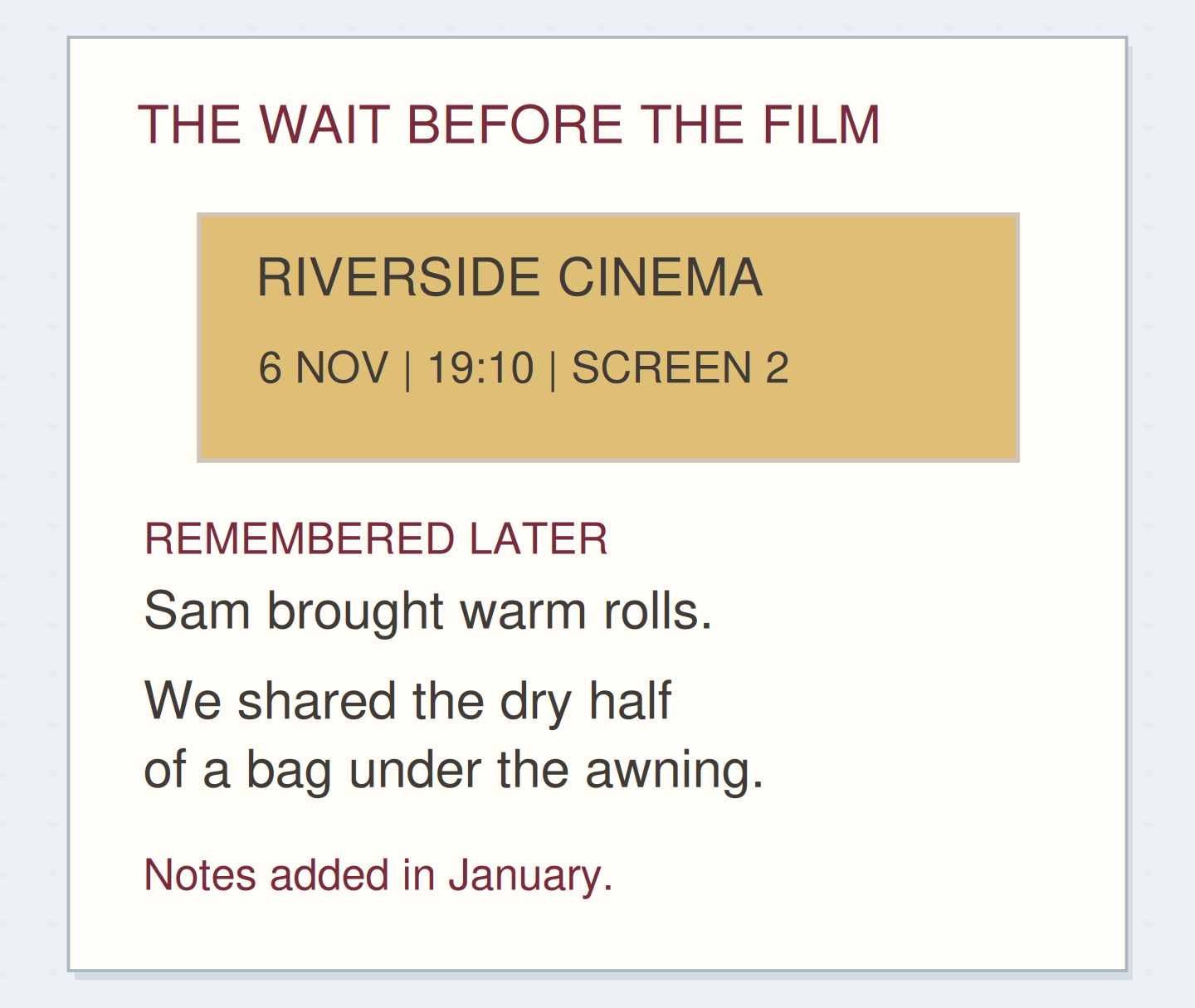
Here is a fictional example: Printed: Riverside Cinema, screen 2, 19:10, 6 November. Remembered: we stood under the narrow awning sharing the dry half of a paper bag; Sam had brought warm rolls because neither of us had eaten. Why I kept it: the wait outside is clearer than the film.
The final page might use only the remembered sentence under the ticket, with the copied event details in a small line above. Keep “remembered in January” if the entry is retrospective. That makes the date of your writing distinct from the date printed on the paper.
Write the story beside a ticket
Edit the example into a record of your own. Leave out anything you do not know.
Printed facts:Riverside Cinema, 6 November, screen 2, 19:10.
Remembered scene:Sam brought warm rolls; we shared the dry half of a bag under the awning.
Recorded when:Notes added in January.
Your words have a place now.
Printed facts and later recollection can sit together with clear labels.
- Words on this card
- 32
Place the words before the paper
Write the caption on scrap paper in your normal handwriting. Lay it beside the real ticket and see how much room both need. On an A5 page, a horizontal ticket may sit across the upper half with the caption beneath. A tall ticket can sit beside a narrow column of writing.
Keep important words away from the binding and do a dry fit before attaching anything. If you want to read the reverse, use a removable holder or a copy rather than covering it permanently. The existing tuck and pocket guides can help with that physical choice.
When you remember very little
Do not create a lively caption from the ticket alone. Write the printed facts and one honest statement: “I know I went with Sam, but I cannot place the evening.” That is still useful context. If you later ask Sam, add their recollection with an attribution and the date of the conversation.
If the ticket is found rather than connected to your own experience, label it that way. “Found inside a second-hand book” is its real story on your page. A stranger’s used ticket should not quietly become evidence that you attended the event.
Keep an honest gap beside the ticket
Move the reveal to see which information changes the record.
Before the revision
A plausible scene is not a memory merely because a ticket survives.
Choose one ticket to represent the story
Several tickets from the same day can overwhelm a small page. Choose the one that identifies the occasion best, then write the relationship of the others in a sentence. If every paper is worth retaining, store the group together and let the journal hold a representative copy or a clear reference.
A damaged ticket does not require a disguised repair. Keep a readable copy if helpful and note what happened to the original. The memory’s value does not depend on making the page look untouched. Avoid adding decorative material merely to hide wear that is part of the object’s history.
Make space before attaching the ticket
Move the checks ahead of the actions that depend on them. Other choices can stay flexible.
One workable order
- Read both sides of the ticketThe reverse may contain information you want to retain.
- Draft the actual captionYour handwriting determines how much space the story needs.
- Dry-fit ticket and wordsThe arrangement needs to work with the real pieces.
- Attach or choose a removable holderThe final placement depends on the access and space checks.
Which check needs to come first?
The example shows one workable order. Reading and drafting can happen in either order; final attachment waits for the checks.
Leave the paper and the experience connected
The ticket page is finished when the printed record and your own memory can be told apart.
Read the caption without looking at the ticket, then look at the ticket without the caption. Each should contribute something the other lacks. Once that connection works, stop. A clear sentence about warm rolls under an awning can do more than a crowded spread of event names and dates.
Where this idea began
Want to follow the idea further? These community discussions and maker references are a good place to start.
- I feel like I just ruined my movie tickets
The discussion connects kept tickets with remembered companions and experiences.
- Trip journal: during, or after the travel?
Participants describe keeping small notes during a trip and expanding them afterward.