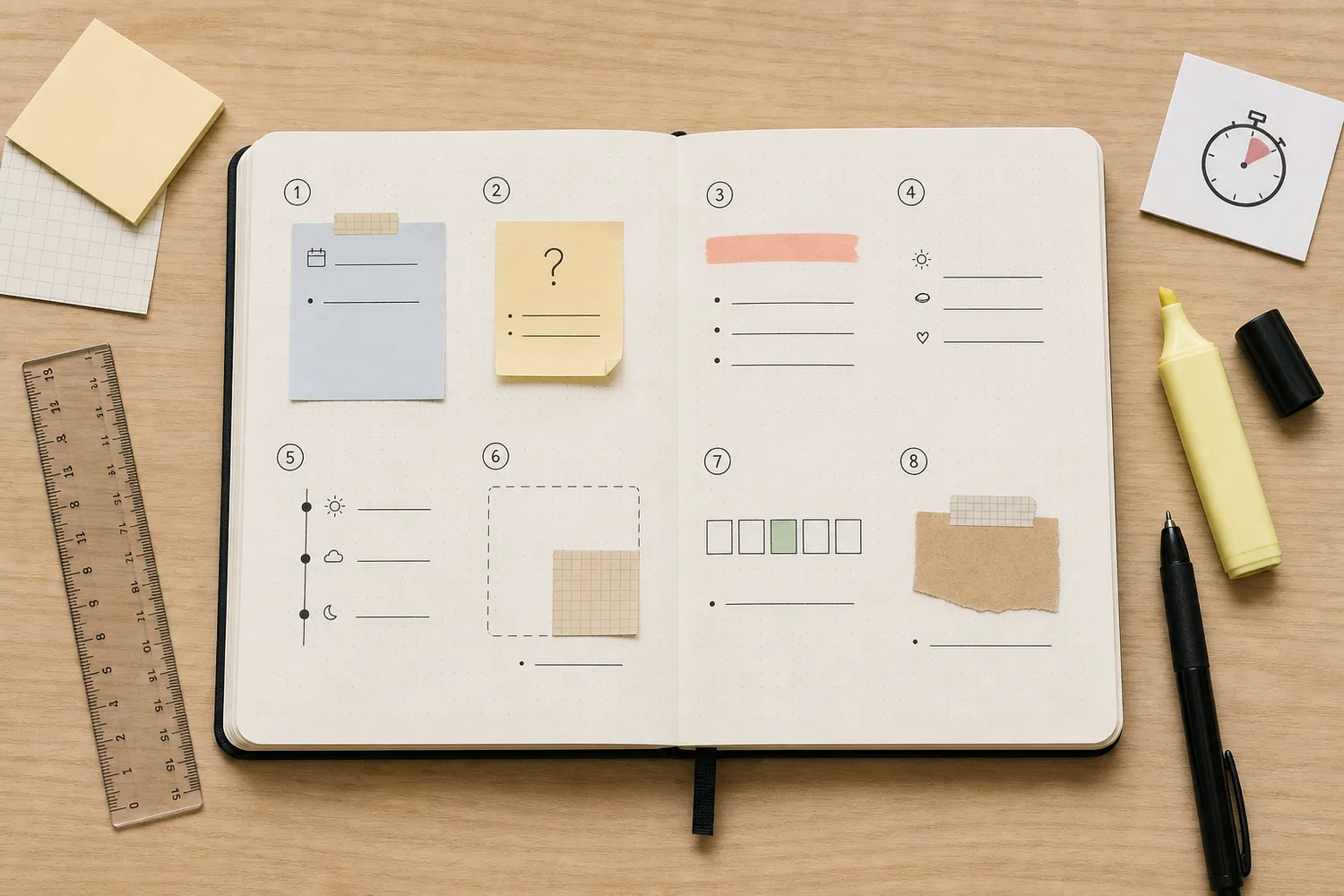
Gather a few things See what you’ll need
- A notebook or loose sheet
- A pen
- A pencil for rough notes
Pick a day you can still reach
Start with today or yesterday. Write the date and whether you are noting events as they happen or remembering them afterward. That distinction will matter if a time is uncertain. There is no need to choose the busiest day; a repeated routine often supplies the most recognizable details.
Decide what counts as an anchor. It might be leaving the house, a meal, a change of company, or the moment you finally sat down. You are choosing places to attach a memory, not building a complete account of how you spent every minute.
Give the day a readable spine
Draw a vertical line down the left third of a page. Leave a narrow strip for time labels and a wider area for sentences. On an A5 sheet, a line about 3 cm from the left edge is a workable example. Adjust it to your handwriting rather than measuring each entry precisely.
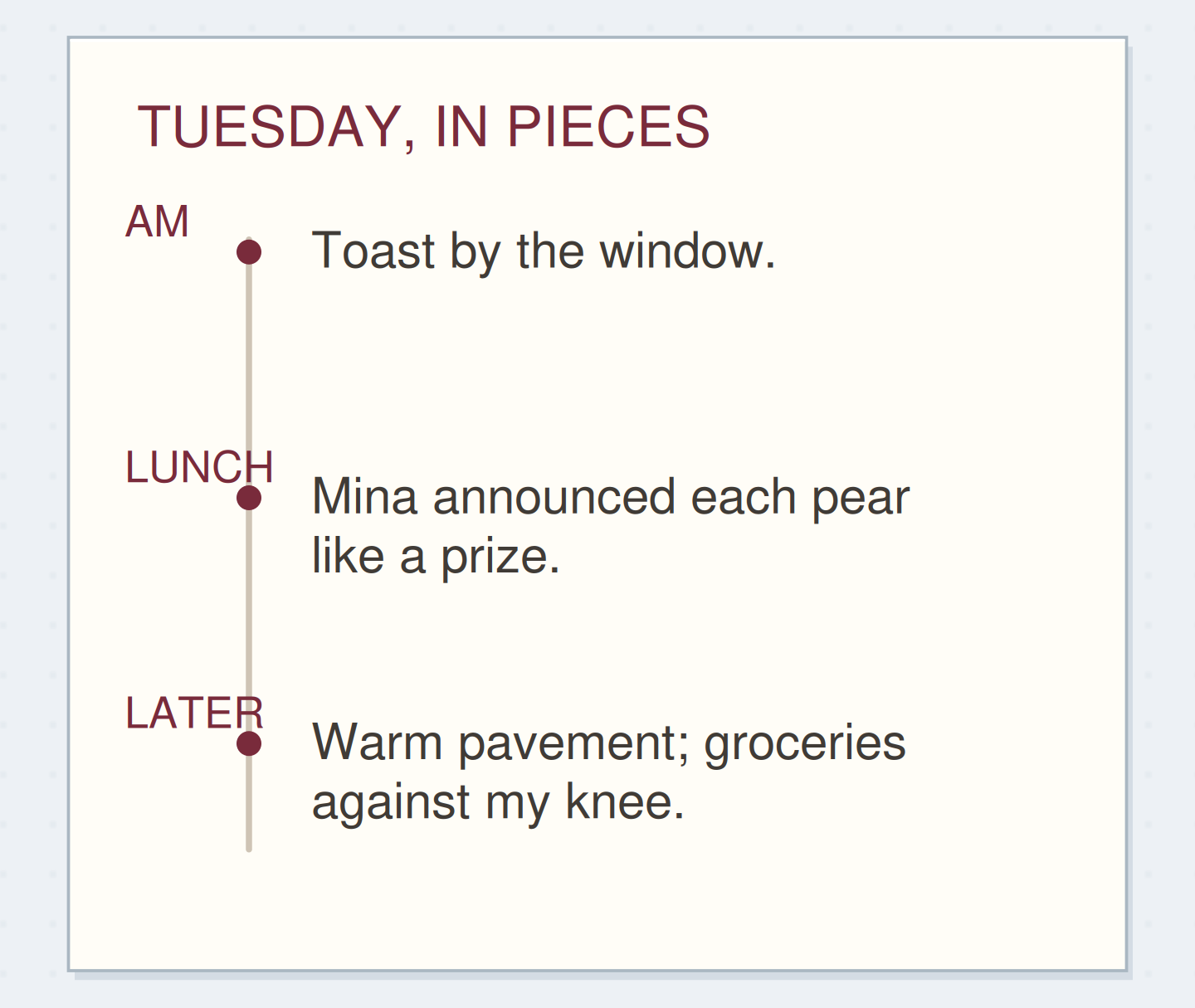
Place the anchors in chronological order, but space them according to the words they need. This is a sequence diagram, not a scaled graph. If lunch needs five lines and the morning needs one, give lunch more room. Write “not to time scale” if the layout might otherwise look like a measurement.
Follow the day through three anchors
The line shows order; spacing is not a measurement of elapsed time.
The outline gives the day a direction.
The empty stretches do not claim that nothing happened.
“A finished timeline shows the moments you kept, not proof that you noticed everything.”
Follow three moments through Tuesday
An example begins “About 7:30: the toaster caught the edge of the bread; ate the rest standing by the window.” The second anchor is “Lunch: Mina brought a pear for everyone and announced it like a prize.” The last says “After the late bus: warm pavement, groceries knocking against my knee.”
These moments tell you something about the day without recounting every task. Draw a dot beside each anchor. Leave the afternoon between lunch and the bus blank if you have nothing you want to record. The space between memories is allowed to remain space.
Write one anchor that holds a scene
Edit the example into a record of your own. Leave out anything you do not know.
When:Lunch
What happened:Mina brought a pear for everyone.
What stayed:She announced each one like a prize.
Your words have a place now.
A broad time label is better than an invented minute.
- Words on this card
- 19
Use the kind of time you know
Exact clock times are useful when they are available, but unnecessary precision can make a reconstructed page misleading. Use “before work,” “around noon,” or “after the visitors left” when those are the facts you remember. Add “about” to a remembered time rather than presenting it as a checked record.
If two moments could have happened in either order, place them together under one broad anchor. A bracket labelled “afternoon” can hold both. You can still show the morning-to-evening progression without inventing the order of a conversation and a cup of tea.
When the line looks empty
An empty-looking timeline usually needs a closer detail, not more events. Revisit one anchor and add what changed: who arrived, what interrupted you, what was on the table, or which sound marked the end of the task. Replace “worked” with “moved the chair to avoid the sun on the screen.”
If you have only one real memory, keep one anchor and shorten the line. Do not manufacture four companions for it. You can also change the heading to “One piece of Tuesday.” The rescue is to make the page fit your evidence, rather than make your recollection fit an impressive spread.
Let one memory set the page size
Move the reveal to see which information changes the record.
Before the revision
Empty slots make a true memory look insufficient.
Try another direction
A horizontal timeline works well across a spread when each entry is brief. Keep important words clear of the binding and use separate boxes on either side if the book does not lie flat. A simple three-row version works in a narrow pocket notebook with no drawn spine at all.
If the scene at one anchor deserves more room, expand it on the next page and write the page number on the timeline. If the day is mostly remembered through a ticket or photograph, begin with its caption instead. The timeline should connect useful records, not require you to rewrite them.
Choose the shape your day needs
Try the form that matches the evidence or space you have.
Several moments belong in a loose chronological line.
Use time words you actually know.
Leave the day with its real gaps
A finished timeline shows the moments you kept, not proof that you noticed everything.
Check that the date, reading direction, and approximate labels make sense. Add a short ending only if it contributes something, such as “The late bus was the quietest part.” Stop there. You can try another day later, but the first page does not create an obligation to account for tomorrow hour by hour.
Where this idea began
Want to follow the idea further? These community discussions and maker references are a good place to start.
- What do you journal if everyday is the same?
The question asks how to document days that feel repetitive.
- Ali Edwards: Day In The Life documenting plan
The post establishes ordinary-day documentation with words and photos as a creator-led practice.