Gather a few things See what you’ll need
- Four related photo copies
- A notebook or loose sheet
- A pen and pencil
- A ruler
- A removable arrangement before attaching
Choose an exercise 4 things to try as you read
Choose images that belong to one occasion
Choose images that contribute different parts of one occasion: the place, an action, a person, and what remained afterward. Four almost identical views may need fewer captions, not more space. Keep originals in their usual location; these small prints are reading copies.
If one picture comes from another day, label that difference next to its number. A tidy two-by-two arrangement should not quietly turn separate occasions into a single sequence.
ONE WORKED EXAMPLE
The fourth picture belongs to another day
You have three photographs from a rainy lunch and a clear picture of the same library entrance taken the following week. You want to use all four in one grid.
Before
Placed beneath one lunch date, the later entrance photo appears to document that afternoon, even though it was taken on another visit.
After
Pictures 1–3 keep the lunch date. Number 4 reads “Entrance, photographed the following Tuesday; shown for the place.” The lunch captions retain the improvised book tray and Noor’s dry side of the steps, with a reference to both original photo sets.
What changed—and what to check
The extra image can supply place information without pretending to be another moment from the lunch. Its date explains why it belongs.
Try this check. Cover the captions, then uncover them and check whether the later photograph’s different date becomes unmistakable.
Number the pictures before writing
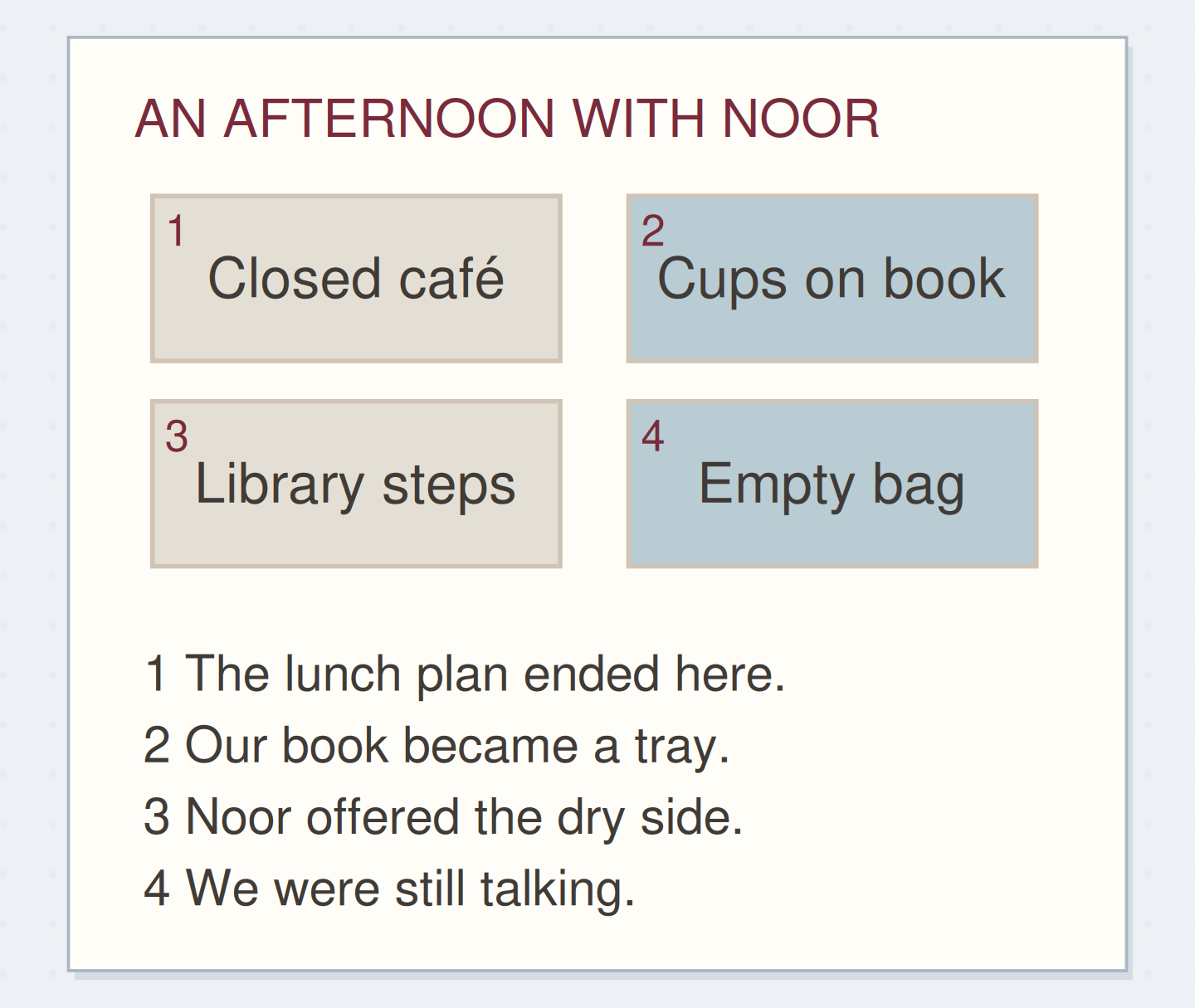
Arrange a two-by-two grid numbered 1–4 in reading order, placing numbers beside important image details. Repeat those numbers in the caption key below.
Four prints around 40 by 30 mm are an A5 starting point. Dry-fit and write two trial captions; use the facing page if the key is cramped.
Compare the optionsConnect four pictures to four useful captions
Connect four pictures to four useful captions
The key adds what happened around the image without writing across it.
Read the words in this example
- AN AFTERNOON WITH NOOR
- Closed café
- Cups on book
- Library steps
- Empty bag
The four pictures belong to one afternoon.
Choose different information, not four copies of the same view.
“A neat key shouldn’t make a guess appear checked.”
GO A LITTLE FURTHERCaption the library-steps afternoon
Caption the library-steps afternoon
Illustrative set: 1 closed café sign; 2 two cups on a book; 3 covered library steps; 4 empty paper bag. Key: 1 our lunch plan ended here; 2 the book became a temporary tray; 3 Noor gave me the dry side; 4 we finished the rolls while still talking.
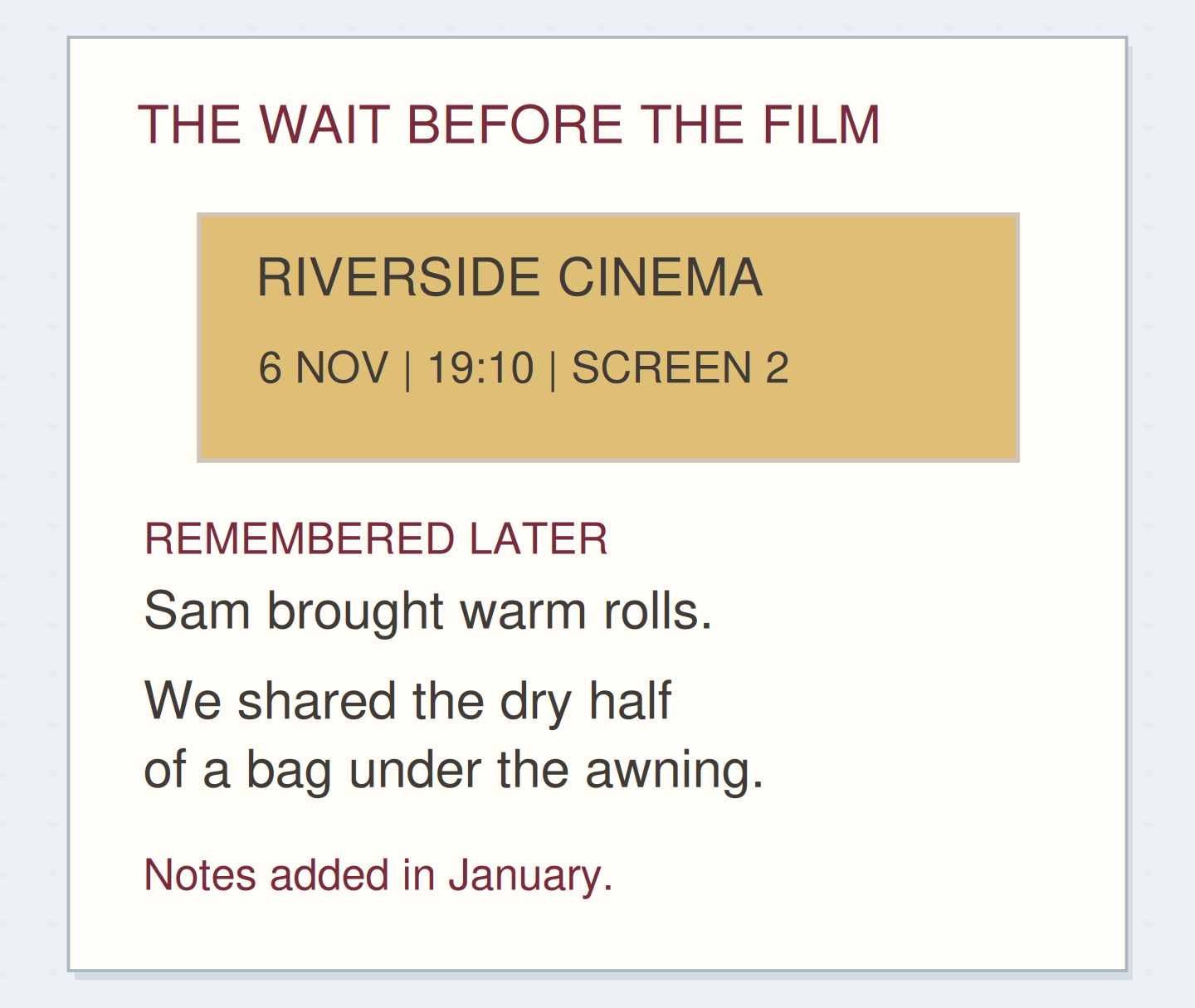
Add occasion and date above. For later captions, put “Notes added in December” below so the two recording moments stay clear.
Write your versionWrite a caption that adds information
Write a caption that adds information
Edit the example into a record of your own. Leave out anything you do not know.
Image number:3
Visible subject:The covered library steps
Outside the frame:Noor offered me the dry side while we balanced the tea.
Your words have a place now.
A caption earns its space by adding more than the visible object’s name.
- Words on this card
- 23
Write the part the picture cannot show
Ask what would be missing if only the photograph survived. “Two cups” names what is already visible; “We used the book as a tray while finding a dry place” adds the action around it. Keep the caption close enough to its number that the reader need not guess.
A photograph cannot establish how someone felt. Use an action you can see, a memory you can identify as yours, or a dated explanation attributed to the person who supplied it.
Keep uncertain identities or dates visible
Use “possibly Jo, not confirmed” or a known season when specifics are uncertain. A neat key shouldn’t make a guess appear checked.
Similar images need distinct reasons to remain, such as before and after a guest arrived. If the fourth adds nothing, use three.
See the differenceKeep an uncertain identity visible
Keep an uncertain identity visible
Read the whole example before and after the change. The tinted lines show revised wording.
Tinted lines contain wording that differs between the two examples.
Before — Before the revision
- UNLABELLED GUESS
- PHOTO 2
- Jo outside the old café.
After — After the revision
- A QUALIFIED CAPTION
- PHOTO 2
- Possibly Jo, not confirmed.
- KNOWN SETTING
- Outside the old café.
Read the whole example before and after the change.
A neat caption can make an uncertain identification look certain. The qualification preserves what you know without discarding the image.
Leave a route to the larger pictures
Reference the folder, album or envelope: “2026, November visit, images 12 to 15.” Descriptive naming and context follow the Library of Congress’s personal-photo guidance; your system can stay simple.
Credit a friend’s image and retain any sharing expectations. For one image with a longer story, choose a larger print and paragraph instead.
Try a what-ifThe smile is visible; the feeling is not
The smile is visible; the feeling is not
Add context without assigning someone an unspoken feeling.
A photograph shows Noor smiling on the library steps as you both balance cups. You remember trying not to spill yours, but cannot remember what Noor said about the afternoon. You want a caption that adds information.
Compare the three choices
Which caption fits the evidence you have?
- “A completely happy afternoon for both of us.”
The picture shows a smile, not the whole afternoon’s feelings. That caption extends beyond the information you have.
- “Noor smiled as we balanced the cups; I remember trying not to spill mine.”
This keeps visible action and your own recalled detail distinguishable. A later explanation from Noor could be added with attribution.
- “Noor was relieved the café had closed.”
That gives a reason for the expression that neither the photograph nor your memory establishes.
Describe an expression without treating it as proof of another person’s inner experience.
What would you try?
Choose an option to see what it would do. You can explore all three.
GO A LITTLE FURTHERTest one caption and one original
Test one caption and one original
Follow every number to its caption, checking whether the date above the grid applies to all four pictures. Correct a swapped caption before attaching the prints.
Then choose one small image and use your written folder, album, or envelope reference to find its original. Fix the reference if that takes you to the wrong set. The page is useful when its small stories and larger pictures are both reachable.
Something for a future page?
The Washi Tape ShopAffiliate links: we may earn a commission if you buy through these links.
Where this idea began
The Library of Congress recommends descriptive information for personal photographs. The linked community discussion considers bringing earlier captions into journals; this four-image layout is an adaptation.
The method references explain the underlying ideas. Community links show the questions and experiences that helped shape this guide; they are not a popularity ranking. The worked examples here are our own.
- Community discussionArchiving Instagram journal entries
The author asks about making a paper record with captions clearly dated to an earlier period.
- Method referenceLibrary of Congress: Keeping Personal Digital Photographs
The guidance recommends selection, descriptive names, subject information, and organized photo records.