Gather a few things See what you’ll need
- A notebook or loose sheet
- A pen
- A pencil for rough notes
Choose an exercise 4 things to try as you read
Choose the season you experienced
Choose a named season, school holidays, rainy weeks or a work-pattern period that fits where you live. Add dates or an approximate range.
Say whether you are collecting as the weeks happen or looking back later. If you began halfway through autumn, name those three weeks rather than implying you watched the whole season. A smaller, honest boundary gives the list a clearer meaning.
ONE WORKED EXAMPLE
Summer without a list of milestones
Your July notes mostly mention the same shaded bench during lunch breaks. You want a seasonal page, but cannot recall a first outing or dramatic change to organize it around.
Before
The draft adds a supposed “first picnic” to make the list feel complete, even though your dated notes do not establish when it happened.
After
“July lunch breaks, from this month’s notes.” Kept repeating: the bench under the plane tree; lunch with the crossword folded beside it. Quietly changed: by the final week, I sat at its far end to stay in shade. First this season: left blank.
What changed—and what to check
The page uses supported repetitions and one observed change. Its headings help sort the record without requiring an event for every category.
Try this check. Match each listed scene to a note or labeled memory, and leave a category empty when it adds nothing.
Use firsts, repeats, and changes
Use “First this season,” “Kept repeating” and “Quietly changed.” Include first indoor dinners, returning meals or routes, and routines that moved or disappeared.
Keep short scenes: “the spare cardigan stayed on the chair after dinner.” Space between the groups helps more than a border that crowds the words.
Compare the optionsSee a season through the way a home is used
See a season through the way a home is used
The same season can hold first occasions, routines, and quiet changes.
Read the words in this example
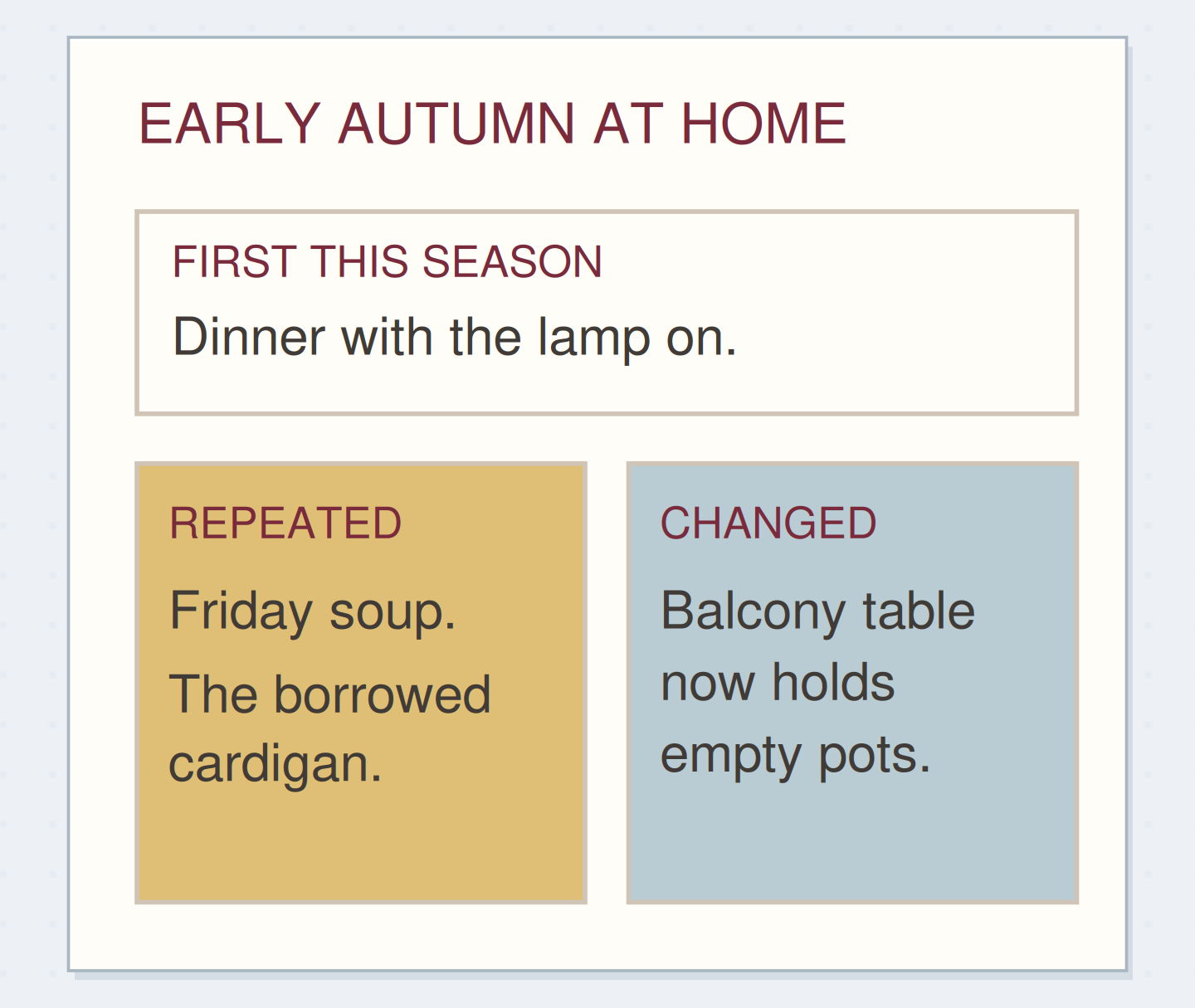
- EARLY AUTUMN AT HOME
- FIRST THIS SEASON
- Dinner with the lamp on.
An indoor dinner marks a specific change in use.
Your season does not need someone else’s traditions.
“Resemblance across pages can be the finding; it needs no manufactured lesson.”
Keep an early-autumn household
Fictional early autumn. First: dinner at the kitchen table with the lamp on. Repeats: Friday soup in deep bowls; shoes by the door after wet walks; the cardigan borrowed by whoever sat nearest. Changed: the balcony table held empty pots instead of breakfast.
A lamp or chair sketch can head the list. Add individual dates only when known or useful to the memory.
Write your versionWrite a lived seasonal list
Write a lived seasonal list
Edit the example into a record of your own. Leave out anything you do not know.
First this period:Dinner at the kitchen table with the lamp on.
Kept repeating:Friday soup and the shared cardigan.
Quietly changed:The balcony table holds empty pots instead of breakfast.
Your words have a place now.
A short seasonal record can include continuity as well as change.
- Words on this card
- 31
Separate what happened from what you hoped for
Keep a wish list separate or clearly labeled. “Wanted soup every Friday” is an intention; “made soup on two Fridays” records an event without a success/failure score.
A plan can stay when the change of plan is part of the story: “We meant to picnic; the kitchen became our meeting place instead.” Place that under what changed, or label it as an intention. The wording should let a future reader tell which event actually happened.
GO A LITTLE FURTHERWhen this season looks like the last one
When this season looks like the last one
Inspect familiar circumstances: who cooks the repeated meal, which room holds it, when the route is walked and with whom.
If nothing changed, keep “Still soup in the chipped bowls.” Resemblance across pages can be the finding; it needs no manufactured lesson.
See the differenceLook closer without inventing change
Look closer without inventing change
Read the whole example before and after the change. The tinted lines show revised wording.
Tinted lines contain wording that differs between the two examples.
Before — Before the revision
- SAME AS LAST YEAR
- AUTUMN
- Soup. Cardigan. Table.
After — After the revision
- THE REPEATED CIRCUMSTANCE
- STILL THE SAME
- Soup in the chipped bowls.
- THIS YEAR
- Maya borrowed the cardigan.
Read the whole example before and after the change.
A list of nouns hides both continuity and small differences. The revised note can keep what stayed and name a real circumstance.
GO A LITTLE FURTHERChoose one physical trace if it helps
Choose one physical trace if it helps
One menu, copied calendar note or label can support a scene. Add its connection in words; collected objects and glued material are optional.
For comparison, reuse the three groups under a new period heading. Link an annual snapshot for the broader arrangement of life.
Try a what-ifA memory returns after the list closes
A memory returns after the list closes
Consider this page before choosing your next move.
Your September list is already dated and finished. In November, you remember a September walk that belongs with it.
Compare the three choices
How could you add it without confusing the record?
- Extend the heading through November.
That would change the period being described even though the walk still belongs to September.
- Insert it without a note so the list reads smoothly.
The scene would remain useful, but the record would no longer show that this detail was recalled later.
- Add the walk with a “remembered in November” note.
The event stays in its September context while the later recording date remains visible.
A later recollection can join an earlier period without changing that period’s boundary.
What would you try?
Choose an option to see what it would do. You can explore all three.
GO A LITTLE FURTHERClose the list at a clear boundary
Close the list at a clear boundary
Check that the entries describe the period at the top. Add the date you stopped collecting and leave unused space alone.
When another memory arrives after you have closed the list, add “Remembered on…” beside it and keep the original period heading. You can preserve a late recollection without making the season longer or pretending it was recorded at the time.
Something for a future page?
The Washi Tape ShopAffiliate links: we may earn a commission if you buy through these links.
Where this idea began
Community prompts use seasons as a starting point, and Ali Edwards demonstrates flexible documenting across a month. This adaptation looks back at lived routines.
The method references explain the underlying ideas. Community links show the questions and experiences that helped shape this guide; they are not a popularity ranking. The worked examples here are our own.
- Community discussionMonthly community prompts
Participants suggest seasonal and holiday prompts as well as looking back over change.
- Method referenceAli Edwards: March documenting
The post demonstrates collecting everyday stories across a month with a flexible amount of decoration.