Gather a few things See what you’ll need
- A notebook or loose sheet
- A pen
- A pencil for rough notes
Choose an exercise 4 things to try as you read
Follow three moments through Tuesday
“About 7:30: the toaster caught the edge of the bread; ate the rest standing by the window.” “Lunch: Mina brought a pear for everyone and announced it like a prize.” “After the late bus: warm pavement, groceries knocking against my knee.”
Dot each anchor. The stretch between lunch and the bus can remain blank; these three moments already say something about Tuesday.
Write your versionWrite one anchor that holds a scene
Write one anchor that holds a scene
Edit the example into a record of your own. Leave out anything you do not know.
When:Lunch
What happened:Mina brought a pear for everyone.
What stayed:She announced each one like a prize.
Your words have a place now.
A broad time label is better than an invented minute.
- Words on this card
- 19
ONE WORKED EXAMPLE
The queue between two appointments
You remember leaving home, waiting at a café and catching the afternoon bus. You want a short timeline of the day, but the appointments themselves have blurred together.
Before
The line has exact-looking hourly gaps, which makes the few remembered scenes appear to be a complete timetable of the day.
After
Three anchors read “Before leaving: found the missing scarf,” “Between appointments: shared the last outdoor table,” and “Afternoon bus: carried the empty cake box.” A note says the spacing follows the writing, not elapsed time.
What changed—and what to check
Relative time keeps the order you remember. Giving each sentence the room it needs avoids implying precise durations or a complete account.
Try this check. Read the time labels alone and check that none claims more precision than you actually remember.
Pick a day you can still reach
Start with today or yesterday and say whether the notes are contemporary or remembered afterward. A routine day offers plenty of recognizable material.
Choose moments where something shifted: you left the house, someone joined you, a meal interrupted work, or you finally sat down. Those changes make useful anchors because you can attach a scene to them. They do not need to account for the minutes in between.
“Let the layout fit the evidence.”
Give the day a readable spine
Draw a vertical line around the left third of the page—about 3 cm from the edge on A5 is one option. Leave a narrow time strip and roomier writing space.
Order the moments chronologically but give each the space its words need. This is a sequence, not a scaled graph; label it “not to time scale” if helpful.
Compare the optionsFollow the day through three anchors
Follow the day through three anchors
The line shows order; spacing is not a measurement of elapsed time.
Read the words in this example
- TUESDAY, IN PIECES
- AM
- Breakfast.
- NOON
- Lunch.
- PM
- Bus home.
The outline gives the day a direction.
The empty stretches do not claim that nothing happened.
Use the kind of time you know
Use the time you know: “before work,” “around noon” or “after the visitors left.” Add “about” to a remembered clock time.
If a conversation and tea could have occurred in either order, group them under “afternoon.” You can show a day’s progression without inventing the sequence within it.
GO A LITTLE FURTHERWhen the line looks empty
When the line looks empty
Before adding another event, return to one you already named. What made this instance different? “Worked” might become “Moved the chair to keep the sun off the screen.” That action gives a routine stretch something recognizable without making the timeline busier.
If only one memory is clear, shorten the line and call it “One piece of Tuesday.” Let the layout fit the evidence.
Try a what-ifThe journey runs past midnight
The journey runs past midnight
Keep the date change visible inside one continuous journey.
Your bus left at 11:40 p.m. on 4 September and you reached home at 12:15 a.m. on 5 September. You want the timeline to follow that journey in order.
Compare the three choices
How should the two anchors sit on the line?
- Put 12:15 a.m. first by sorting the clock numbers.
That sorting rule loses the date boundary and places the arrival before the departure.
- Label both anchors 4 September to keep the outing together.
One outing can cross two dates. Keeping its entries together does not require changing the arrival date.
- Keep departure before arrival and mark where 5 September begins.
The journey remains in order and both clock times keep their actual dates. A heading such as “Late bus home, 4–5 September” can hold the pair.
When a sequence crosses midnight, read the date and clock time together.
What would you try?
Choose an option to see what it would do. You can explore all three.
GO A LITTLE FURTHERTry another direction
Try another direction
A horizontal spread suits brief entries; keep words clear of the binding or use separate boxes. A pocket notebook may need only three rows with no spine.
Expand a rich scene on another page and link it. If a ticket or photograph holds most of the memory, begin with that caption rather than rewriting it.
Compare the optionsChoose the shape your day needs
Choose the shape your day needs
Try the form that matches the evidence or space you have.
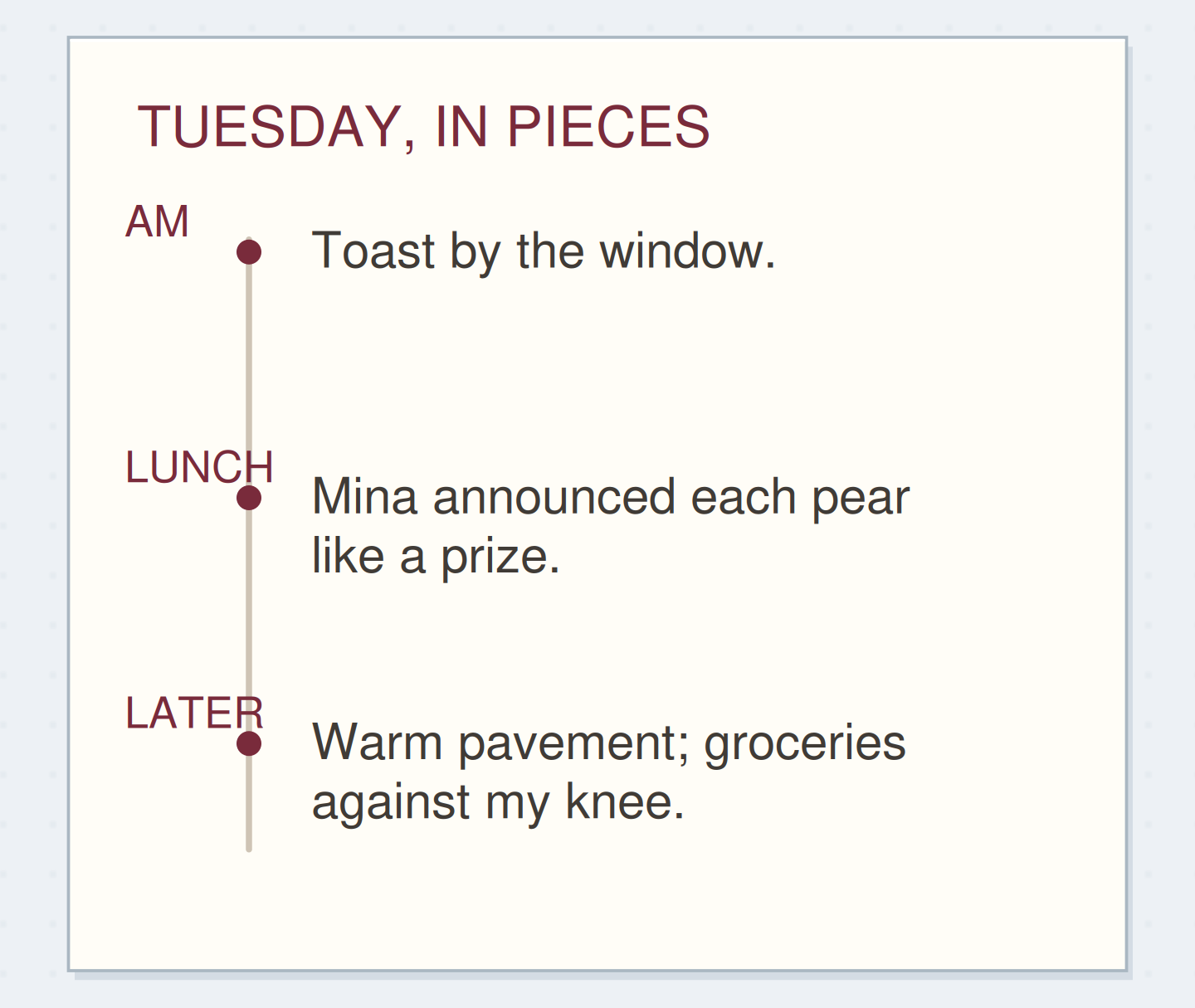
Read the words in this example
- TUESDAY, IN PIECES
- AM
- Toast by the window.
- LUNCH
- Mina announced each pear
- like a prize.
- LATER
- Warm pavement; groceries
- against my knee.
Several moments belong in a loose chronological line.
Use time words you actually know.
GO A LITTLE FURTHERLeave the day with its real gaps
Leave the day with its real gaps
Check date, reading direction and approximate labels. Add an ending only if it contributes: “The late bus was the quietest part.”
If one scene still has more to say, put a small page reference beside it and continue elsewhere. Leave the timeline as your route back to that scene; you do not need to squeeze the fuller story into its narrow space.
Something for a future page?
The Washi Tape ShopAffiliate links: we may earn a commission if you buy through these links.
Where this idea began
This pen-only timeline shares Ali Edwards’s Day In The Life focus on everyday experience. It uses a few selected scenes rather than a complete account of a day.
The method references explain the underlying ideas. Community links show the questions and experiences that helped shape this guide; they are not a popularity ranking. The worked examples here are our own.
- Community discussionWhat do you journal if everyday is the same?
The question asks how to document days that feel repetitive.
- Method referenceAli Edwards: Day In The Life documenting plan
The post establishes ordinary-day documentation with words and photos as a creator-led practice.