Gather a few things See what you’ll need
- A notebook or loose sheet
- A pencil and pen
- A ruler if helpful
- Your own place memories
Choose a small territory
Pick a route or area you can describe comfortably: the walk to school, one block around an old flat, or the shops you use now. A smaller territory leaves more room for the memories. Write the place and period at the top, such as “Around the old flat, 2018 to 2020.”
Decide whether you are mapping a remembered neighborhood or the current one. Buildings change, and a vanished shop can still be a useful landmark on a memory map. Label it with “then” or its approximate years rather than trying to make the drawing match today’s street layout.
Draw three anchors first
Use small rectangles or plain dots for three places. Put them roughly in relation to one another, leaving wide gaps for connecting lines. On a single A5 page, reserve the bottom third for captions. Add a short “schematic, not to scale” note so a stretched route does not look like a measured distance.
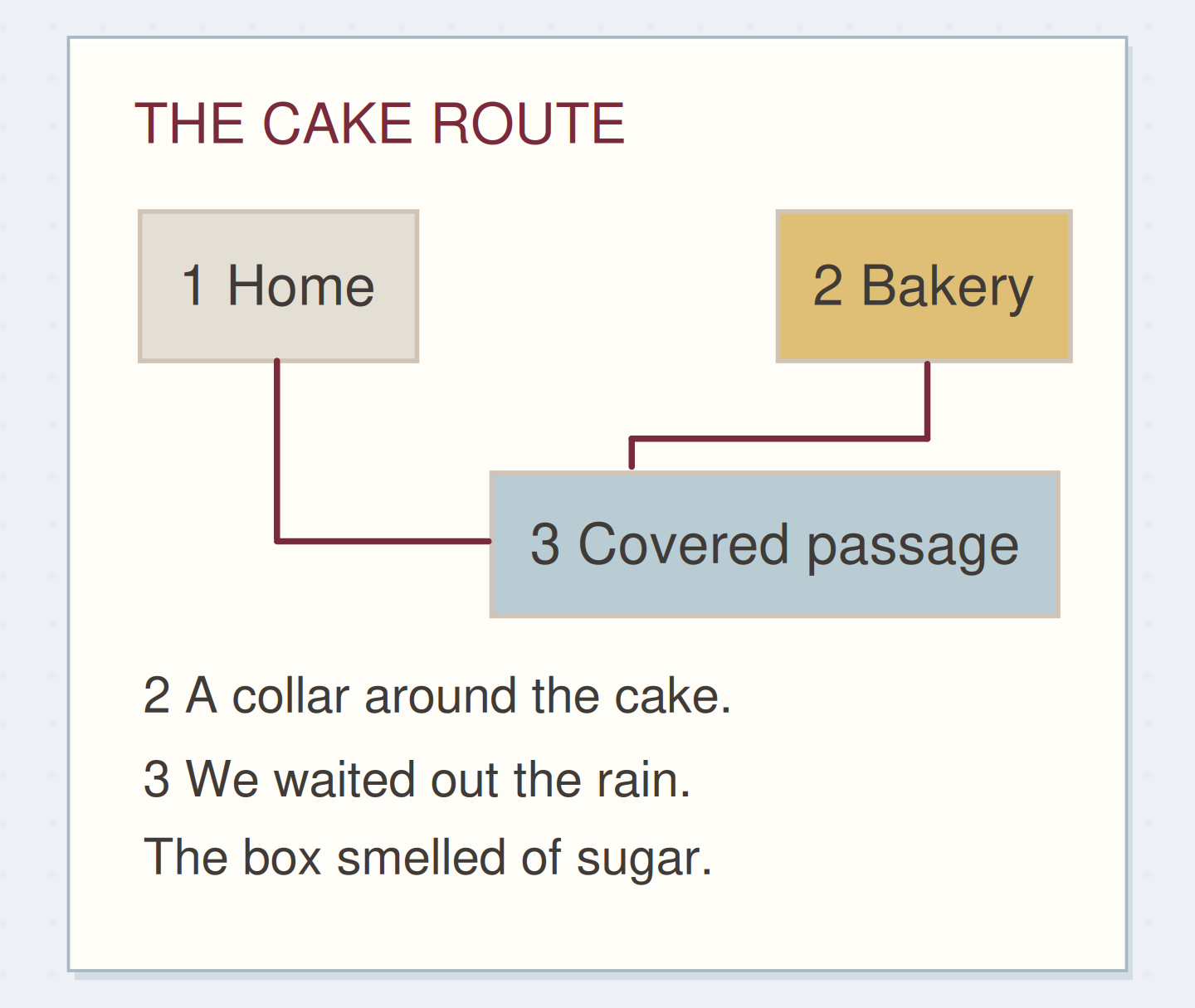
Give each anchor a number. The number lets the map remain simple while the caption carries the story. If several memories belong to one shop, put them under the same number instead of drawing a new landmark for every visit.
Build a route that leads to a memory
Landmarks, connection, and captions each add a different kind of information.
Three anchors establish a small territory.
The drawing is schematic, not a measured map.
“Your map is finished when each chosen landmark has a story you can find from its number.”
Trace the cake route
In this fictional example, 1 is Home, 2 is Bakery, and 3 is Covered passage. A loose line runs from the bakery through the passage to home. Caption 2 reads, “The baker put a cardboard collar around the cake.” Caption 3 says, “We stopped here when the rain started; the box smelled of sugar.”
The route explains why the passage matters. Add a dotted line for the direct route you did not take only if that comparison contributes to the story, and label it clearly. Otherwise, one line and three captions are enough to make the map readable.
Write a landmark’s personal caption
Edit the example into a record of your own. Leave out anything you do not know.
Landmark:3, covered passage
What happened:We waited for the rain to stop.
What the map cannot show:The cake box smelled of sugar.
Your words have a place now.
The map locates the place; the words explain why it belongs.
- Words on this card
- 24
Write what the place did in your life
“Bakery” identifies a building. “The place that lent us a tray for the party” identifies its part in your life. Keep both kinds of information where possible. A future reader needs to know what the building was, but the personal connection is the reason it belongs on this page.
Sensory details can help when they are yours to recall: the door’s heavy push, a radio behind the counter, or the way bags gathered on a particular bench. Avoid decorating the map with details borrowed from photographs of places you do not actually remember.
When you cannot remember the streets
Replace the street map with a relationship map. Put “home” in the middle and draw lines toward the places you remember, without claiming which turn led where. Label a line “walked together” or “after school.” You still show a meaningful connection without inventing geography.
If you consult a current map to check a street name, make a brief note that you checked it now. Keep remembered features separate from present-day facts. You can leave an unnamed landmark labelled “the shop with the red door” until a reliable source gives you more.
Remove geography you do not know
Move the reveal to see which information changes the record.
Before the revision
A remembered connection does not establish a street direction.
Let another person add a route
Someone who shared the neighborhood may remember a different corner, nickname, or shortcut. If you ask them, give their note an initial and the date of the conversation. A second route can use a different line pattern, with a written key. Color alone should not carry the distinction.
Keep the first map readable by limiting additions to one other perspective at a time. A large family or several decades may deserve separate pages. For the life story of a single object from that home, use an object-biography page and cross-reference it beside the relevant landmark.
Choose how to add another memory
Try the form that matches the evidence or space you have.
One additional caption can stay under the existing landmark.
Keep the number and identify the contributor.
Stop before it becomes an atlas
Your map is finished when each chosen landmark has a story you can find from its number.
Check that every line has a purpose and that the captions name the period clearly. You can omit roads, buildings, and directions that add no useful context. Close the page with the territory still small. Another neighborhood can have another map, rather than being squeezed into the unused corner of this one.
Where this idea began
Want to follow the idea further? These community discussions and maker references are a good place to start.
- Esri Community: Childhood memory sketch maps
The educator’s community article asks people to sketch personally meaningful places and explain their associations.
- Museum of Art and Photography: Memory Maps
The museum workshop documents a practice of drawing and discussing personal responses to a city.