Gather a few things See what you’ll need
- A notebook
- A pen or pencil
- One familiar object or its photograph
Choose something with a lived connection
Pick an object you use, recognize, or have a clear memory of: a bowl, key ring, bag, chair, or borrowed tool. Expensive or old is not a requirement. The useful question is whether the object has been present in more than one meaningful setting or has one scene you want to preserve.
Place it where you can look at it, or use a photograph if it is elsewhere. You can also write about something you no longer own. In that case, label the description as remembered and avoid adding details that only seem plausible.
Give its life a few stops
Draw three small headings across a page or down its length: First known, A change, and Now. Under each, leave room for a place, a person, and a scene. Three stops are a manageable starting point, not a requirement that every object have a dramatic transformation.
Use approximate dates where needed. Add “told by” to information you learned from someone else. A separate line headed “Unknown” can hold gaps such as who originally bought it. Keeping the gap visible makes the page more honest and gives future additions an obvious place.
Follow a bowl through its known chapters
A change of home and use gives one object a small biography.
The first remembered scene begins the page.
It does not claim to be the object’s actual origin.
“An object biography is complete when its known scenes and its uncertainties are both easy to read.”
Follow a bowl through three kitchens
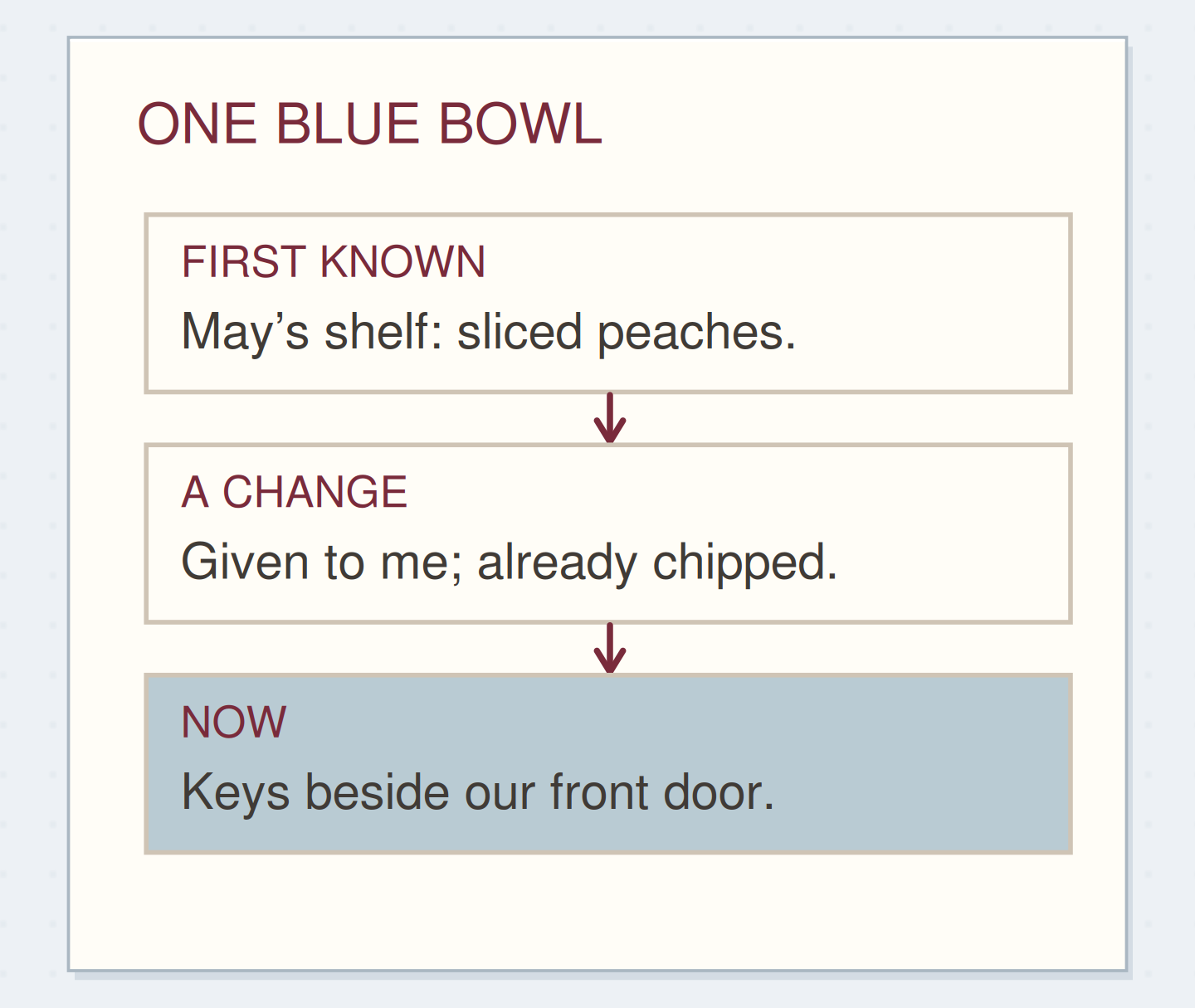
Here is a fictional example: First known: on Aunt May’s kitchen shelf, before I moved away; she used it for sliced peaches. A change: she gave it to me when I took the small flat; the chip was already there. Now: it holds keys beside our door, and the pale patch inside still looks like a slice of peach.
The object’s function changes, but the association stays. A simple oval sketch with the chip marked can identify it. The sketch does not need shading or accurate perspective. Its job is to distinguish this bowl from the other blue bowl you may own later.
Write one object’s known history
Edit the example into a record of your own. Leave out anything you do not know.
First known:May’s kitchen shelf; sliced peaches.
A change:She gave me the bowl, already chipped.
Now or last known:It holds keys beside our door.
Your words have a place now.
A personal biography can begin where your own knowledge begins.
- Words on this card
- 26
Notice marks without inventing their cause
Describe visible wear before assigning it a story. You may know when a handle was repaired because you did the stitching. You may not know how a scratch appeared. Write “scratch on the left side, origin unknown” rather than converting every mark into an event.
If a family story says the object came from a particular place, attribute the story. “May said she brought it from her first flat” is different from an independently checked origin. A personal page can hold both observation and inherited memory when the wording keeps their sources clear.
Begin where your knowledge begins
An unknown origin does not prevent a biography. Start with the earliest time you remember seeing the object. Then write about its part in your own life: where it sat, who reached for it, and when its use changed. The first known scene can be the beginning of this page even if it was not the object’s beginning.
If you are tempted to search for an identical object online, decide whether that search serves your memory. A matching shape or maker’s mark may identify a type, but it will not establish the history of your particular object. Keep those two questions separate.
Leave the origin unknown
Move the reveal to see which information changes the record.
Before the revision
An unsupported origin makes the story tidier but less reliable.
Let the page hold the story
You can make the record while continuing to use the object, giving it away, or simply remembering something already lost. The page does not tell you what to keep. It preserves the connection you chose to describe, so the story is not dependent on a label remaining attached to the item.
If another person receives the object and wants its history, a copy of the page can travel with it. Keep their next chapter separate from yours. If the object belongs in a neighborhood or family-phrase story, add a page reference rather than repeating the entire biography.
Choose how the story can travel
Try the form that matches the evidence or space you have.
The page can accompany an ordinary object you continue using.
No special display is necessary.
End at the last known chapter
An object biography is complete when its known scenes and its uncertainties are both easy to read.
Add the date you wrote the page and, if useful, where the object is now. Stop without filling every gap. Another story may arrive later, but the bowl already has a readable path through three kitchens. That is enough to make it more than an unnamed shape at the edge of an old photograph.
Where this idea began
Want to follow the idea further? These community discussions and maker references are a good place to start.
- Memory Journal?
Participants organize older memories by places, objects, and events when dates are uncertain.
- Smithsonian: Object History Sleuths
The interview explains an object biography as its changing locations, owners, and meanings.