Gather a few things See what you’ll need
- A notebook or loose sheet
- A pen
- A pencil for rough notes
Find a phrase with a shared meaning
Choose a saying, nickname, mispronunciation, or repeated instruction that means something particular in your household. Family can include chosen family, housemates, or a long-standing group of friends. You do not need a famous origin story. A phrase first noticed last month belongs beside one remembered from childhood.
Begin with something people are comfortable having written down. The aim is to preserve a voice and its context, not to collect embarrassing remarks. If a saying is connected to an experience someone does not want revisited, choose another expression for this page.
Give the phrase four parts
Write the expression as the heading. Under it, leave room for “what we mean,” “who says it,” and “one occasion.” Add the date you made the entry. If the origin is uncertain, give that uncertainty its own sentence rather than leaving a blank that invites a future guess.
An index card or half a notebook page is enough for a first entry. Keep several sayings on one page only if each has its own clear block. A little white space is useful here because you may later add a second person’s version.
Give a family phrase its private meaning
The same words gain a definition, an occasion, and an honest gap.
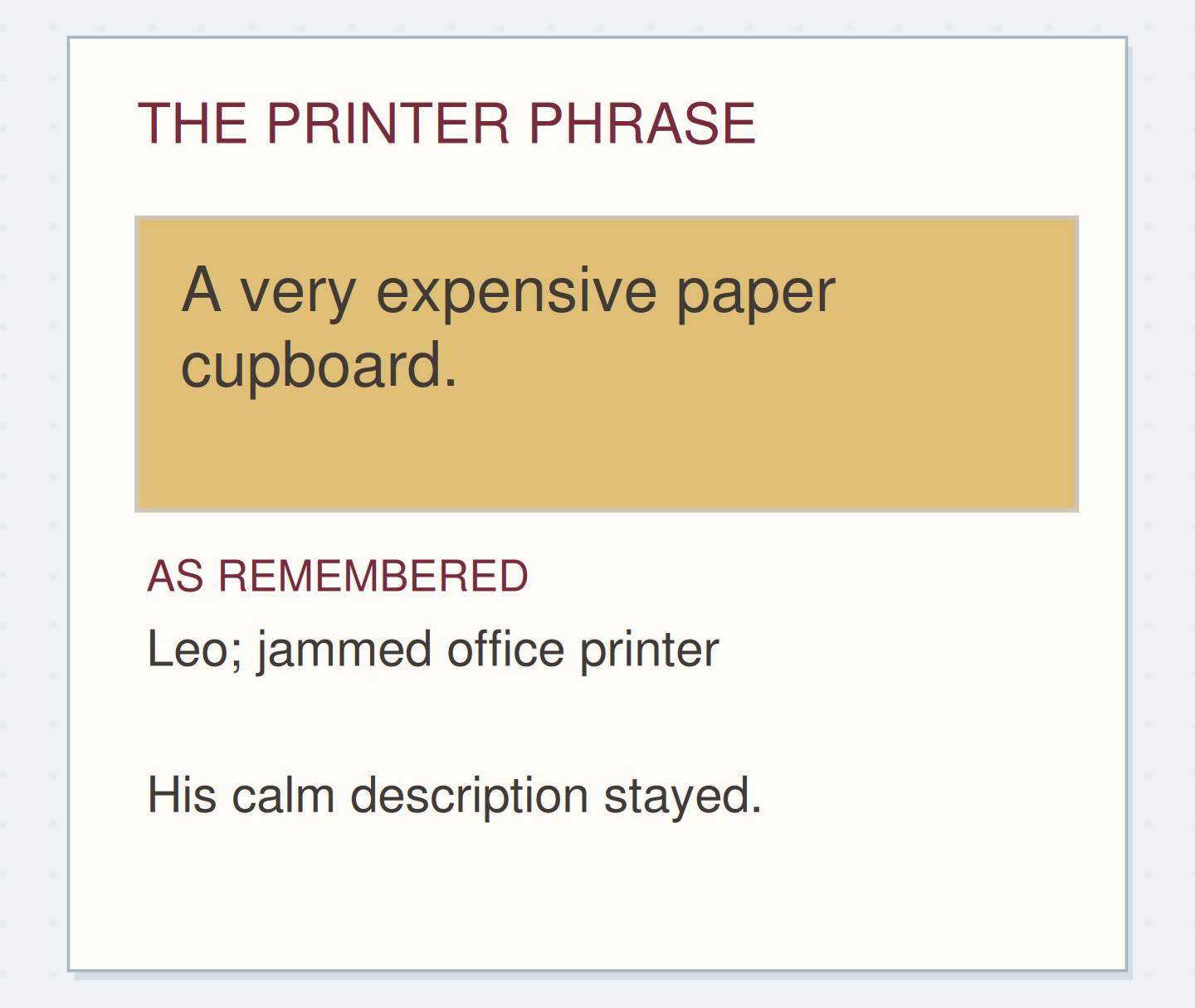
The expression is saved, but a visitor would not understand it.
A private phrase needs a little explanation.
“One expression with a clear meaning and an honest occasion is a complete archive entry.”
Explain “somewhere sensible”
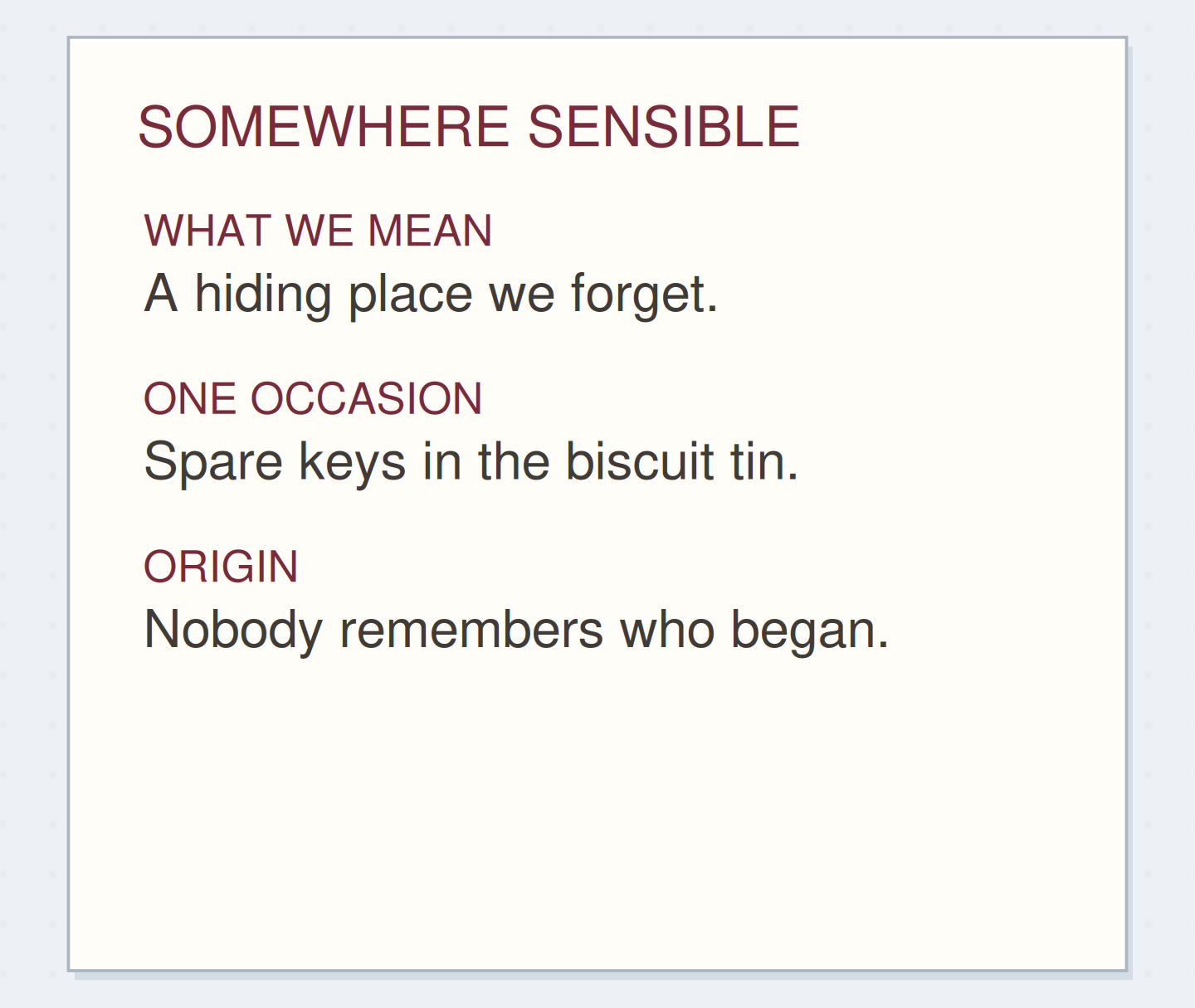
Here is a fictional entry: “Somewhere sensible.” What we mean: a hiding place so careful that the owner forgets it. Who says it: Dad, and now the rest of us. One occasion: we found the spare keys in the biscuit tin before the holiday. Origin: no one remembers who started it.
The explanation makes the phrase readable outside the family. Add “Recorded in September, from my recollection” beneath it. If Dad later says the phrase began with a lost birthday present, write that as a new attributed note rather than silently changing the entry’s history.
Make a family-phrase entry
Edit the example into a record of your own. Leave out anything you do not know.
Expression:Somewhere sensible
What we mean:A hiding place so careful we forget it.
One occasion and source:Spare keys in the biscuit tin; my memory.
Your words have a place now.
You can preserve an expression without proving who first said it.
- Words on this card
- 26
Ask for one occasion
A broad question such as “Tell me our family history” can feel enormous. A smaller invitation is easier: “When do you remember hearing that?” or “Was that something your grandmother said?” Let the person choose how much to tell. A short answer can be enough to complete your caption.
If you write their exact words, check the wording with them while you can. Otherwise summarize in your own language and label it as your summary. You can ask whether they want their name attached to the story before sharing the page beyond the notebook.
Keep two versions without forcing agreement
Families often disagree about who first said something. Put the accounts side by side: “My memory” and “Sam’s memory, told in October.” Note where they agree and leave the rest open. The disagreement may itself show how a phrase has travelled through the household.
If you remember only a sound or a partial line, record the fragment as a fragment. Avoid polishing it into a neat quotation. A spelling chosen to suggest pronunciation can sit beside a plain-language explanation, especially when the expression crosses languages or dialects.
Keep differing origins visible
Move the reveal to see which information changes the record.
Before the revision
A neat origin claim may exceed what anyone knows.
Build an archive slowly
Give every entry a short searchable heading and a page number. In the back of the notebook, list the phrases alphabetically or under the person most associated with them. Use whichever route you would actually try when looking for a saying. A tiny archive does not need both systems.
When a phrase appears in a new ordinary-day entry, add a page reference rather than rewriting its whole history. You can also connect a saying to a photograph or an object-biography page, such as the biscuit tin from the worked example. The connections can grow without making the original page crowded.
Choose a way back to the phrase
Try the form that matches the evidence or space you have.
An alphabetical list helps when you remember the words.
Keep the page reference short.
Finish one voice at a time
One expression with a clear meaning and an honest occasion is a complete archive entry.
Stop after reading it as though you were a visitor who had never heard the phrase. If the private shorthand makes sense, the page has done its job. Leave room for additions, but do not turn the project into an interview schedule for every relative. The next saying can arrive during an ordinary conversation.
Where this idea began
Want to follow the idea further? These community discussions and maker references are a good place to start.
- Dad’s Family Journals
The author records events, outings, and ordinary family days across several notebooks.
- StoryCorps: Great Questions
Its question bank includes family stories, remembered people, and specific life experiences.