Gather a few things See what you’ll need
- A notebook or loose sheet
- A pen
- A pencil for rough notes
Choose a line, not a transcript
Listen for wording that surprises you, describes an ordinary thing freshly, or belongs to a familiar voice. A phrase can be funny without being a joke. It might be a child’s name for a household object, an unexpected comparison, or a sentence that captures the mood of a room.
Keep the scope small: one line from a day is plenty. You are not collecting a complete record of someone else’s conversation. Leave out private details you have no reason to preserve, and use a general setting or relationship rather than identifying a stranger in your notebook.
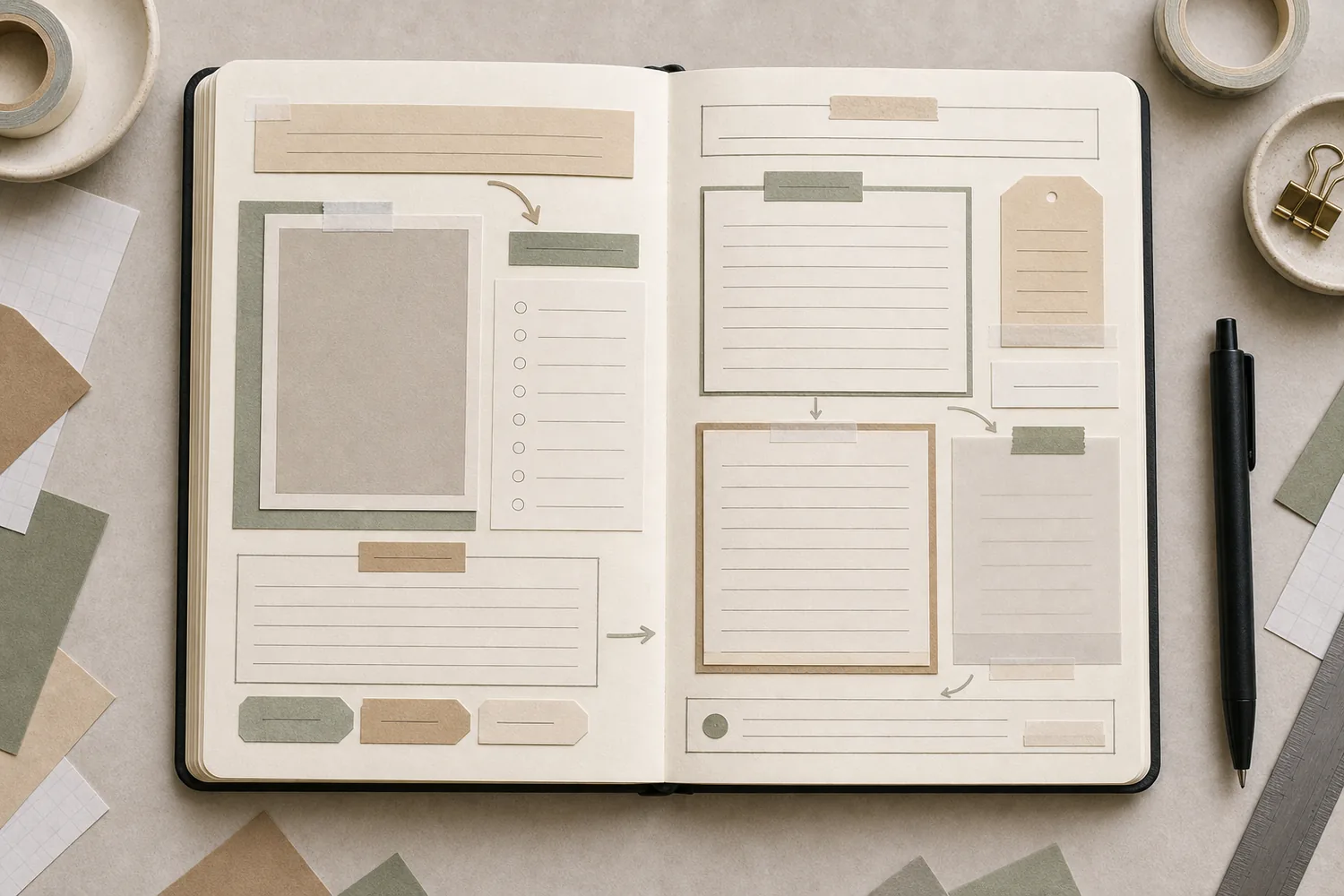
Reserve three small fields
Write a date, then leave space for the phrase, the setting, and one reason you noticed it. These can be three short lines on a memo. If you like a larger heading, write the actual words before drawing a border so you do not end up squeezing the end of the sentence.
Add a tiny text label beside the phrase: “exact,” “as remembered,” or “paraphrase.” These labels do a useful job without needing an elaborate symbol key. Exact means you are confident of the wording, not that you have formally recorded or verified the speaker.
Give the words their scene
Keep wording, accuracy, and circumstance as different pieces.
The words are vivid, but their referent is missing.
A future reader does not yet know what the cupboard was.
“The entry is complete when you can tell what was said, what you know about the wording, and where it belonged.”
Keep the printer scene
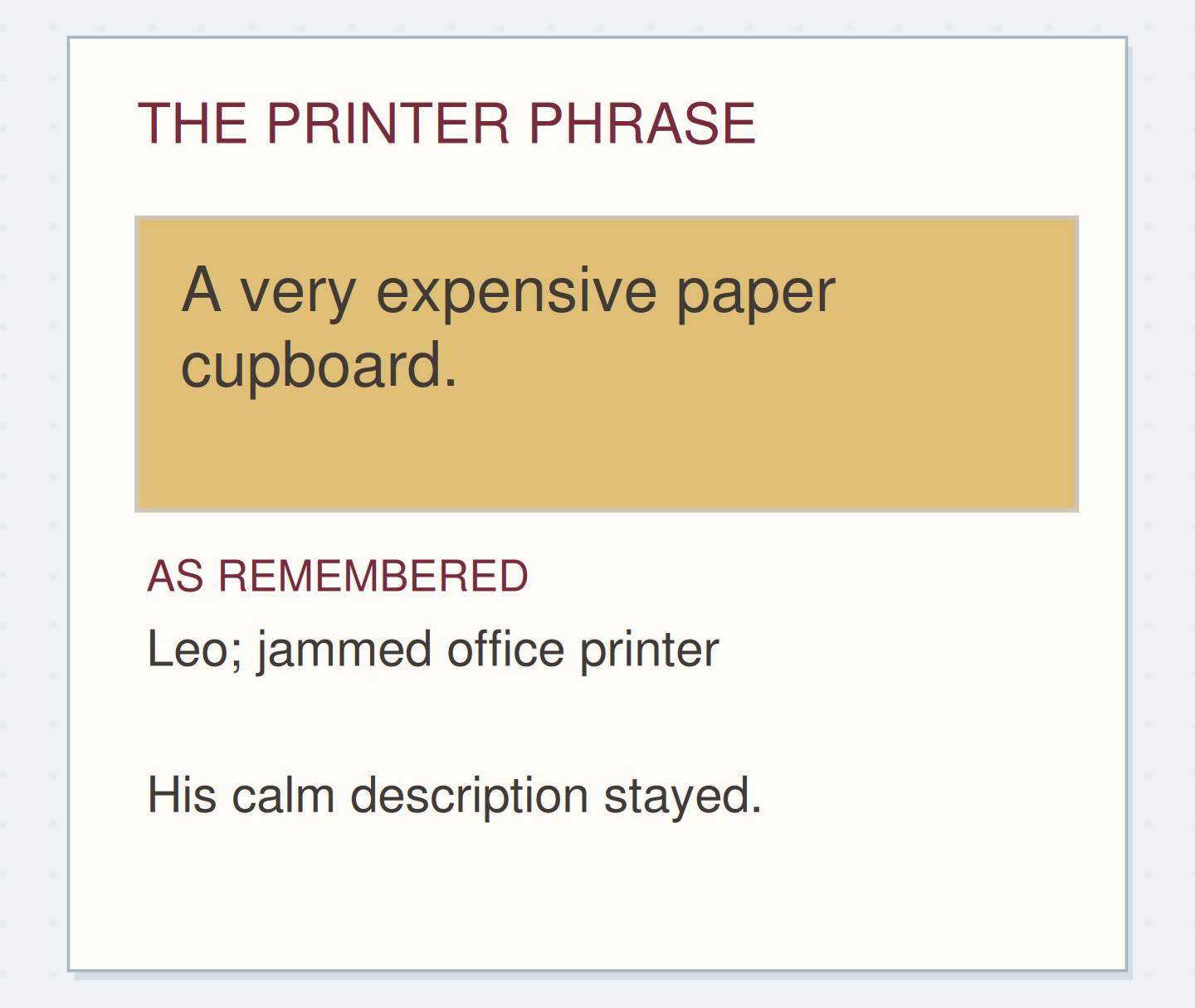
Try this fictional example: Phrase: “A very expensive paper cupboard.” Context: Leo, beside the jammed office printer, Tuesday afternoon. Why it stayed: he said it gently while everyone else was hunting for the missing sheet. Label: as remembered, written after work.
The context changes the line. Without it, the words could describe a filing cabinet, an art object, or an argument about spending. The final note records your experience of the moment. It does not claim to explain everything the speaker thought or intended.
Keep a phrase with its accuracy label
Edit the example into a record of your own. Leave out anything you do not know.
Phrase or paraphrase:A very expensive paper cupboard.
Setting:Leo, beside the jammed printer.
Accuracy:As remembered after work.
Your words have a place now.
You can preserve an idea without pretending it is a verbatim quote.
- Words on this card
- 19
Know when to remove the quote marks
If you remember the idea but not the wording, write it in your own sentence: “Leo compared the broken printer to an expensive cupboard.” Label that a paraphrase and omit quotation marks. You still keep the observation without turning an uncertain reconstruction into a verbatim statement.
If you later ask the person and they remember different words, add their version underneath with the date of the conversation. There is no need to erase your first record. Two labelled versions can show how a phrase travelled through the day and through your memory.
When the quote has lost its scene
A notebook full of clever lines can become strangely hard to understand. Pick one entry and add the missing situation in plain language. Where were you? What had just happened? Which ordinary object were you both looking at? One of those answers may be enough to restore the scene.
If the setting is gone too, write “context not remembered” and keep the words as an isolated phrase. Do not invent an occasion because the entry looks unfinished. A clear gap is more useful than a polished explanation that you might later mistake for something you actually recall.
Restore context without inventing it
Move the reveal to see which information changes the record.
Before the revision
A quotation alone leaves its subject ambiguous.
Give recurring voices a little room
For sayings repeated at home, move to a family-phrases page. That format can hold several occasions and the history of an expression. A one-day phrase log is better for a line whose timing mattered. You can cross-reference the two rather than copy the same words into multiple elaborate entries.
A multilingual phrase can keep its original wording with your own rough translation underneath. Label a translation as yours, especially when the humor depends on a word that has no tidy equivalent. Explain the situation rather than trying to make the translation equally clever.
Choose a truthful wording form
Try the form that matches the evidence or space you have.
Use quotation marks only for wording you know.
This is a choice about accuracy, not decoration.
Stop with the words and their setting
The entry is complete when you can tell what was said, what you know about the wording, and where it belonged.
Read the phrase once aloud if that helps you check its rhythm, then put the notebook away. You do not need to search for a better line to finish the page. On another day, the most useful entry may be a quiet sentence that would never look impressive as a quotation poster.
Where this idea began
Want to follow the idea further? These community discussions and maker references are a good place to start.
- Spent a day keeping track of some of the things I overheard
The thread shares an overheard-language page and attributes its prompt to Journal Sparks.
- Emily Neuburger: Journal Sparks
The author’s announcement verifies the book attribution made by the overheard-journal thread.