Gather a few things See what you’ll need
- An old paper calendar or planner
- A notebook
- A pen
- A pencil for uncertain links
Choose one bounded page
Take one month or week from a paper calendar, planner, or appointment book you already own. Write its year and the date you are reviewing it. Start with a small area so the exercise does not turn into an attempt to reconstruct your entire past.
Look for an entry that produces a real association: a name, place, crossed-out plan, or unusual note. You do not need to choose the busiest day. A short ordinary entry may connect to a clearer scene than a large event whose details are no longer available.
Make three labelled spaces
Use headings for Calendar says, I remember, and Still uncertain. Copy the calendar wording exactly into the first space if it is short, including a cancellation or question mark. In the second, write the memory it brings up. In the third, keep any unresolved date, identity, or sequence.
An appointment written in advance is evidence of a plan, not automatic proof that the meeting happened. A tick or note may help, but interpret your old marks cautiously if you no longer remember the key. Use words such as “planned” or “apparently completed” where appropriate.
Keep the calendar clue separate from the scene
An appointment can open a memory without proving its date.
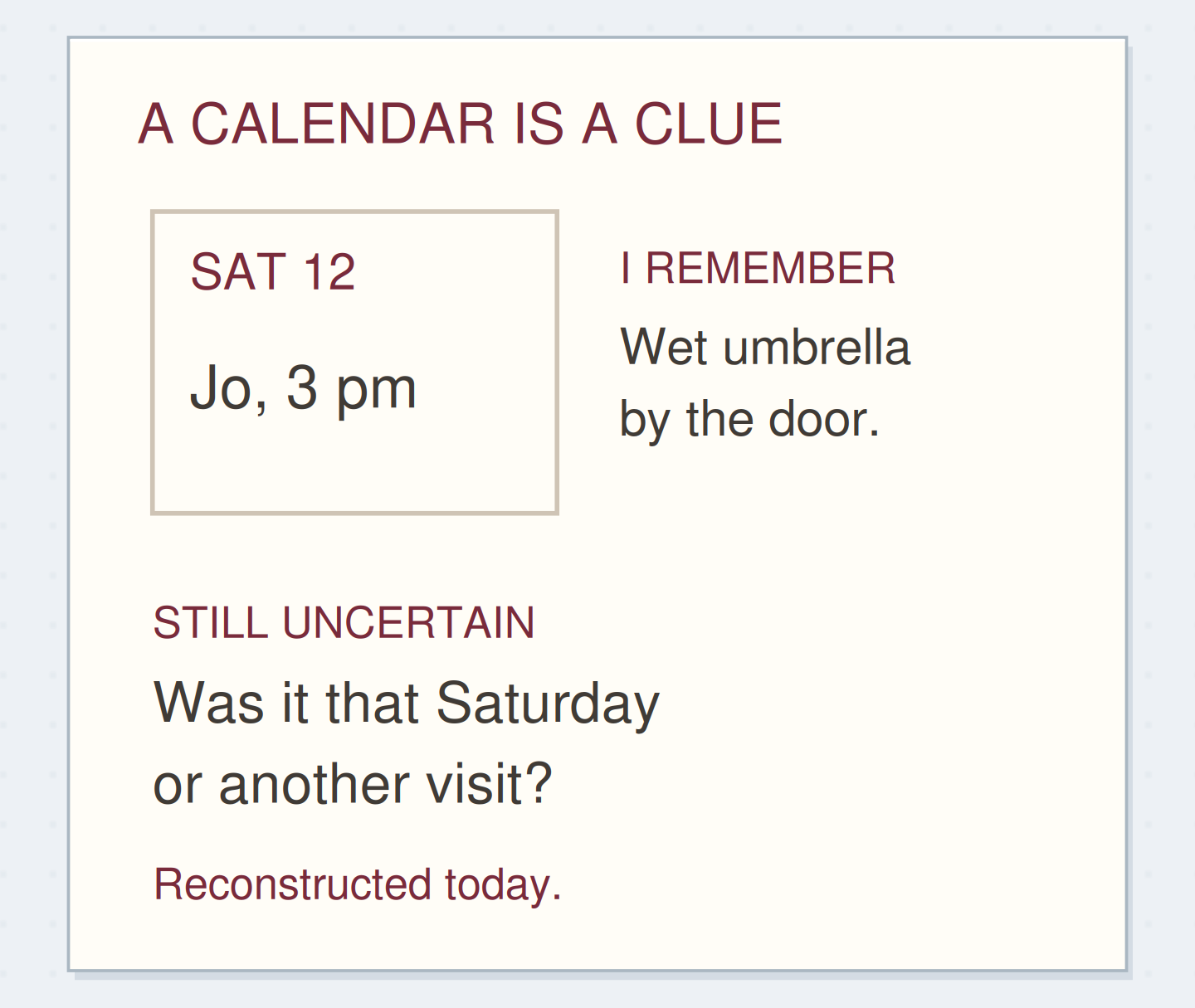
The calendar records “Jo, 3 pm” on Saturday 12.
This may be a plan; the page does not yet confirm the meeting.
“The memory rescue is complete when the source clue, remembered scene, and remaining uncertainty are clearly separated.”
Follow “Jo, 3 pm” carefully
An illustrative entry reads: Calendar says: “Jo, 3 pm,” Saturday 12th. I remember: Jo left a wet umbrella open beside the door; we moved the shoes and laughed at the puddle. Still uncertain: whether this was that Saturday or another visit in the same month.
The page can hold this memory without assigning it a false date. Give the scene a heading such as “Jo’s wet umbrella, probably this month.” If another reliable note later connects it to the 12th, add the source and the date you checked it.
Recover one scene with its limits
Edit the example into a record of your own. Leave out anything you do not know.
Calendar says:Saturday 12: Jo, 3 pm.
I remember:A wet umbrella beside the door; we moved the shoes.
Still uncertain:Whether it was that Saturday or another visit that month.
Your words have a place now.
A source clue can be useful without settling every detail.
- Words on this card
- 31
Write around one remembered action
Choose the clearest action and add only details you genuinely recall. Who moved the shoes? Where did the umbrella stand? What happened immediately afterward? A few lines can develop the scene. Avoid filling the room with plausible furniture or invented dialogue just because a longer paragraph looks more complete.
If no further memory arrives, keep the clue as a short record. “Lunch planned with Jo; no clear recollection now” is useful and honest. You do not need to make every calendar entry yield a story in order to justify keeping the calendar.
Let crossed-out plans remain plans
A cancelled appointment can produce a different memory from the event it names. You may remember the unexpected free afternoon, the phone call, or what you did instead. Write that scene separately and retain the cancellation in the copied calendar line.
If you cannot tell whether a crossed-out entry was cancelled, moved, or merely completed, label the mark as unexplained. Do not choose the most interesting interpretation. The rescue is to reduce the claim until it matches the evidence, not to make the old page tell a tidier story.
Let a cancelled plan stay cancelled
Move the reveal to see which information changes the record.
Before the revision
The written appointment and crossing-out do not explain themselves.
Leave a route back to the calendar
Record where the clue came from: notebook label, year, month, and page if available. A small copy of the relevant square can sit beside your new entry, but it is optional. Keep the new recording date visible so the memory is not mistaken for a contemporaneous diary entry.
If you ask someone else about the occasion, attribute their answer separately. They may supply a detail, confirm a date, or remember another visit entirely. You can retain several accounts without combining them into one authoritative reconstruction. The original calendar remains the starting clue.
Label the reconstruction before filing it
Move the checks ahead of the actions that depend on them. Other choices can stay flexible.
One workable order
- Identify the calendar and periodThe new note needs a route back to its clue.
- Separate source words and recollectionThe source should not appear to prove details it never recorded.
- Write the new recording dateA later reconstruction must not resemble a contemporary entry.
- Add the entry to your journalThe filed record should retain its source and limits.
Which check needs to come first?
The example shows one workable order. The first three checks can happen in any order; all belong before the record is treated as complete.
Stop after one honest recovery
The memory rescue is complete when the source clue, remembered scene, and remaining uncertainty are clearly separated.
Add a reference to a fuller entry if you made one, then put the calendar away. You can return to another month later. Recovering one real scene is enough for this session; the unfilled years do not become a backlog simply because you discovered a way into one of them.
Where this idea began
Want to follow the idea further? These community discussions and maker references are a good place to start.
- Restarting a journal and keeping calendar diaries
The author describes old paper calendars containing snippets of everyday life.
- Monthly Log
The discussion considers recording memorable events without forcing an entry into every date.
- Bullet Journal: Monthly Logs
The article shows monthly records that connect dated events with short notes about notable moments.