Gather a few things See what you’ll need
- A notebook
- A pen
- An optional photo or quick sketch
Watch one ordinary interaction
Choose a moment you have just seen: greeting you at the door, claiming a sunny patch, investigating a bag, or settling down beside a familiar person. Write what happened before deciding what it meant. Small actions provide more reliable material than a sweeping description of your pet’s personality.
You can record a repeated habit, but give it one particular occasion. “Always steals my seat” becomes “Tuesday: waited beside the chair until I stood up, then climbed in.” The dated instance makes the routine easier to imagine and leaves room for it to change.
Set up an observation and an aside
Write the date, pet’s name, and location. Below, make two short blocks: What I saw and My caption. The first is a plain observation. The second can be playful, affectionate, or simply a note about why you wanted to keep it. This separation lets your own voice stay visible without confusing it with evidence.
A photo is optional. A small outline of the blanket or toy can do the same identifying job, and words alone are enough. If you include a print, reserve the writing space before attaching it so the observation does not end up reduced to a tiny label.
Separate the action from your playful caption
Both can belong on the page when their roles stay clear.
A paw on the last corner is something you observed.
The shapes represent the blanket and corner, not a staged animal photograph.
“The page is finished when the action, setting, and your own response are easy to tell apart.”
Keep the final corner of the blanket
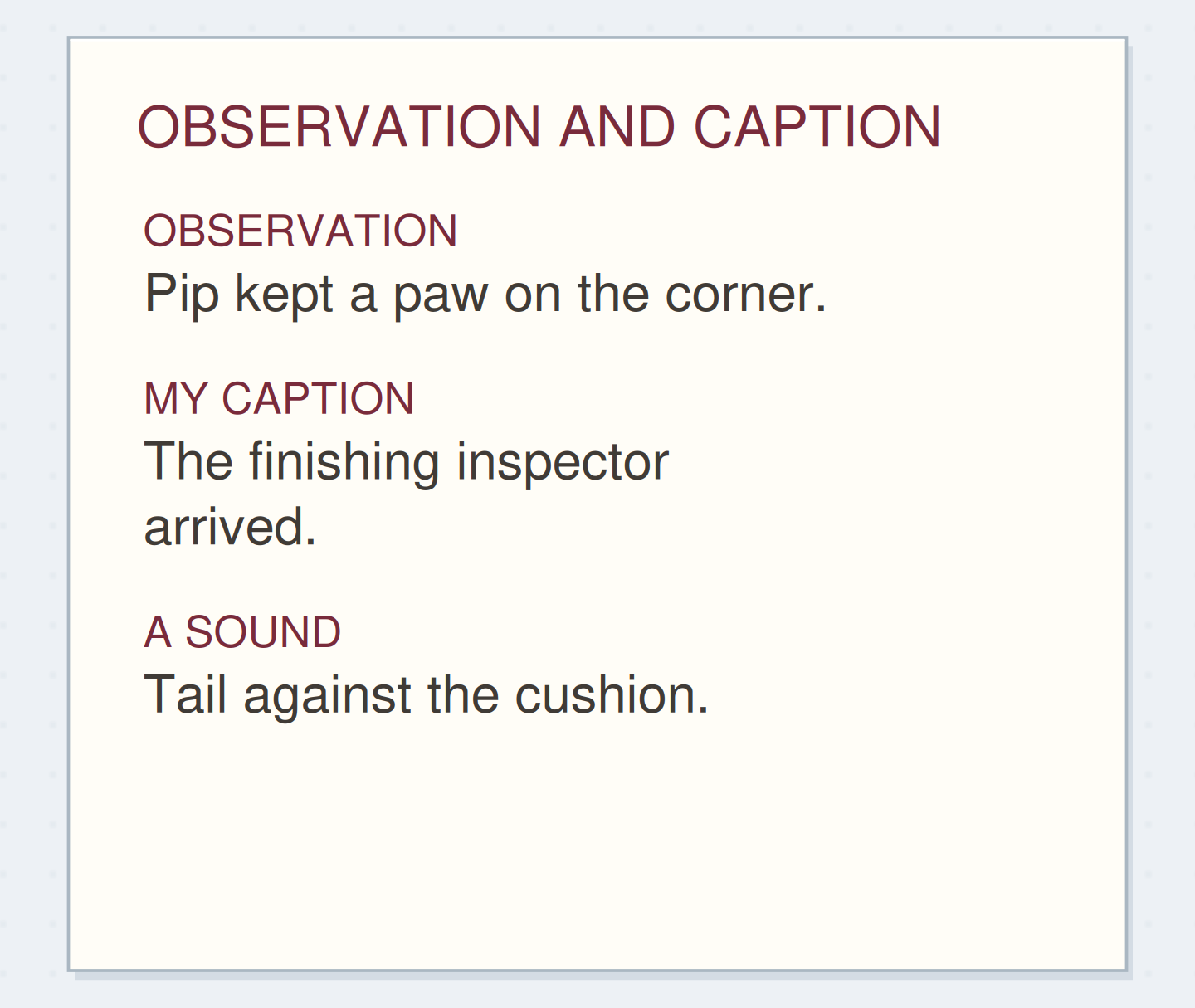
Here is a fictional record: 14 October, Pip, living-room sofa. What I saw: I folded the blue blanket twice; Pip put one paw on the remaining corner and stayed there while I tucked the edge under. My caption: apparently the finishing inspector needs a seat.
The joke belongs in your caption. It does not claim to know Pip’s intention. Add one detail that could be missed in the photograph, such as the quiet thump of the tail against the cushion. You now have a complete little scene without an invented story about what the animal was thinking.
Write one pet scene
Edit the example into a record of your own. Leave out anything you do not know.
What I saw:Pip put a paw on the blanket’s last corner.
Where and when:Living-room sofa, 14 October.
My caption:The finishing inspector needs a seat.
Your words have a place now.
A pet-memory entry can be playful without presenting inference as fact.
- Words on this card
- 27
Follow a habit without scoring it
If the same object or routine keeps returning, give it a page heading and add occasional dated notes. A toy may move from the basket to the doorstep, or a favorite resting place may shift as the room changes. Record the occasions you notice; you do not need daily checkboxes.
Keep absence distinct from a negative result. An empty week means you made no memory entry, not that the behavior stopped. If you need reliable observations for a practical care question, make a separate factual record suited to that question rather than using a casual memory page as evidence.
When the photo missed the moment
A blurred photograph can still anchor a scene, but it does not need to carry the whole page. Write the action in one clear sentence and label the image as a glimpse. You can also draw the object involved or keep only the words. There is no requirement to reproduce the moment visually.
If the story is old, mark what you remember and what you are unsure about. “At the old kitchen door, probably the first winter” is a useful setting. Avoid inventing exact dates, dialogue from people nearby, or details of the room merely to make the entry more complete.
Let words carry a missed photograph
Move the reveal to see which information changes the record.
Before the revision
A poor picture does not need to be recreated.
Add another person’s observation
Someone else in the household may notice a different habit. Invite one short contribution and date it. Keep their wording attributed, especially if they remember the event differently. A page with two observations can show how a pet fits into more than one person’s day.
For a long-running notebook, a simple index under the pet’s name and a few recurring objects is enough. Link a meal scene or visitor entry when the animal was part of that story. Avoid copying every event into a separate pet volume unless that duplication is something you enjoy.
Choose a useful second record
Try the form that matches the evidence or space you have.
A household member may notice something different.
Attribute the added observation.
Keep the scene small
The page is finished when the action, setting, and your own response are easy to tell apart.
Stop after one scene or a short cluster of related observations. The notebook does not need to record every stage of your pet’s life to contain something worth keeping. A paw on a blanket, described while you still remember how it looked, can be a complete entry on its own.
Where this idea began
Want to follow the idea further? These community discussions and maker references are a good place to start.
- A bullet journal for a dog
The author explains wanting to retain shared pet memories, alongside separate practical records.
- Dad’s Family Journals
The author records events, outings, and ordinary family days across several notebooks.