Gather a few things See what you’ll need
- A notebook or loose sheet
- A pen
- A pencil for rough notes
Choose a period with its own sound
Pick one journey, a month in a particular home, a project, or a season of commuting. Give the page that period as its title. A small selection of three to five tracks is easier to explain than every song you happened to hear. You can include a track because it irritated you or surprised you, not only because you loved it.
Write the artist and track title as accurately as you can check them. If the version matters, note live, acoustic, or the album name. Leave an uncertain identification labelled rather than guessing at the artist from a half-remembered chorus.
Give each track a scene line
Make one row for the music and one for the memory. The first can hold title, artist, and approximate date. The second answers: where did this track meet your life? Keep the caption in your own words. You do not need to copy lyrics to show why a song mattered.
Leave enough room for one specific action or circumstance. “Reminds me of summer” is a start; “played while we carried the table down three flights” identifies a scene. A little line between entries will do more for readability than miniature album covers squeezed into the margins.
Give the track a place in your life
The fictional title becomes a memory through the circumstances around it.
A title and artist identify music, not yet a personal occasion.
Use checked metadata for your own real track.
“The page is finished when each chosen track has a reason to be beside the others.”
Try a moving-day soundtrack
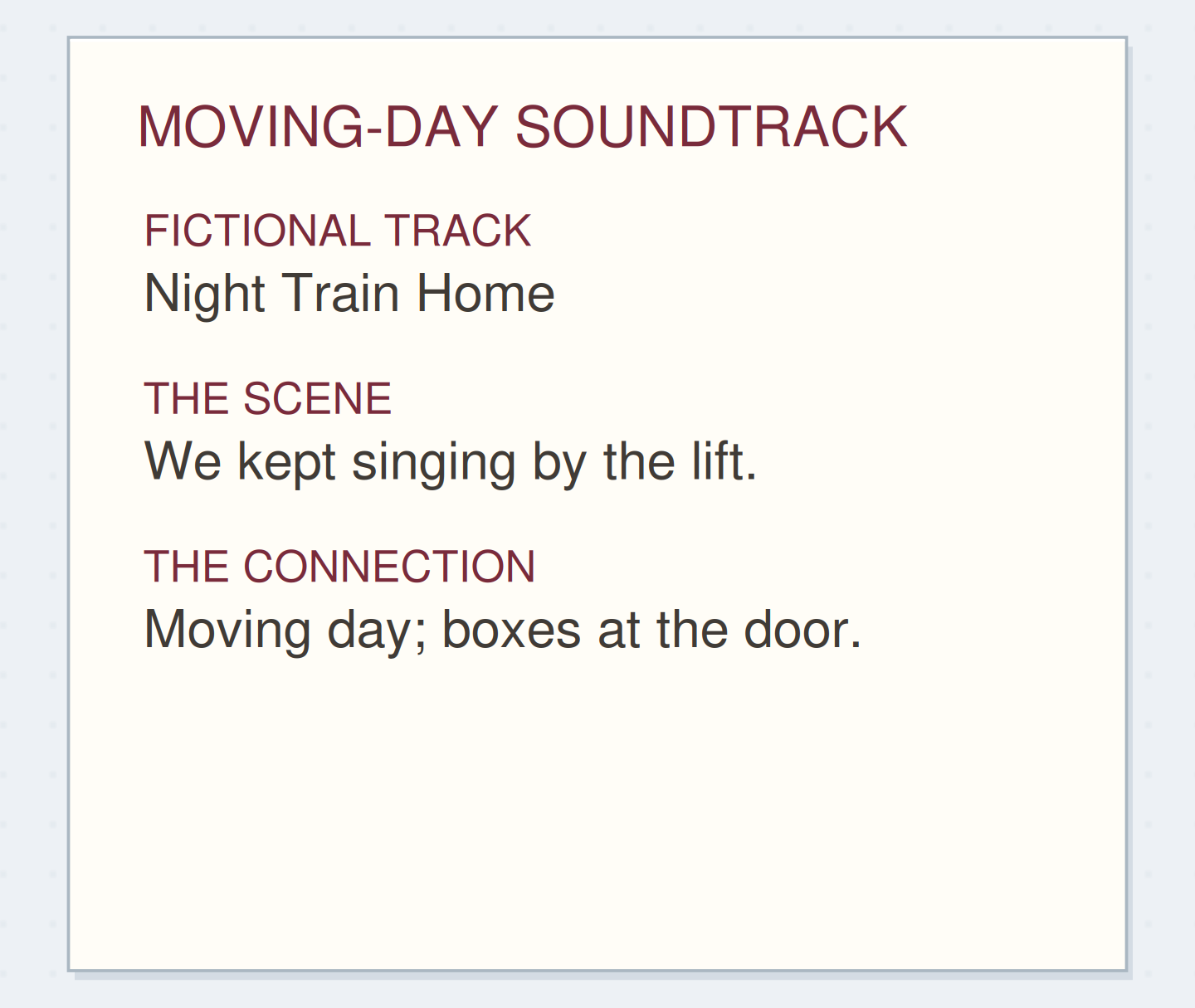
Use this fictional example rather than real song metadata: “Night Train Home” by The Window Seats. Period: the Saturday we moved. Scene: the portable speaker kept stopping when someone carried it too far from the doorway. Connection: we sang the tune while waiting for the lift, even after the music cut out.
A second fictional track could hold the quiet evening after the boxes were inside. The contrast creates a small sequence: carrying, waiting, settling. You can order the tracks as the day unfolded instead of reproducing the sequence of a streaming service’s list.
Write a track’s memory caption
Edit the example into a record of your own. Leave out anything you do not know.
Track and artist:Night Train Home, The Window Seats (fictional example)
The scene:The speaker cut out while we waited for the lift.
Why it belongs here:We kept singing between trips with the boxes.
Your words have a place now.
Replace the fictional metadata with a real track you know.
- Words on this card
- 35
Separate association from song meaning
Write what the music means in your memory, without assuming it is what the songwriter intended. A cheerful song can be tied to a difficult move; a sad song can belong to a funny car journey. The caption records your association and does not need to explain or defend the mismatch.
If a companion chose the track, add that fact. “Ana put this on while we cooked” tells a different story from “I listened alone on the bus.” A note about the room, people, or repeat button can be more useful than a review of the music itself.
Keep the scene when the title is missing
You may remember the event and not the track. Write “unidentified song on the café radio” and keep the scene anyway. Add what you genuinely recall about the sound in plain words, such as a solo trumpet or a repeated piano figure. Avoid presenting a guessed lyric as an accurate quotation.
If you later identify the song, date the addition and explain how you checked it. If you cannot, the page still preserves a real encounter with music. You can also leave a gap in a playlist rather than filling it with a track that only seems like the right one.
Keep a real scene without a guessed title
Move the reveal to see which information changes the record.
Before the revision
A guessed title may attach the scene to the wrong music.
Make the page understandable without playback
A link or playlist name can be a useful extra, but keep the basic identifying words on paper. Write where the list lived when you made the entry if that will help you find it. The memory caption should still make sense when the audio is unavailable.
If you return later and the track brings up a new association, add a dated after-note. Do not replace the older caption simply because the song now belongs to another chapter. Two different rooms attached to the same music can be part of the page’s interest.
Choose what makes the record readable later
Try the form that matches the evidence or space you have.
The title and artist remain when a link fails.
Write enough metadata to distinguish the version.
End with a few clear connections
The page is finished when each chosen track has a reason to be beside the others.
Check the names, keep the date range, and read the captions without playing anything. If they still evoke the period, you have made a useful paper record. Stop before selecting another dozen songs just to fill the spread. A short soundtrack with real scenes can hold more than a long list of titles.
Where this idea began
Want to follow the idea further? These community discussions and maker references are a good place to start.
- What do you keep besides a journal?
A participant describes annual playlists assembled from music meaningful during the year.
- Ali Edwards: Listen storytelling prompts
The creator invites stories about music, voices, and the ordinary sounds of life.