Gather a few things See what you’ll need
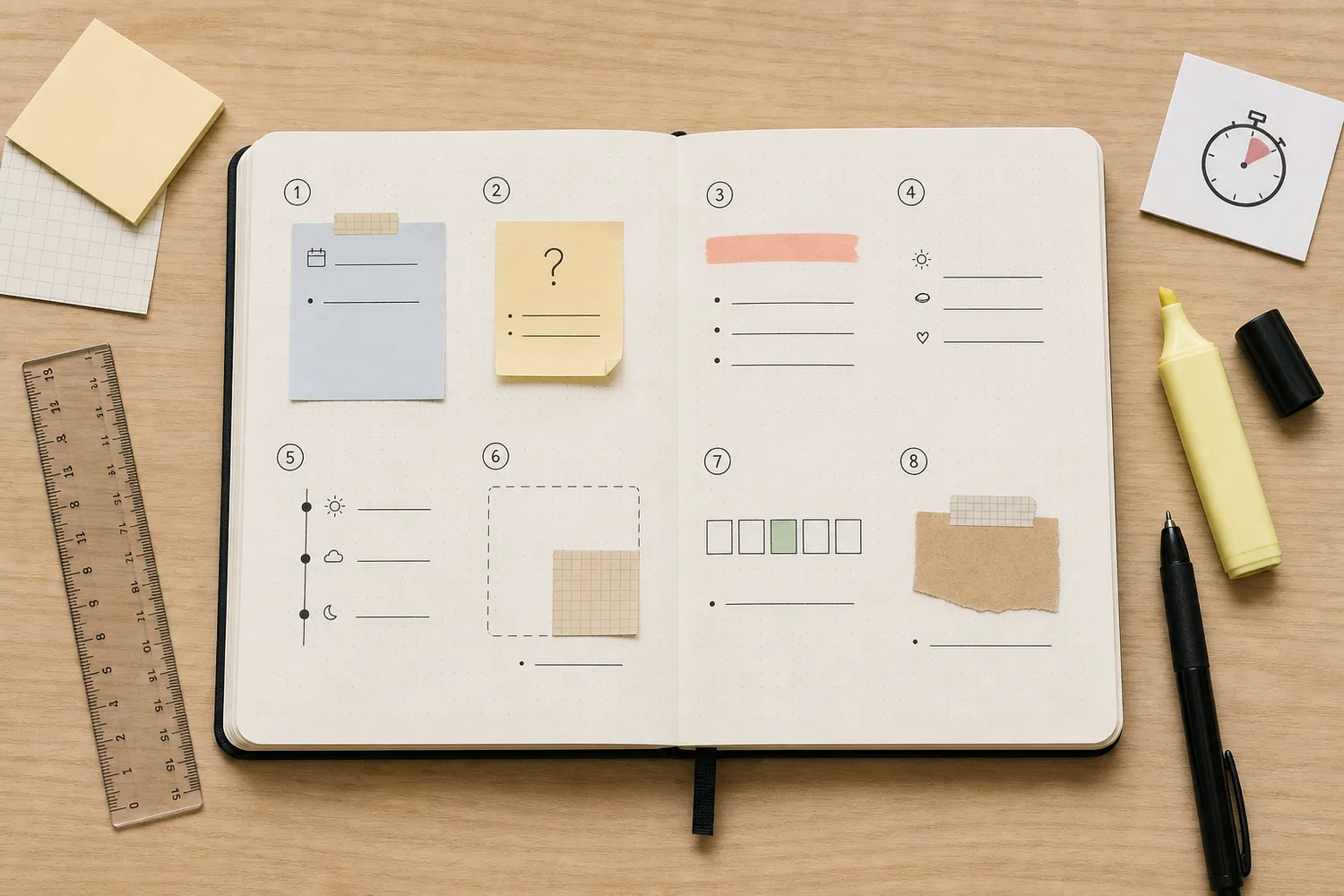
- Journal and pen
- Optional memo card
- Optional duplicate photo print
- Optional tested highlighter
Choose an exercise 4 things to try as you read
Start with three symbols you can remember
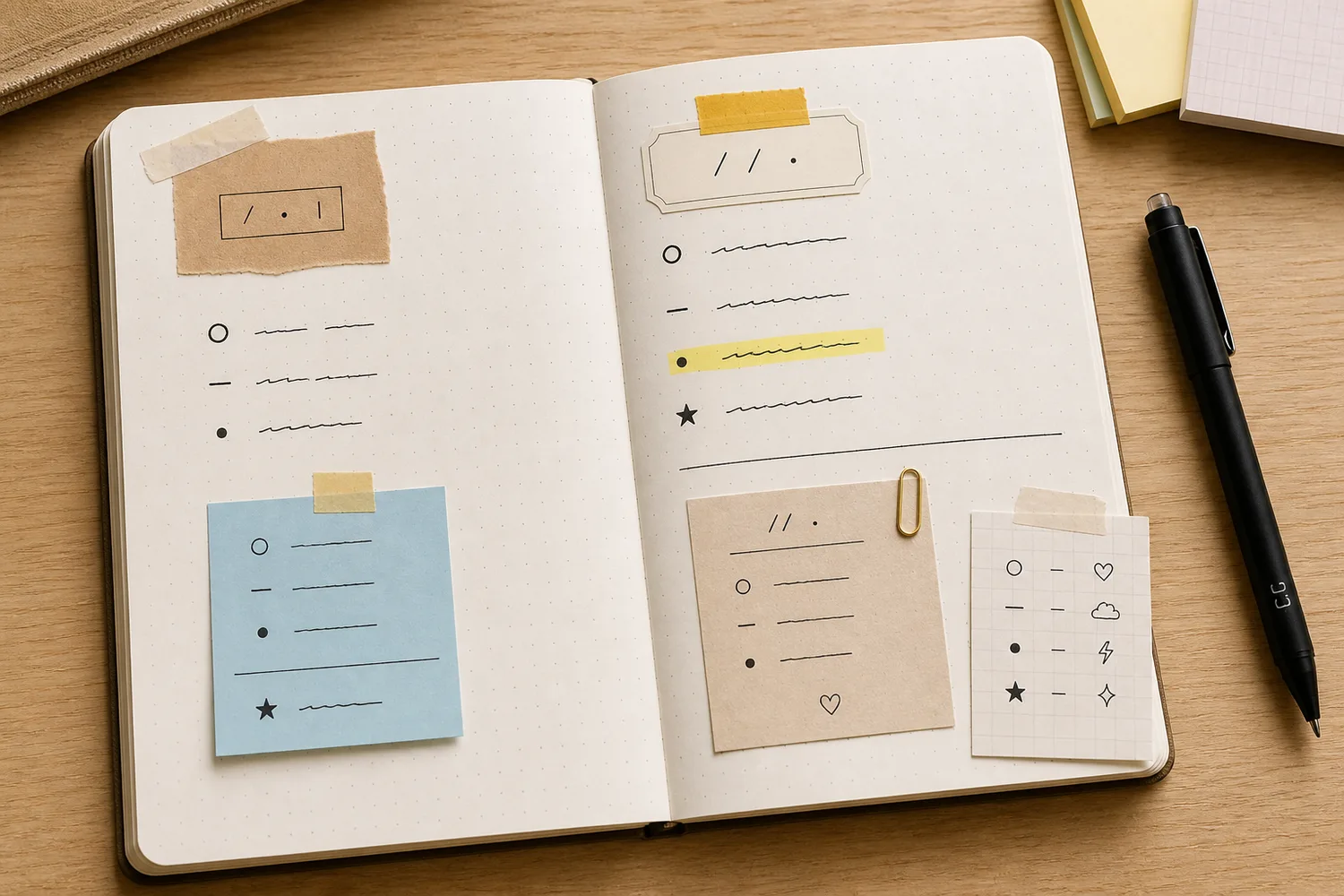
In the Bullet Journal method, an open circle, ○, marks an event; a dash, –, marks a note or observation; and a dot, •, marks a task. When you finish a task, turn its dot into an X. These marks let you tell 'went to the market' from 'go to the market' without adding an explanation to every line.
The method also uses an asterisk beside a task to show priority. We'll keep that meaning here and use a bracket or highlight for a memory you want to notice. If you already have a personal key that works, you can keep it. The important thing is that you'll understand your own page when you return.
Compare the optionsChoose the role of the line before its mark
Choose the role of the line before its mark
Compare three meanings the same market trip might have.
Read the words in this example
- Event
- market visit
Use the event role for the visit itself.
A market visit that already happened is an event. In the article’s Bullet Journal key, it receives the open-circle event mark. Add the date and a concrete detail if you want a memory record; it does not need to become a task to count.
ONE WORKED EXAMPLE
One market trip, two different jobs
You are logging a morning trip to the market and planning to send your sister a photograph of the flowers you found there before the weekend.
Before
Both lines have task dots, so the already completed outing looks unfinished and the photograph request gets lost among memories.
After
The page reads “○ Market before nine — yellow tulips at the last stall” and “• Send Jo the tulip photo.” After sending it, the second mark becomes X while the event circle stays unchanged.
What changed—and what to check
The event remains a record; the task mark carries completion status. You can review unfinished actions without reinterpreting every sentence.
Try this check. Point to the line that still needs action, then check that its symbol changes only when that action is complete.
One thing that happened, or one thing you noticed
An event line records something that happened: “○ We had lunch on the steps — the stone was still warm.” One concrete detail is enough. Date it and leave room below if the moment later becomes a longer story.
A note records an observation: “– The room felt quieter with the big light off.” It can sit beside the event without becoming another task to finish. Choose the mark for what the sentence means now.
Write your versionLet one event keep one concrete detail
Let one event keep one concrete detail
Name what happened, then keep the detail that brings its scene back.
Event:We ate lunch on the steps.
Note:The warm stone held the heat after the sun moved.
Your words have a place now.
The filled card is a sample. Replace any part with your own words; leave a field empty if it does not help.
- Words on this card
- 18
Keep an ordinary action, or three pieces of the day
A task memory begins with something you actually did. Once you've crossed its task dot into an X, add a brief detail: 'X watered the basil — smelled wonderful afterward.' This keeps the action readable while remembering a little more than its completion. You can use the same idea for folded laundry, a finished email, or finally clearing the table.
A three-bullet day brings an event, a note, and a completed task together. For example: '○ Ate outside,' '– The evening stayed warm,' and 'X called Dad — talked longer than planned.' Write the date above, keep the symbols in one column, and leave a small gap between lines. If you only have two entries, keep two; there isn't a missing third answer to supply.
Write your versionAdd a memory beside a completed action
Add a memory beside a completed action
Keep the completed task clear, then add what happened around or after it.
Finished:Watered the basil.
I noticed:My hands smelled green for the rest of the afternoon.
Your words have a place now.
The filled card is a sample. Replace any part with your own words; leave a field empty if it does not help.
- Words on this card
- 16
Something to do, or a little card to keep
Put an asterisk beside the dot of a task that needs priority: “* • send the photos.” When it is finished, change the dot to X and leave the asterisk beside it. Use a bracket or highlight for a memory you want to find, so priority keeps its task meaning.
A memo can hold the same system: date, two or three entries, and perhaps a mood word. Attach it later if useful. The smaller space is an option for the page, not a reason to leave out a necessary detail.
GO A LITTLE FURTHERHelp one line say a little more
Help one line say a little more
An emotion symbol is your own addition, separate from the core Bullet Journal key. You might use a small heart for tenderness or a cloud for heaviness. Define the meaning in a little legend, then add it beside a line only when that feeling matters. A friendly-looking event can carry a difficult feeling; the extra mark can remind you of that without explaining it at length.
A highlighted log starts with the writing. Once the notes are down, choose the line you'd like to find first next time and highlight only that one. Let the pen ink dry and use a combination you've tested on this paper. If it smears, use a bracket in the margin instead. You don't need to highlight the date, every bullet, and the mood word as well.
Try a what-ifHow can the memory stand out clearly?
How can the memory stand out clearly?
A priority task and a favorite memory need different kinds of emphasis.
You want to remember a favorite sentence without changing the Bullet Journal key. An asterisk already marks your priority task on the same page.
Compare the three choices
How can the memory stand out clearly?
- Add an asterisk beside the memory
That would give the same mark two jobs here, making later task review less clear.
- Turn its note dash into an X
An X means a completed task in this key; the memory has not become a task.
- Bracket the sentence in the margin
A bracket can provide visual emphasis while the event, note, and task marks keep their stated meanings.
Keep status marks and visual emphasis separate when you want to scan actions later.
What would you try?
Choose an option to see what it would do. You can explore all three.
Let the short lines look like short lines
Align the symbols down one left edge and leave enough space to distinguish the entries. A small group beside a photograph can hold two lines comfortably; it does not need more writing to earn its place.
When a bullet grows into a story, put a page reference beside it and continue elsewhere. On your next return, use the mark to tell whether the line asks for action or simply keeps a memory.
Something for a future page?
The Washi Tape ShopAffiliate links: we may earn a commission if you buy through these links.
Where this idea began
Ryder Carroll describes abandoning a diary when inconsistency felt like failure, then returning to long-form writing only when a Rapid Logged note needs more attention. His Bullet Journal guides supply the task, event, note, completion, priority, and plus-sign meanings used here.
Want to explore the techniques a little further? Here are the maker tutorials and references behind this guide.
- Method referenceRyder Carroll: How to Long-Form Journal in Your Bullet Journal
Ryder Carroll’s account connects a brief logged note with optional longer reflection.
- Method referenceBullet Journal: what rapid logging, bullets, and signifiers mean in the official method
Official meanings for tasks, events, notes, status changes, and signifiers; decorative variants remain optional.
- Method referenceTiny Ray of Sunshine: rapid logging, bullets, and signifiers
Tiny Ray of Sunshine’s practitioner guide explains Bullet Journal notation with credit to the method.
- Design principleNielsen Norman Group: visual hierarchy and guiding the eye
Visual hierarchy supplies a background principle for clear focal content and supporting details.
- Design principleNielsen Norman Group: proximity and grouping
Proximity supplies the principle of grouping related content with smaller gaps.
- Design principleNielsen Norman Group: whitespace and scanability
Whitespace supplies a background principle for leaving readable space around content.