Gather a few things See what you’ll need
- A notebook
- A pen
- A loose sheet or envelope
- A place to note the opening date
Choose the reader and return date
Write who the page is for: you after a move, your household next New Year, or yourself on an ordinary date six months away. Choose a return date you can understand immediately. “Open after the exam results arrive” works if you also name the exam and the year.
The National Archives of Australia’s time-capsule guidance asks people to consider audience, message, location, and opening date. Borrow that planning habit on a smaller scale. This is a personal notebook exercise, not a preservation guarantee for a sealed container or buried collection.
Write what the future reader will not know
Reserve the upper half of the page for the present. Describe the room, one repeated routine, a person you see often, and something currently unfinished. Use facts you can observe. The future reader may appreciate the squeaking chair more than a carefully written statement about who you hope to become.
Below, write a short letter. Explain what you are curious about rather than issuing demands. “Did we ever hang the kitchen print?” invites a reply. “You must have transformed your life by now” can make the later page feel like an exam you never agreed to take.
Follow a capsule from writing to reply
The return date connects two honest views of ordinary life.
The first page names the room and an open question.
A question can concern a small routine rather than an achievement.
“The capsule is complete when the dated message and its later reply can be read together.”
Build a six-month example
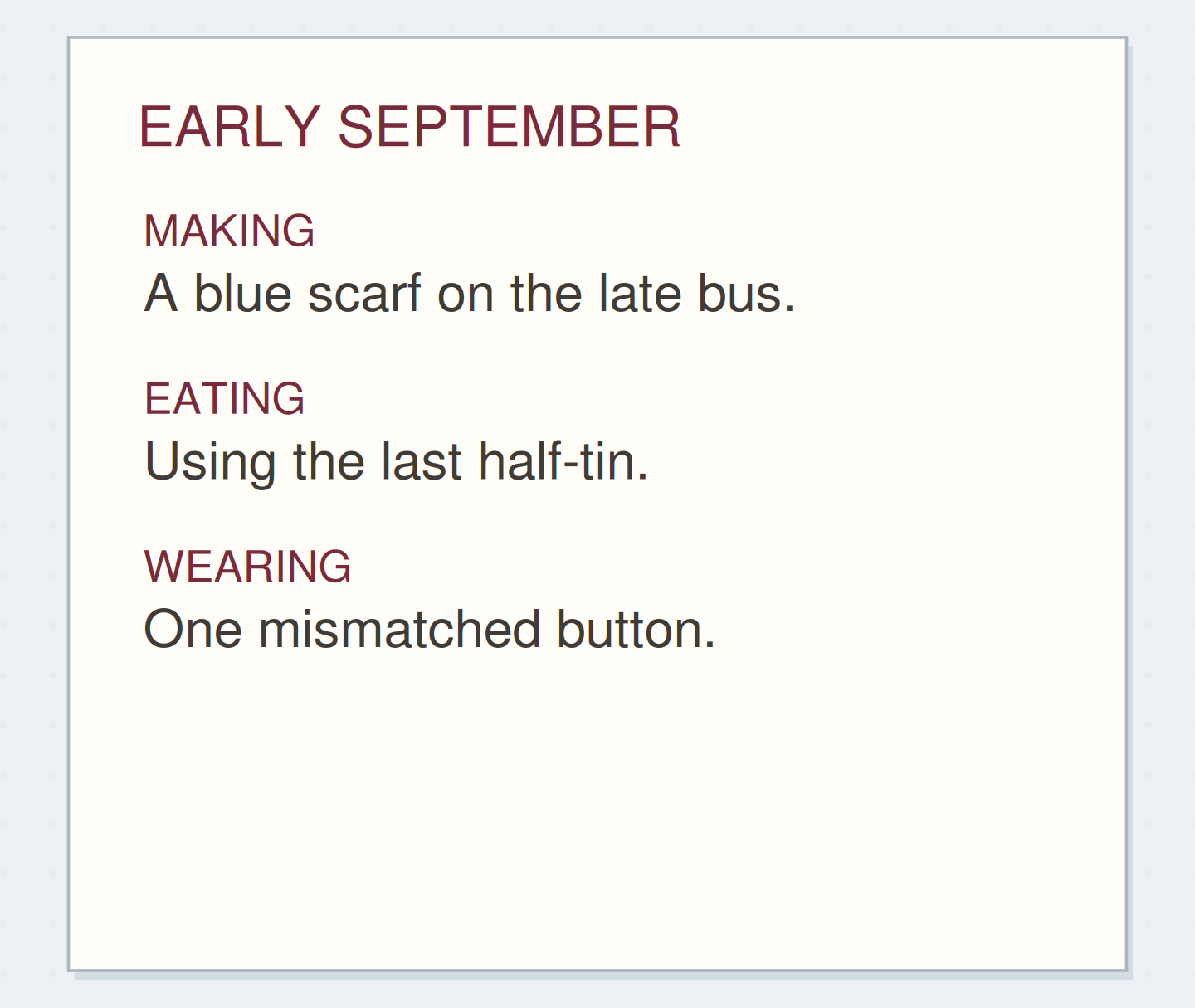
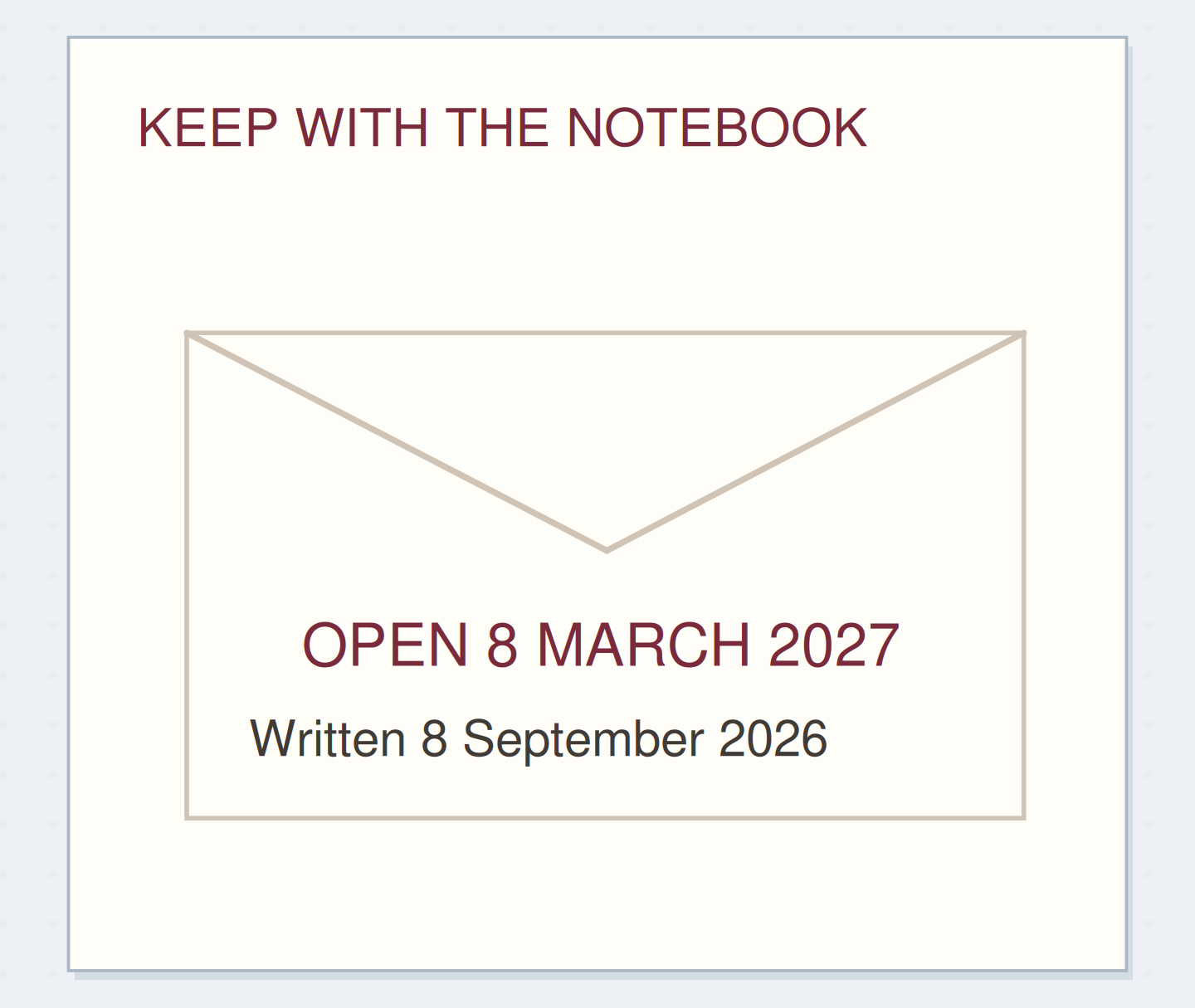
Try this fictional capsule: Dated 8 September 2026. Open 8 March 2027. Present: the plant sits on a stack of cookbooks; the blue chair squeaks; Thursday dinners are usually eggs. Letter: “I’m wondering whether this room will still be ours. Have we found a place for the print? I hope you remember the evening we ate by the window.”
Finish the inside with one question you can answer later. The question need not concern an achievement. “What became ordinary after this?” can reveal changes that a list of goals would miss. Keep predictions labelled as predictions, separate from descriptions of what is happening now.
Write a small message for later
Edit the example into a record of your own. Leave out anything you do not know.
Present detail:The blue chair squeaks; Thursday dinners are eggs.
Question:Did we ever hang the kitchen print?
Return date:Open 8 March 2027.
Your words have a place now.
A capsule does not need a dramatic prediction.
- Words on this card
- 24
Give the capsule a simple home
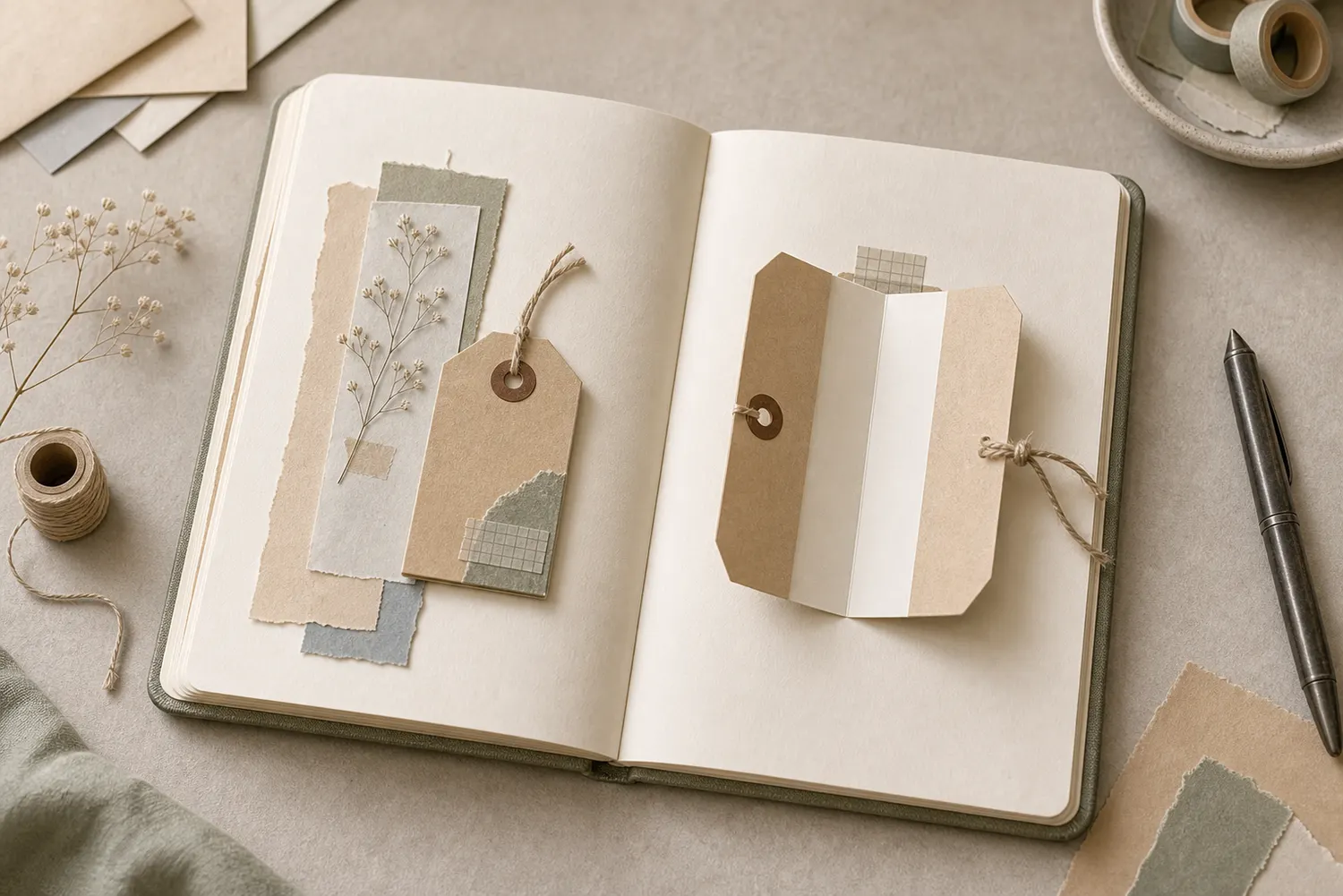
You can mark the page with a folded paper cover or place a loose letter in an envelope kept with the notebook. Write the opening date on the outside. If you use a cover, dry-fit it and check that the words remain accessible without tearing the page.
Keep this small paper record indoors in a stable, dry place with your other journals. Do not add food, damp plants, or bulky objects. A description or copy can stand for a keepsake. The point is to retain readable words, not to test whether an improvised container can survive weather.
If you miss the opening date
Open it when you find it and write the actual reading date. The delay becomes part of the story. You do not need to pretend you returned on schedule or restart the entire exercise. A capsule opened early can be labelled just as honestly.
If you dislike what you wrote, leave the original intact and respond on another page. You may feel differently now. A reply can simply say which details were accurate, which hopes changed, and which sentences you no longer recognize. Reflection is optional; a factual after-note is enough.
Let a late opening keep its real date
Move the reveal to see which information changes the record.
Before the revision
A planned date does not say when you actually read the letter.
Answer from the present you have reached
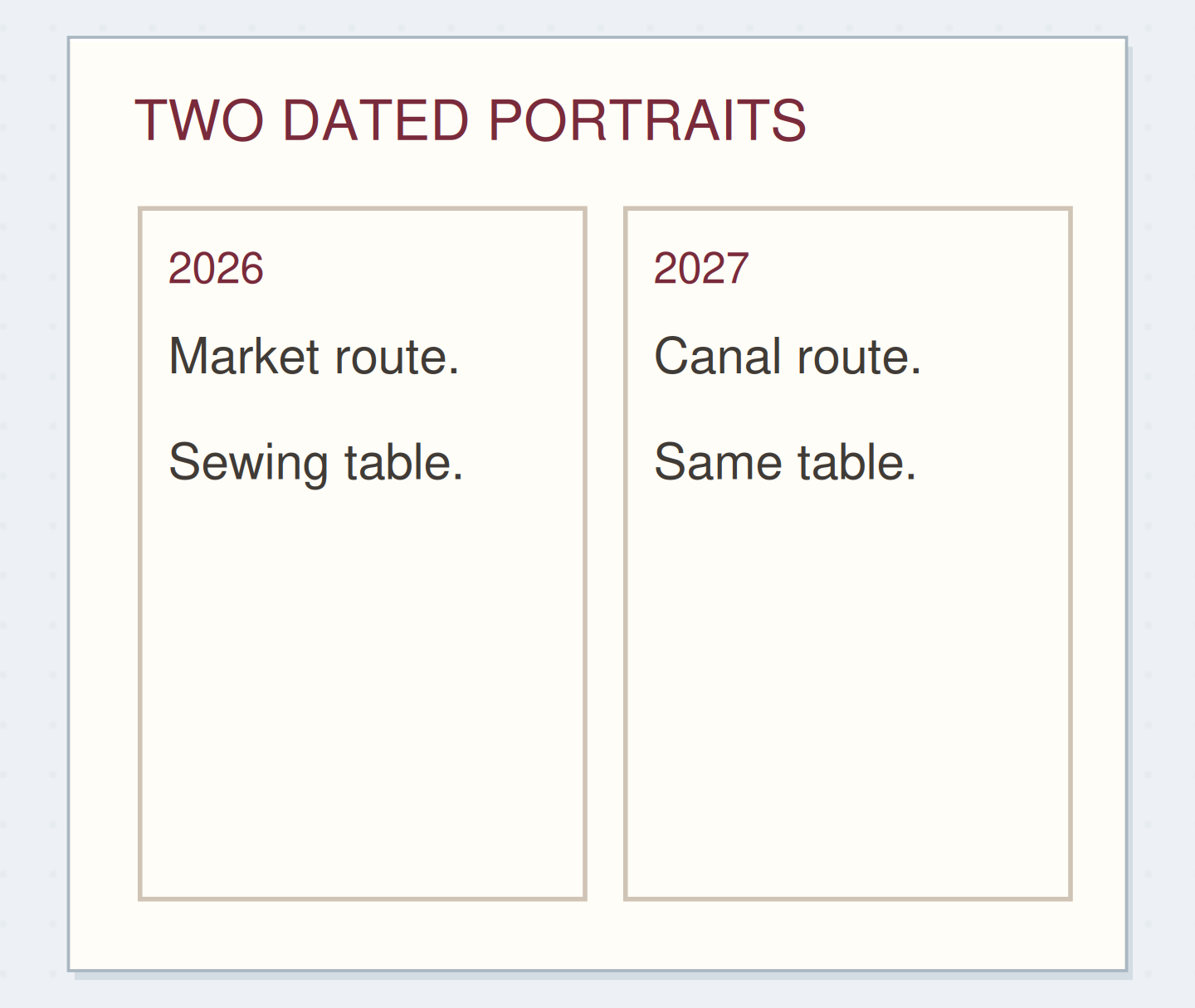
Read the original once before replying. Choose one detail that stayed and one that changed. In the example, the reply might be: “Still here. The print is finally above the table, but the chair went to Maya. Thursday eggs became Sunday pancakes.” Those specific changes do more than a broad statement about growth.
Date the reply and connect it to the first page. If you want another capsule, write it from today’s circumstances on fresh paper. Do not overwrite the old opening date or keep adding to the original until its time boundary disappears.
Read before replying
Move the checks ahead of the actions that depend on them. Other choices can stay flexible.
One workable order
- Read the original messageYour reply needs the actual words you wrote then.
- Write today’s dateThe new note needs its own time boundary.
- Add a separate replyKeeping it separate preserves the original viewpoint.
Which check needs to come first?
The example shows one workable order. Read before replying. You may date the new note before or after writing the reply.
Leave a readable pair
The capsule is complete when the dated message and its later reply can be read together.
An unanswered capsule can also remain a finished record of a particular moment. Keep the opening note somewhere you can find it, then return to the rest of your notebook. You have made one small bridge between two dates, not a permanent promise to document every future transition.
Where this idea began
Want to follow the idea further? These community discussions and maker references are a good place to start.
- Time capsule journal
The post describes journals closed at life transitions and opened on named future dates.
- National Archives of Australia: Creating a time capsule
The guidance stresses audience, storage location, opening date, and careful material selection.