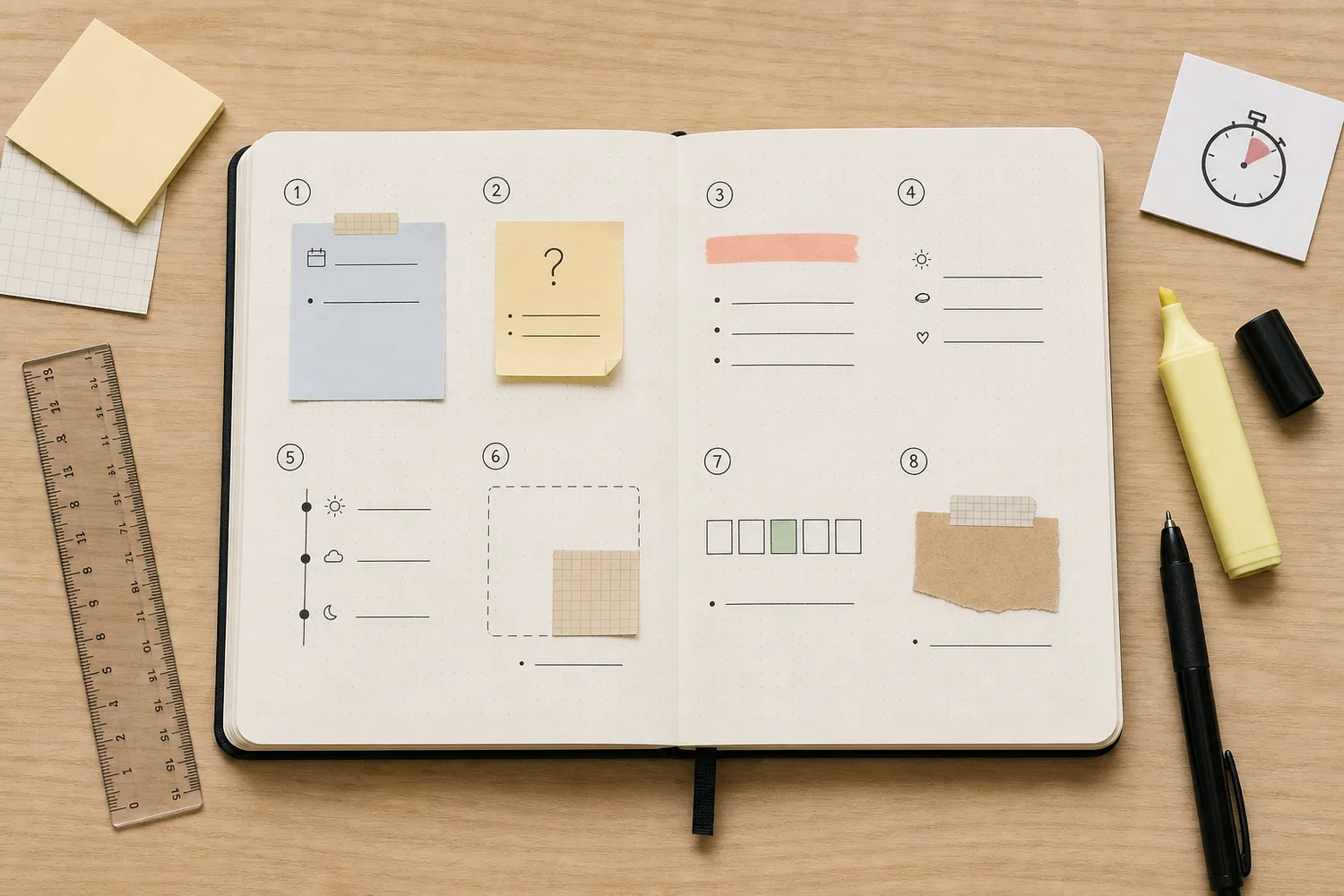
Gather a few things See what you’ll need
- One or two clean, dry paper scraps
- Journal and pen
- Scissors
- Small amount of paper adhesive or tape
- Optional memo card
Choose an exercise 4 things to try as you read
Keep the part you want to remember
Before you attach anything, check that the scrap is clean, dry, and flat. If it's greasy, smells of food, or has sticky residue, photograph the interesting bit or draw it instead. A whole packet is rarely necessary; one word or a small corner of color may bring back just as much.
Set the piece beside some empty writing space. What would you forget without a note: who was there, why you bought it, or what happened afterward? Keep that answer in the caption. Before attaching a receipt copy or label, check for an address or account detail you would rather leave off the page. Store important originals separately.
Compare the optionsChoose what form of the scrap belongs on paper
Choose what form of the scrap belongs on paper
Change the condition of the object and inspect a suitable way to keep its useful part.
Read the words in this example
- label
- context
Keep the small original piece with its context.
A clean, dry, flat label can sit beside a sentence about why it mattered. Keep only the useful portion so the object leaves room for the memory. If the original is important or difficult to replace, use a copy and store it separately.
ONE WORKED EXAMPLE
The blue from the bus stop
A clean paper wrapper matches the blue shelter where you waited with a friend. You want to keep that ordinary detail on a small memo.
Before
The whole wrapper fills the memo and makes its branding more noticeable than the memory you want to write beside it.
After
A small blue rectangle sits at the memo’s edge. The caption reads, “Bus-stop blue. We waited through two showers and finished the crossword.” The date is written below, with enough plain paper around the sentence to read it easily.
What changed—and what to check
Keeping the color rather than the whole wrapper leaves room for what happened there. The caption makes this particular blue worth returning to.
Try this check. Cover the brand name on the leftover wrapper and check that the memory still makes sense.
A receipt line or a color you couldn't throw away
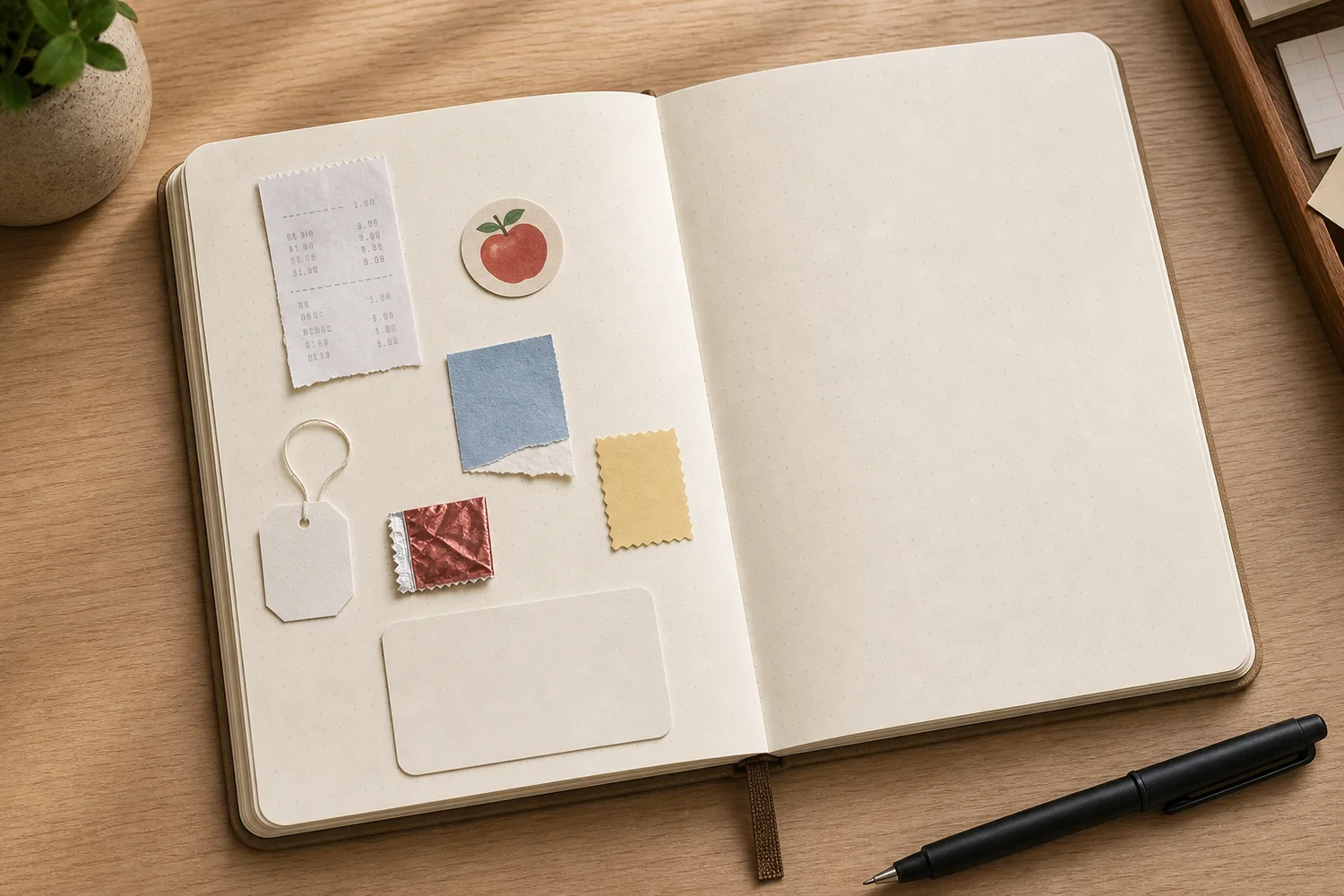
For a receipt memory strip, find the part worth keeping: the place, date, one item, or a funny word. Make a copy or transcribe it before attaching it, since thermal receipt printing can fade or darken. Trim the copy into a narrow strip and write beside it. 'Bought the extra bun for the walk home' says more than the total alone.
For a packaging color chip, cut a small square or rectangle from a clean wrapper, envelope, or paper bag. Put it on the page like a paint swatch and give it a name from your day: 'the blue at the bus stop' or 'peach juice yellow.' Add a sentence about why you noticed it. The color can matter even when the brand doesn't.
Write your versionKeep what the receipt’s total leaves out
Keep what the receipt’s total leaves out
Use one printed clue, then add the action or reason that makes it yours.
Printed clue:One extra bun, Market Bakery
We bought it to share on the walk home.
Your words have a place now.
The filled card is a sample. Replace any part with your own words; leave a field empty if it does not help.
- Words on this card
- 16
Keep a small part of what you ate or drank
A fruit sticker makes a tiny food entry. Place a clean sticker on a memo or directly on the page, then add what you ate, where, who was there, and one detail. 'Pear / desk / afternoon call / still a little crunchy' is enough. If the sticker has lost its hold, use a tiny tape tab or a little suitable adhesive; a drawn frame won't physically hold it down.
A tea-tag note records a pause. Let the tag and string dry completely, then attach the tag or secure the clean string with a small piece of tape. Write the time, weather, and one thought nearby. You might keep '4:10 / rain / let the phone ring.' Curve the string toward the words if you like, keeping it flat enough that it won't snag when you turn the page.
GO A LITTLE FURTHERBorrow a date or a word
Borrow a date or a word
A calendar tear-off can become the date at the top of the page. Cut the number from an old calendar or another replaceable scrap, paste it down, and add the month and year you mean. The printed number supplies the shape; your handwriting gives it an unambiguous date. Leave room for two short memories beneath it.
A found-word title starts with a word on packaging or junk mail. Cut out 'fresh,' 'home,' 'sweet,' or any word that makes you think of something from the day. Paste it above a few lines of your own handwriting. 'Fresh' could introduce newly washed sheets; 'sweet' might mean the text you received during a difficult morning. You're free to take the word somewhere the packaging never intended.
Write your versionLet a found word take on your own meaning
Let a found word take on your own meaning
Replace the packaging word, then connect it to a specific part of the day.
Fresh
Today, this means:The sheets dried in the wind and smelled of the garden.
Your words have a place now.
The filled card is a sample. Replace any part with your own words; leave a field empty if it does not help.
- Words on this card
- 15
A few scraps together, or one with its own little card
For a desk-paper cluster, choose two or three pieces that remind you of different parts of the same day. Put the largest, quietest paper down first. Overlap it with a smaller color piece, then add the little sticker, word, or receipt copy you want to notice first. Keep one edge roughly aligned and write why the pieces belong together. If they need three unrelated stories, give them separate pages.
An everyday archive card gives a very ordinary scrap its own place. Attach it to a memo, add the date, and complete 'found at' and 'kept because.' You can number the cards if you'd enjoy collecting them: No. 01, No. 02, and so on. A grocery label with 'kept because he chose dinner' already has a reason to stay.
Try a what-ifThe useful scrap includes a private detail
The useful scrap includes a private detail
Choose what the page actually needs to keep.
A receipt has the café name and date you want, plus an account reference. The page may be shown to friends.
Compare the three choices
Which preparation fits this memory page?
- Fold the account reference under before attaching the receipt
The detail remains on the page and could become visible if the fold opens. A selective copy gives a clearer boundary.
- Cover the reference with a translucent scrap
The layer may soften the print but still leave it readable. Check opacity on a copy if you choose a covering method.
- Make a copy that keeps the café and date but omits the account reference
You keep the memory cues and choose what is visible. Keep the original elsewhere if it serves another purpose.
Keep the memory cue; leave unrelated private information off a shared craft page.
What would you try?
Choose an option to see what it would do. You can explore all three.
Choose the scrap with the clearest sentence
If the page looks overwhelmed by packaging, trim the loose pieces smaller before attaching them. Keep the word or color you actually like. If you've already pasted a loud piece, place a plain writing card partly over it and let just a little show. Make sure the journal can still close comfortably.
Try finishing “I kept this because…” for each loose scrap. If two pieces lead to the same sentence, choose the one that carries the clearest detail and save the writing space. Date the caption before putting the page away. You do not need to store the whole packet to keep the afternoon.
A little tape for your next page?
The Washi Tape ShopAffiliate links: we may earn a commission if you buy through these links.
Where this idea began
Storm Dolfi describes collecting everyday receipts, stickers, junk mail, and fabric scraps, then using the journals for memories and design research. The receipt sources support copying unstable thermal print; the remaining references informed small clusters and hierarchy.
Want to explore the techniques a little further? Here are the maker tutorials and references behind this guide.
- Maker exampleStorm Dolfi: Collage and Junk Journaling
Storm Dolfi’s everyday-paper journals supply the named memory and design-research example.
- Material careNational Archives: unstable thermal paper, fading, darkening, copying, and reformatting
Paper-preservation guidance informs copying unstable thermal information before creative use.
- Material careThe National Archives: thermal paper guidance
Thermal-paper preservation guidance supports making a more stable copy of information that may fade.
- Creative contextAli Edwards: simplifying memory keeping instead of overcomplicating it
Ali Edwards’s simpler memory-keeping approach informs reducing decorative decisions.
- Design principleGet It Scrapped: visual hierarchy and repeated details in scrapbook clusters
Visual hierarchy and repeated details explain relationships within a scrapbook cluster.
- Construction referenceAllison Davis: practical cluster building with varied sizes and textures
Allison Davis’s cluster-building tips inform combining varied sizes and textures.