Gather a few things See what you’ll need
- A journal page
- A pen
- One small scene you remember
Keep the event steady while the voice changes
Choose a small event with a beginning and an end: finding a seat, asking a question or returning a borrowed bowl. Write a factual anchor at the top, such as “Tuesday, arriving early at the community drawing group.” Keep that event the same in every version so you’re comparing voices rather than different days.
In a community thread about repeated “I” openings, some writers describe trying third person. UNSW’s reflective-writing guidance also makes room for alternative perspectives. Here, the change is a writing choice: you’ll test how a narrator directs attention without claiming that grammatical distance produces a particular personal outcome.
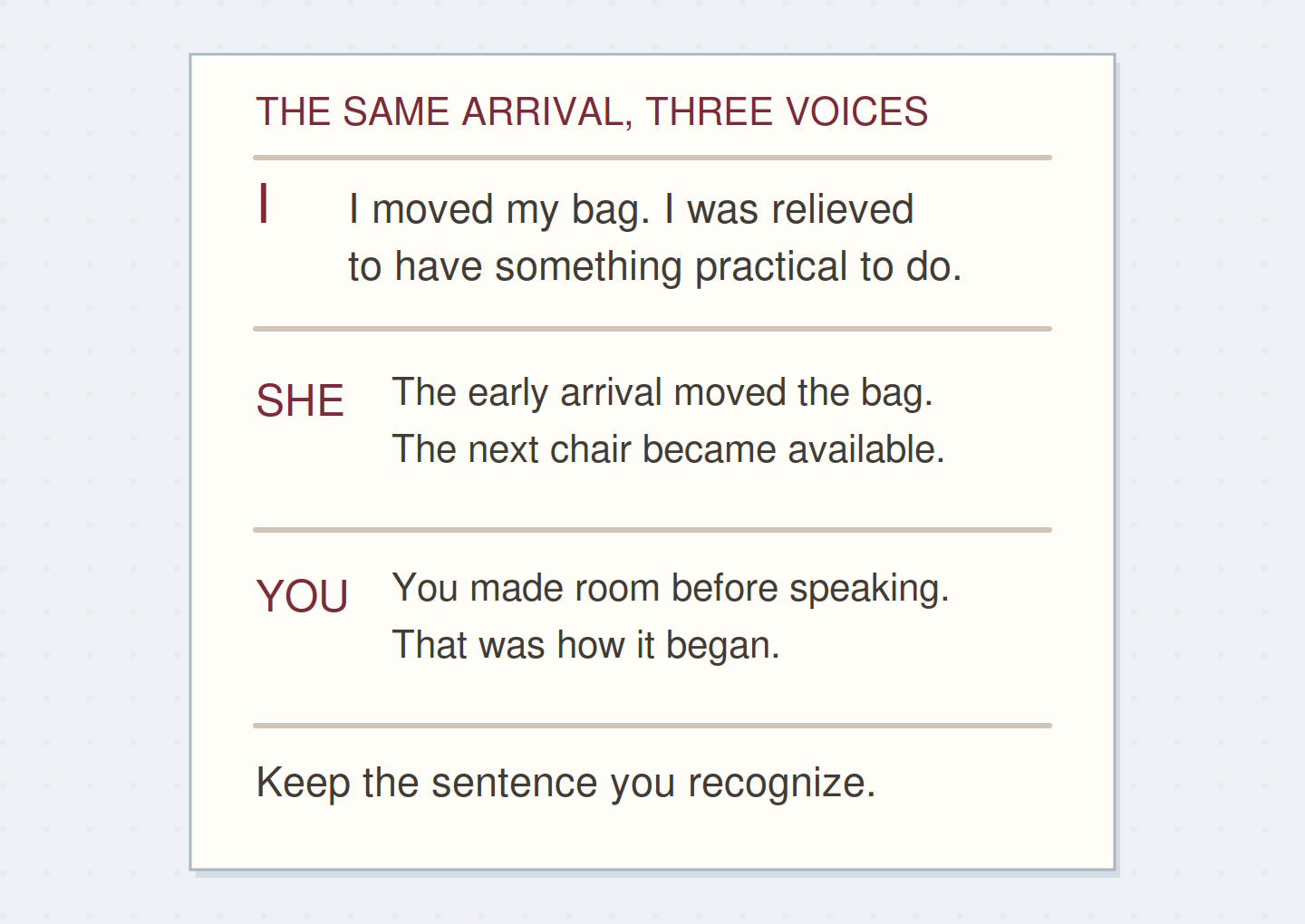
Read one arrival in three voices
The facts stay steady while the narrator directs attention.
First person includes the writer’s private experience.
The feeling is reported by the person who had it.
Begin with the version you already know
Write three sentences in first person. Include what you did, what you noticed and something you thought or felt at the time. Don’t improve the prose yet. This first version gives you material to work with and preserves the inside information an observer would not have.
For example: “I arrived ten minutes early. I moved my bag from the chair beside me when someone came in. I was relieved to have something practical to do.” That last sentence belongs to the writer’s experience. Keep it available even if you choose to omit it from the next version.
“The useful result is a new sentence you recognize as yours.”
Write only what an observer could notice
Retell the scene using your name, an initial or “the early arrival.” Describe actions, timing and objects. You might write, “The early arrival sat near the window, moved a bag off the next chair and looked toward the doorway.” You don’t need to imagine a real person secretly watching you.
Pause at any sentence about a motive. Could the observer actually know it? “She moved the bag because she was lonely” supplies information the scene doesn’t establish. You can add that thought separately as your interpretation, but don’t let the change of narrator turn a guess into an observation.
Retell your scene twice
Use first person, then an observer, then compare what each includes.
I moved my bag and felt relieved to have something practical to do.
The early arrival moved a bag off the neighboring chair.
The observer version shows the act of making room.
Your words have a place now.
A third-person sentence cannot establish another person’s private motive.
- Words on this card
- 32
Compare the drawing-group arrival
The inside version ends, “I was relieved to have something practical to do.” The observer version ends, “The bag moved, and the empty chair became available.” A note to the writer might say, “You made room before you knew what to say. That was how this conversation began.”
These versions emphasize feeling, visible action and a direct acknowledgement. The final note doesn’t prove a general truth about the writer; it stays with this arrival. Read all three and ask which sentence sounds most like something you want to keep. You can combine that sentence with your original account without rewriting the entire entry.
Keep an observer from inventing a motive
The revision limits the observer to the available action.
Starting version
The narrator presents a motive as if it were visible.
If the new voice feels artificial
Use the third-person version for only one sentence. “The early arrival moved the bag” may be enough to make you notice an action you skipped. Then return to “I.” You don’t need to sustain a narrator you dislike, and formal language isn’t required just because you’ve changed pronouns.
If the note to yourself becomes bossy, replace commands with an acknowledgement or a question. “You should be more confident” could become “You stayed for the first exercise; what made that possible?” The question leaves room for your answer. If none of the versions helps, keep the first one and close the experiment.
Change the focus as well as the pronoun
A scene can also begin with the room or an object: “The empty chair was the first thing I noticed.” This varies the sentence without removing your voice. Try it when your main aim is prose variety rather than a different perspective on the event.
For a playful version, let a familiar object narrate, but label the paragraph “Imagined.” A chair can describe the bag leaving its seat in a tiny fictional scene. Keep any real-world conclusion in your own voice afterward. The experiment can make writing enjoyable without turning invented narration into a record of what actually happened.
Try three gentle changes of focus
You can vary an entry without committing to an unfamiliar voice.
An object can open an ordinary sentence.
The writer can return immediately to first person.
Keep the discovery, not the disguise
Finish with “Changing the narrator made me notice…” and name one difference. You might have noticed a practical action, a missing detail or a sentence that sounded too certain. If nothing changed, write that plainly; you’ve still learned which version you prefer for this subject.
The useful result is a new sentence you recognize as yours. Stop after three short versions and one comparison. There’s no need to convert old entries into a new voice. You can return to this exercise whenever the same account feels too automatic, then go back to writing in the way that feels natural.
Where this idea began
Want to follow the idea further? These community discussions and maker references are a good place to start.
- How to avoid using “I” so much
The author wants sentence variety, and several replies describe occasionally narrating their own life in third person.
- Reflective writing — UNSW Sydney
Includes alternative perspectives and personal responses among the material of reflective writing.