Gather a few things See what you’ll need
- A notebook page
- A pen
- One small event you want to describe accurately
Choose one event with a clear boundary
Pick a small instance: a message without a reply, a changed plan or a comment you found confusing. Give it a time frame. “The message I sent on Tuesday morning” is easier to describe than “how everyone treats me.” A bounded event keeps the exercise from becoming a trial of an entire relationship.
In a community discussion about performing in a journal, a reply suggests visibly correcting exaggerated wording. George Mason University’s reflection guide distinguishes description from interpretation. This page uses that distinction as a practical writing move, preserving both the event and the meaning you currently give it.
Separate three kinds of sentence
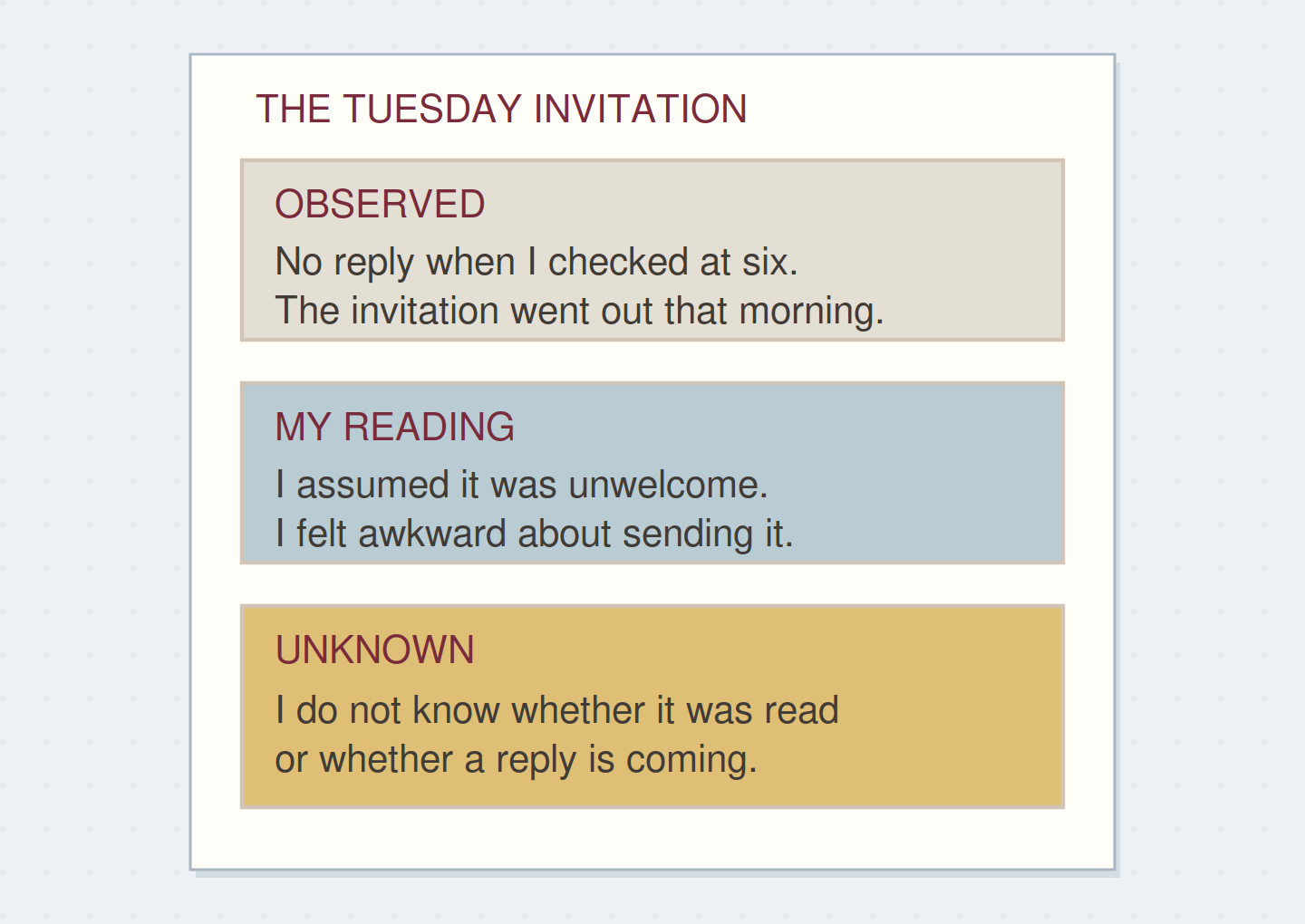
The invitation example keeps the reaction while labeling its uncertainty.
The first sentence says what was checked.
It gives a time frame without assigning a motive.
Write what you observed and how you know it
Describe the action, words or timing you can identify. “I sent the invitation at nine; at six I hadn’t received a reply” tells us what the writer checked. “They deliberately ignored me” adds a motive that the timing alone doesn’t establish. You can write that thought in the next space.
Memory has limits, so qualify it when needed: “As I remember it…” or “I didn’t note the exact words.” An observation column is not a claim that your recollection is flawless. It simply asks you to show the basis of the account. If you checked a message or a calendar, you can note that without copying unnecessary personal details.
“An unknown can remain an unknown in a finished entry.”
Give your interpretation its own sentence
Write “My reading was…” or “I took this to mean…” and include the thought you actually had. “I took the silence to mean they didn’t want to come.” That sentence preserves your experience while making its status clear. You don’t have to replace it with a more reassuring story.
Then add what you don’t know: whether they saw the message, had time to answer or had decided about the invitation. These unknowns aren’t alternative facts. They are the limits of your current information. If you name another possible explanation, label it possible rather than treating it as a correction you are required to believe.
Write observed, interpreted and unknown
Preserve your actual response without presenting a guessed motive as established.
At six, I had not received a reply to the morning invitation.
I assumed it wasn’t welcome and felt awkward.
I don’t know whether it has been read or whether a reply is coming.
Your words have a place now.
You do not need to substitute a reassuring explanation for the uncertain one.
- Words on this card
- 34
Read the three parts together
Observed: “I sent the picnic invitation on Tuesday morning. When I checked at six, there was no reply.” My reading: “I assumed the invitation wasn’t welcome, and I felt awkward about having sent it.” Unknown: “I don’t know whether the message has been read or whether a reply is coming.”
The final sentence says, “For tonight, I can record the awkwardness without deciding what the silence means.” This is an original ordinary example, not a verdict about the other person. The writer’s feeling remains on the page. What changes is the certainty attached to the explanation.
Find the extra certainty in one word
A small revision can change the status of a claim.
Starting version
The wording assigns a motive without enough information.
Don’t erase your reaction to make the page look neutral
If the exercise produces a dry report that no longer sounds like your experience, add a direct response: “I was disappointed” or “I kept checking.” Reporting your own feeling is different from claiming another person’s motive. The entry can be personal and carefully labeled at the same time.
If you start inventing many possible explanations, stop after naming the uncertainty. You don’t need a list of ten reasons someone might be late or silent. “I don’t know why” may be the most accurate sentence available. The aim is to distinguish information, not to make uncertainty disappear through more writing.
Look for the word that carries extra certainty
Read the entry for words such as “everyone,” “always,” “obviously” or “deliberately.” Ask what each word adds and whether your example supports it. A precise correction might change “everyone left” to “three people left before I did.” The rest of the sentence may stay exactly as it is.
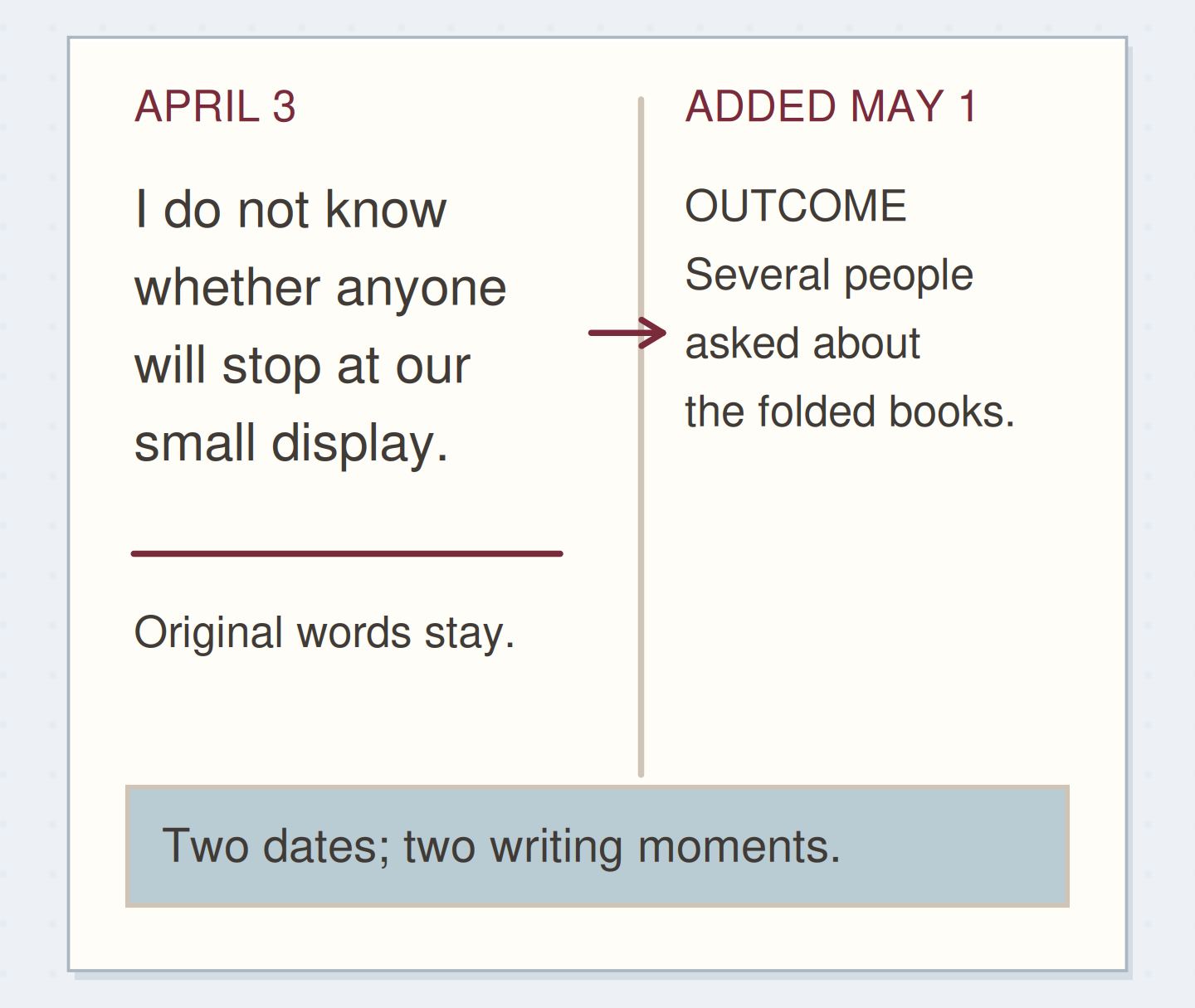
You can keep the original wording visible and date a later correction. UNSW’s reflective-writing guidance includes personal responses and alternative interpretations; the page doesn’t need to settle on a single final explanation. Sometimes the most useful revision is simply changing “was” to “seemed to me,” while leaving the question open.
Choose the accurate kind of ending
The entry can close without an explanation of another person.
A feeling can remain part of an accurate account.
State it as your own response.
End where your information ends
Finish with one sentence about what you can say now. You might record a reaction, a question to ask later or the fact that you’re waiting for more information. If you choose a practical follow-up, keep it separate from the account of what has already happened.
An unknown can remain an unknown in a finished entry. Stop when the observation, interpretation and uncertainty are distinguishable. You can add a dated update if new information arrives. That later note may confirm, change or leave your interpretation unresolved, and the original entry will still show honestly what you knew at the time.
Where this idea began
Want to follow the idea further? These community discussions and maker references are a good place to start.
- I can’t stop performing
A reply suggests marking exaggerated wording and adding a factual correction in the margin instead of silently rewriting the entry.
- Reflective Essays — George Mason University Writing Center
Suggests noting expectations before an experience and distinguishes description from interpretation in the later reflection.
- Reflective writing — UNSW Sydney
Includes alternative interpretations, personal responses and open questions within reflective writing rather than requiring a single right answer.