Gather a few things See what you’ll need
- A notebook or loose writing page
- A comfortable pen
- A place to keep private writing
Choose who the page is talking to
Pick one addressee and one reason for writing today. “Dear Mara, I keep thinking about the afternoon we sorted your books” is a manageable opening. “Dear everyone who has ever misunderstood me” asks a single page to carry too much. You can address a place or an earlier version of yourself if that feels more natural.
Kathleen Adams includes unsent letters among her journal-writing techniques. A journaling community discussion also describes keeping them alongside entries about particular people. Here, the small scope is an editorial choice: one scene usually gives you enough material to begin without requiring a complete relationship history.
Watch a letter find its subject
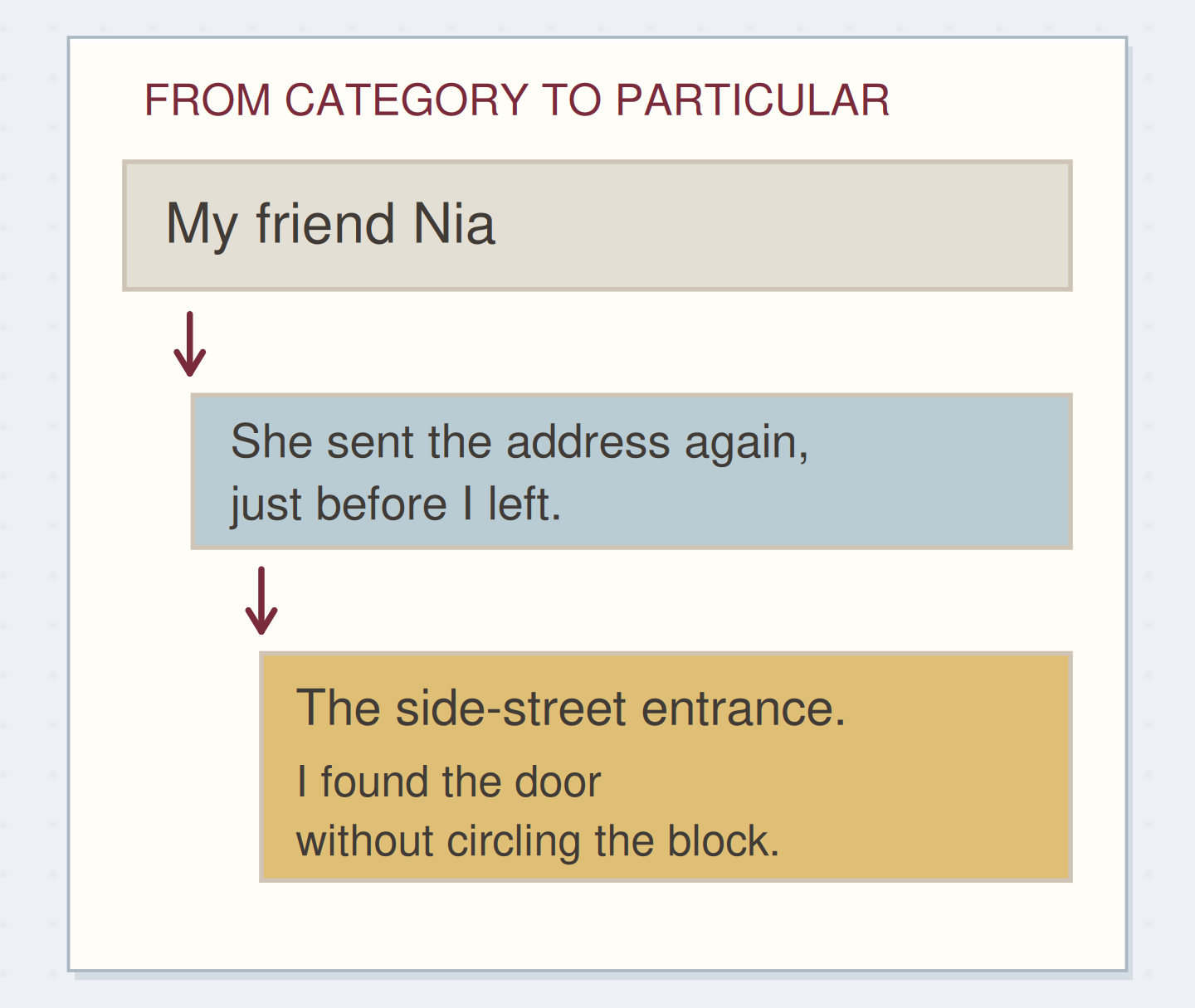
Each state narrows the same book-sorting memory.
A person gives the entry a direction.
The greeting names the listener; it does not promise delivery.
Label the letter before you begin
Put the date above the greeting and add “Unsent journal letter.” That little label tells your future self what kind of document this is. You’re recording your own account, including uncertainty and unfinished thoughts. You don’t need an envelope, a formal salutation or an address block unless you enjoy them.
Choose a modest boundary, such as the space beneath the greeting or about ten minutes. If identifying details would make this page awkward to keep, use an initial and a context phrase you’ll understand later. Initials aren’t a privacy guarantee; choose a storage place that suits the sensitivity of your writing.
“You don’t owe the page an imagined reply.”
Move from the scene to the unsaid sentence
Begin with something you both could have noticed: where you were, what happened or what was said. Then write the sentence you didn’t say. Keep those jobs separate. “You shut the book” describes an action; “You didn’t care” interprets it. You can include the interpretation, but call it yours: “I took that to mean…”
Continue with what matters now. That might be a wish, an appreciation or a boundary for your own time. If a new topic arrives, give it a brief parking note at the bottom instead of following every branch. Direct address is the structure; polished letter writing is optional.
Draft the sentence you left unsaid
Replace the example with your own small scene. Initials are enough.
Dear Mara, on Sunday you offered me the atlas.
I wasn’t sure you wanted to part with it.
I’m keeping the question open.
Your words have a place now.
These three parts can become a short letter; they do not need a reply.
- Words on this card
- 23
Try the book-sorting example
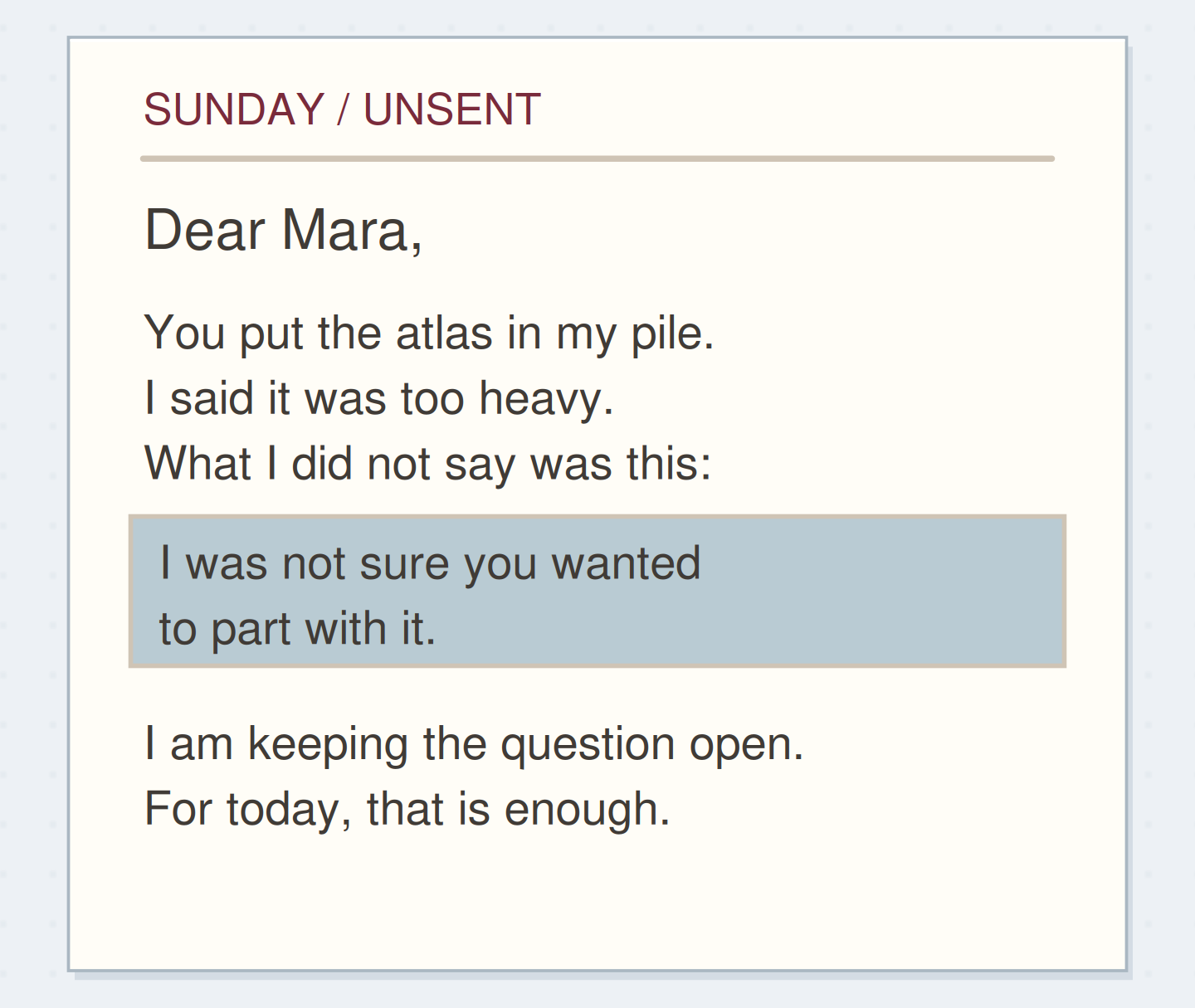
Here’s a complete small entry: “Dear Mara, when we sorted your books on Sunday, you put the battered atlas into my pile. I said it was too heavy. What I meant was that I wasn’t sure you wanted to part with it. I keep remembering how you used it to plan imaginary train trips. I wanted to ask which journey you still think about. For now, I’ll keep that question beside the atlas.”
The letter has a scene, an unsaid thought and a present ending. It doesn’t invent Mara’s answer. Notice how the atlas carries the subject without requiring a summary of every visit the writer has made.
Separate a guess from your own account
Move the reveal control to see what changes when the writer owns the interpretation.
Starting version
The first version treats a guessed motive as certain.
Rescue a letter that turns into an argument
If you keep answering an imagined rebuttal, draw a short line and write “What I actually know.” Put one observable detail underneath it. Then ask, “What do I want this page to preserve?” You may discover that you want to preserve a question rather than win the conversation.
If direct address feels too intense or artificial, remove the greeting and write “The sentence I didn’t say was…” That still gives the unsaid thought a place. You can also stop after the scene. An unfinished letter is a valid entry; it doesn’t need a dramatic final paragraph to justify the space.
Try appreciation, departure or an ordinary question
An appreciation letter can name one action and its effect: “You left the instructions in pencil so I could change them.” A departure letter might address a room you’re leaving and describe the habit you’ll miss. A question letter can hold something you’re curious about without constructing a reply.
Keep the scope matched to the tone. Appreciation doesn’t require declaring someone perfect. A goodbye doesn’t require deciding that a chapter of your life is settled. You can write several letters to the same addressee on different dates and let each one preserve its own position.
Choose the kind of letter you need
The structure can hold different tones without forcing an ending.
Appreciation can stay specific.
Name a real action and what you valued in it.
End with what belongs to this entry
Finish with one present-tense line: “Today, this is what I wanted to say.” Or use something more specific, such as “I’m keeping the question open.” Date any later addition so that today’s thoughts remain distinguishable from a future reading.
The stopping point is one scene and one unsaid sentence, followed by a deliberate pause. You don’t owe the page an imagined reply. If you later decide you want a real conversation, draft that communication separately with its actual purpose and recipient in mind. This journal letter has already done its smaller job of recording your words.
Where this idea began
Want to follow the idea further? These community discussions and maker references are a good place to start.
- Need inspo for a loved-one journal
A participant includes unsent letters among journal entries focused on particular people, alongside descriptive scenes.
- A Short Course in Journal Writing — Kathleen Adams
Defines unsent letters as a journal-writing form addressed to someone or something without intending to deliver the entry.