Gather a few things See what you’ll need
- A notebook page
- A pen
- One moment you genuinely appreciated
Choose an instance inside the familiar category
Start with something you already appreciate, even if you’ve written it many times. Under “friend,” look for an action. Under “home,” look for a use or a moment. Under “food,” look for a detail of preparation, company or timing. The familiar category can be the doorway rather than the whole entry.
A community writer who was listing ten items a day asked how to avoid repetition and later chose to try fewer items. Greater Good in Action’s gratitude-journal guidance recommends specificity and depth. This version uses those writing choices without requiring a fixed daily quantity or promising a particular emotional effect.
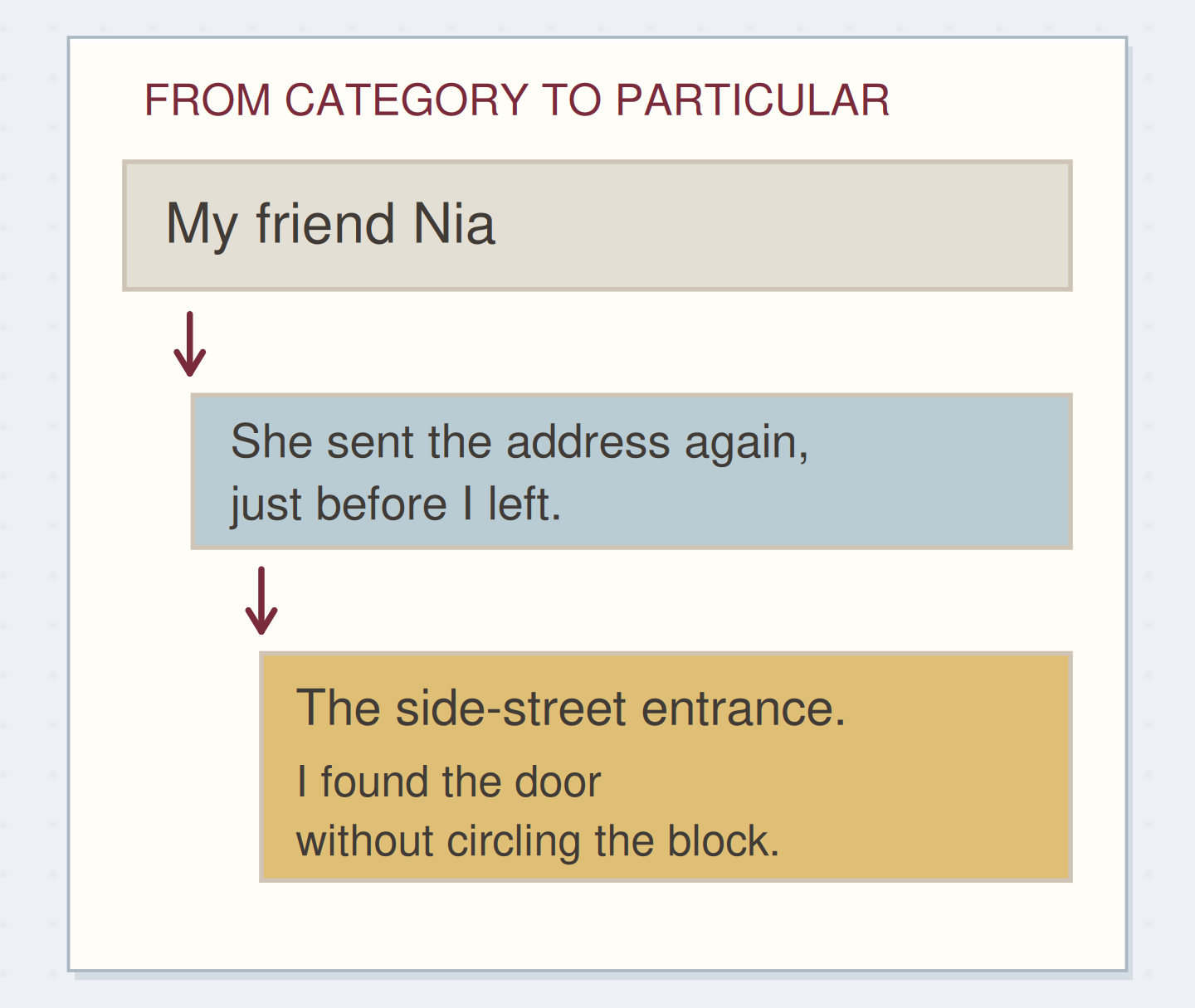
Move from a category to this particular moment
The subject stays “a friend” while the entry becomes more recognizable.
A broad subject identifies what you appreciate.
It is a starting point, not a failed entry.
Write what happened before naming its value
Use one sentence to place the event: “Nia sent the address again before I had to ask.” That is a concrete action. Then write what made it useful or meaningful to you: “I was already at the bus stop, and it saved me searching through the earlier messages.”
You can appreciate something that wasn’t done for your benefit. A carefully lettered library sign or a patch of shade can be your subject. Describe what you encountered and why you chose to notice it. There’s no need to infer a stranger’s intentions or make a claim about how they meant you to feel.
“Specific gratitude can be small and still be complete.”
Add the detail that makes this occurrence different
Look for timing, manner, effort or a small quality. Did the person remember a preference? Did a familiar place offer something you needed that afternoon? Did an ordinary meal taste different because of one ingredient? Choose a detail you can describe honestly rather than exaggerating the scale of your response.
Finish with a sentence beginning “I appreciated…” and name the specific thing. “I appreciated not having to ask again” is more exact than “I’m so lucky to know wonderful people.” You can use enthusiastic language when it’s yours, but strong adjectives aren’t required to make the appreciation count.
Write one specific appreciation
Use a person, place, object or ordinary event that you actually appreciated.
Nia sent the address again before I left.
She explained that the entrance was on the side street.
I appreciated finding the door without circling the block.
Your words have a place now.
The entry can remain modest; you do not need to make the whole day positive.
- Words on this card
- 27
Read one appreciation at full size
“Nia sent the address again just before I left for the repair café. She included the entrance on the side street, which I’d missed in the first message. I found the door without circling the block. I appreciated how the extra detail made arriving feel straightforward.”
The entry records a person, an action, a distinguishing detail and the writer’s response. It doesn’t declare that the friendship is perfect or that the whole afternoon went well. The same friend could appear in tomorrow’s entry for a different reason, and both pages would have something particular to preserve.
Keep a familiar subject, add a real instance
Specificity changes the information, not the sincerity of the appreciation.
Starting version
The category is sincere but does not identify today’s moment.
When appreciation starts feeling compulsory
Reduce the quantity before searching harder. One entry can hold one real thing. If nothing feels like gratitude today, write an observation, a complaint or a different kind of entry. You don’t have to rename an experience in order to use your notebook.
Watch for comparisons that dismiss your own day: “Other people have it worse, so I should be grateful.” That sentence describes pressure, not the particular appreciation this exercise is looking for. Try “One thing that was useful today…” if that feels more accurate, or leave the prompt entirely. The notebook can hold gratitude without demanding it.
Return to the same person or place honestly
A repeated subject can still produce a distinct entry. Yesterday you valued a friend’s practical message; today you might value an unhurried conversation. If the same action is what you appreciate again, say so and add the current context. You don’t need to disguise a repeated comfort as a new discovery.
You can also keep a short series about one ordinary support, such as the kitchen table. Each entry might describe a different use: sorting a pattern, sharing lunch or leaving an unfinished drawing. Stop the series when it feels exhausted. The purpose is noticing particulars, not proving endless originality.
Choose a scale that feels honest
The prompt can shrink or be set aside.
A single instance can fill the exercise.
Reduce the list before inventing appreciation.
End while the appreciation is still yours
Read the entry and check that its main sentence sounds like something you mean. Remove any extra praise added only to make it seem more worthy. If you want to thank a person directly, you can choose to do that separately; the journal entry itself doesn’t require delivery or a response.
Specific gratitude can be small and still be complete. Stop after the moment, the detail and what you valued. On another day you may write a different kind of page. That flexibility keeps the notebook available for your actual experience, including appreciation that arrives irregularly or sits beside an inconvenient feeling.
Where this idea began
Want to follow the idea further? These community discussions and maker references are a good place to start.
- What are the things you guys write in your gratitude logs
The author runs out of new items in a ten-item daily log and later says they will try fewer entries; replies discuss repetition and specificity.
- Gratitude Journal — Greater Good in Action
Recommends describing particular details and varying the details when writing about the same person or subject.