Gather a few things See what you’ll need
- A notebook page
- A pen
- Two statements that both feel true today
Write two statements in language you actually use
Start with “Part of me wants…” twice, or simply write two direct sentences. “I want to join the group” and “I want to keep my Saturday unplanned” are clear enough to work with. Avoid giving one statement a respectable label and the other a dismissive one; both need a fair description.
A community response to a new journaler explicitly makes room for contradiction, repetition and questions. UNSW’s reflection guidance also allows personal responses and alternative interpretations. This exercise takes that permission seriously by giving the two statements comparable space, without requiring a final verdict about which one is the correct feeling.
Give both Saturday wishes their context
The tension becomes more specific without choosing a winner.
Both statements get space before explanation.
Neither is labeled the sensible or foolish side.
Ask when each statement becomes especially true
Under the first statement, describe the situation in which you notice it. Under the second, do the same. “I want company when I’ve spent the day working alone.” “I want quiet when several conversations overlap.” These conditions may reveal that the statements concern different parts of an experience.
Keep the context concrete. Time, duration, place, number of people and the kind of activity can all matter. You don’t need a full explanation of your personality. A sentence about a noisy kitchen at the end of a long afternoon may tell you more about this tension than a label you apply to yourself everywhere.
“Two true statements can share a page without becoming one sentence.”
Give each side a small piece of evidence
Write one recent example beneath each statement. For wanting company, you might recall enjoying a walk with a friend. For wanting quiet, you might recall being ready to leave a crowded room. The examples need not be equally dramatic, and they don’t have to cancel each other out.
Then read them together. Is the tension about company itself, or about the form, timing or duration of it? You may find a useful distinction, but don’t manufacture one just to tidy the page. “I want both, and I don’t yet know how they fit” is a clear account of where you are.
Write both sides fairly
Use ordinary preferences or mixed responses, and let both sound like your own words.
I want the drawing group because I enjoy a shared subject.
I want Saturday open after a week of appointments.
I want the experience, but I’m unsure about a standing commitment.
Your words have a place now.
You can finish with “Both are here today” if no useful distinction appears.
- Words on this card
- 31
Try the unplanned-Saturday example
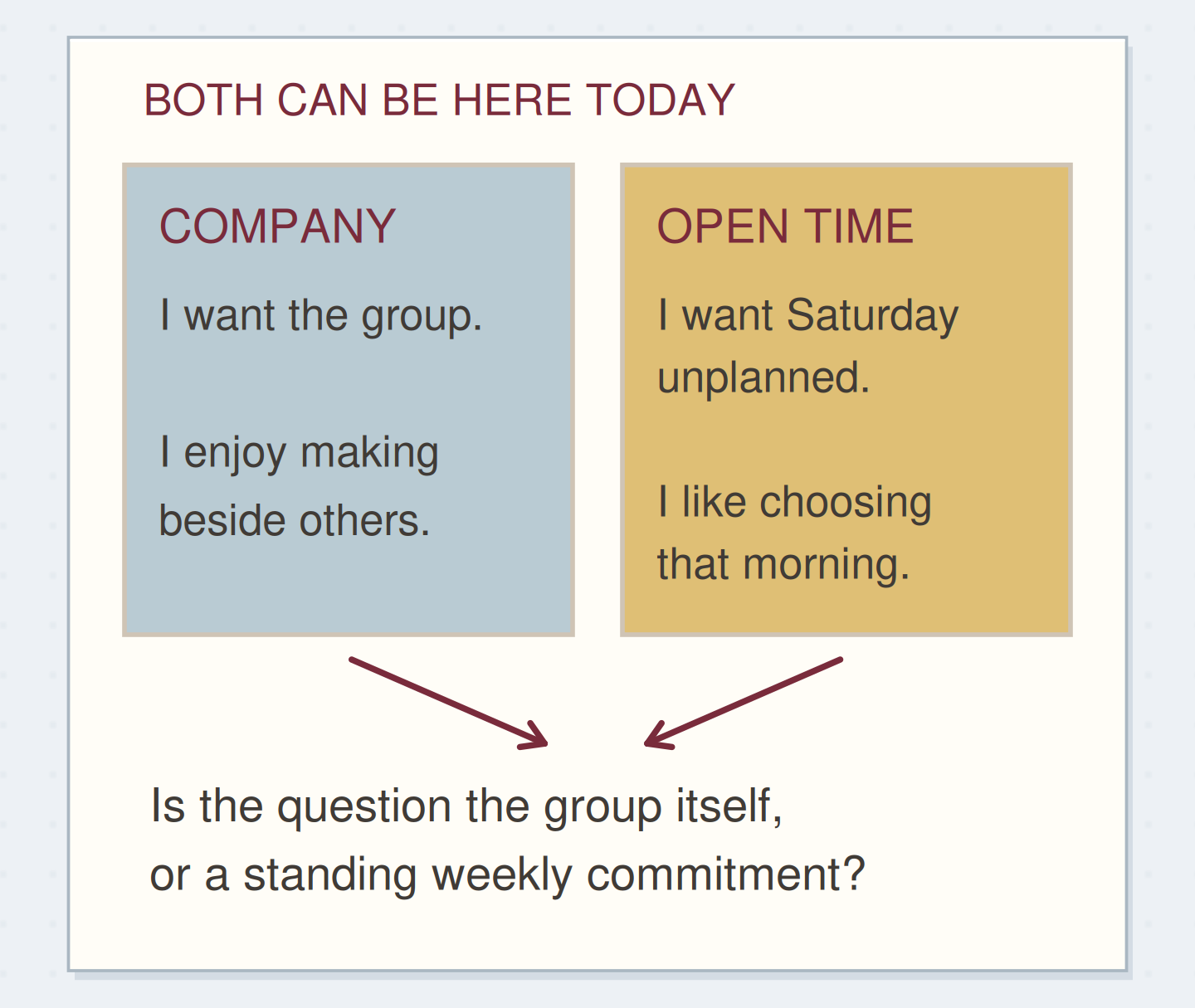
First statement: “I want to join the weekend drawing group.” Context: “I like making things beside other people, especially when there’s a shared subject.” Second statement: “I want to keep Saturday open.” Context: “After a week of appointments, I value deciding what to do that morning.”
The writer’s distinction is, “I want the group experience, but I’m unsure about a standing commitment.” That suggests a question they could ask about occasional attendance. It doesn’t require choosing the group or staying home. The page has made the tension more precise, and that can be its complete result.
Replace loaded labels with actual preferences
The revision lets the two sides be described rather than judged.
Starting version
The labels decide the contest before the entry begins.
When the page becomes a contest between sides
If you keep adding arguments to make one side win, pause and check your labels. “Responsible me” and “Lazy me” have already decided the contest. Rename them with the actual preferences: “Wants a commitment” and “Wants flexibility.” Then give each one a concrete example rather than another accusation.
If the statements are genuinely incompatible for this occasion, say so. You may have to choose an action while still having mixed feelings about it. The journal can distinguish the choice from the feeling: “I’m staying home today, and I still wish I could be at the group.” A decision does not have to erase the unchosen wish.
Look for a condition you could vary
Sometimes the tension changes when one condition changes. A one-hour visit differs from an all-day gathering. An occasional session differs from a weekly commitment. Write the condition in plain language and ask whether it affects either statement. This is an option to explore, not a command to compromise every time.
Other contradictions are simply part of a moment: being pleased a project is finished while missing the routine of making it. You may not need to vary anything. Describe what you’re glad to leave and what you’ll miss. Keeping those details separate can make the entry richer than the single word “bittersweet.”
Choose the kind of ending the tension needs
Some tensions lead to a changed condition; others remain mixed.
A duration or frequency may matter.
Explore the condition without requiring a compromise.
Close with a distinction or an honest unresolved line
End with one of these forms: “These statements concern different…”, “The condition that matters is…”, or “Both are here today.” Choose the form that matches what the page actually showed. You can add a practical next question, but there’s no need to resolve the feeling before closing the notebook.
Two true statements can share a page without becoming one sentence. Stop once both have a fair description and enough context to recognize them. If you return later, date the new view. The earlier tension can remain intact as a record of that day, even if your preference eventually becomes clearer.
Where this idea began
Want to follow the idea further? These community discussions and maker references are a good place to start.
- My first journal ever. Any tips?
A participant explicitly suggests allowing repetition, lists, questions and contradictions in personal entries.
- Reflective writing — UNSW Sydney
Makes room for alternative interpretations and open questions rather than requiring one right answer.