Gather a few things See what you’ll need
- A notebook page
- A pen
- A question you can name in one sentence
Give the voices different jobs
Choose labels that describe a tension rather than dividing yourself into a sensible side and a foolish side. “Wants to begin” and “Wants more information” both have understandable concerns. If the labels become long, use A and B after defining them once at the top.
A community discussion asks what a back-and-forth conversation with oneself should be called; the useful distinction here is dialogue, with alternating turns. Kathleen Adams describes dialogue as a journal-writing technique. For this version, assign one voice the job of describing the current difficulty and the other the job of asking specific questions.
Hear a question become more precise
Step through the sketchbook exchange without adding an imaginary answer.
The first statement has no specific starting action.
The next voice needs to ask about one word.
Give each turn a small boundary
Write the date, the labels and a plain opening question. Set a starting limit of six turns, three from each voice. This is enough to test the form without staging an entire play. Leave a new line between turns so you can see where each voice begins.
Keep each turn to one or two sentences at first. Long speeches often contain several questions, making the next response harder to write. If you hear three competing thoughts, pick one to answer and put the others below the dialogue under “Later.” You can use them in another entry if they still matter.
“A dialogue can finish with a better question.”
Ask questions that change the next sentence
Start with a real statement, such as “I keep postponing the sketchbook.” Let the second voice ask about a word in that sentence: “Which part are you postponing?” Answer with a concrete action. Then let the next question respond to that answer rather than returning to the original complaint.
Useful questions include “When did that happen?”, “What would count as enough?” and “Which part do you already know?” Avoid building an interrogation where every answer is judged. The second voice needs curiosity, not authority. It can also admit, “I don’t know how to answer that yet.”
Write the next three turns
Try a statement, a precise question and a reply.
I keep putting off the sketchbook.
Which part are you putting off?
Choosing the first subject.
Your words have a place now.
Read the reply before deciding what the next question should be.
- Words on this card
- 16
Follow one six-turn conversation
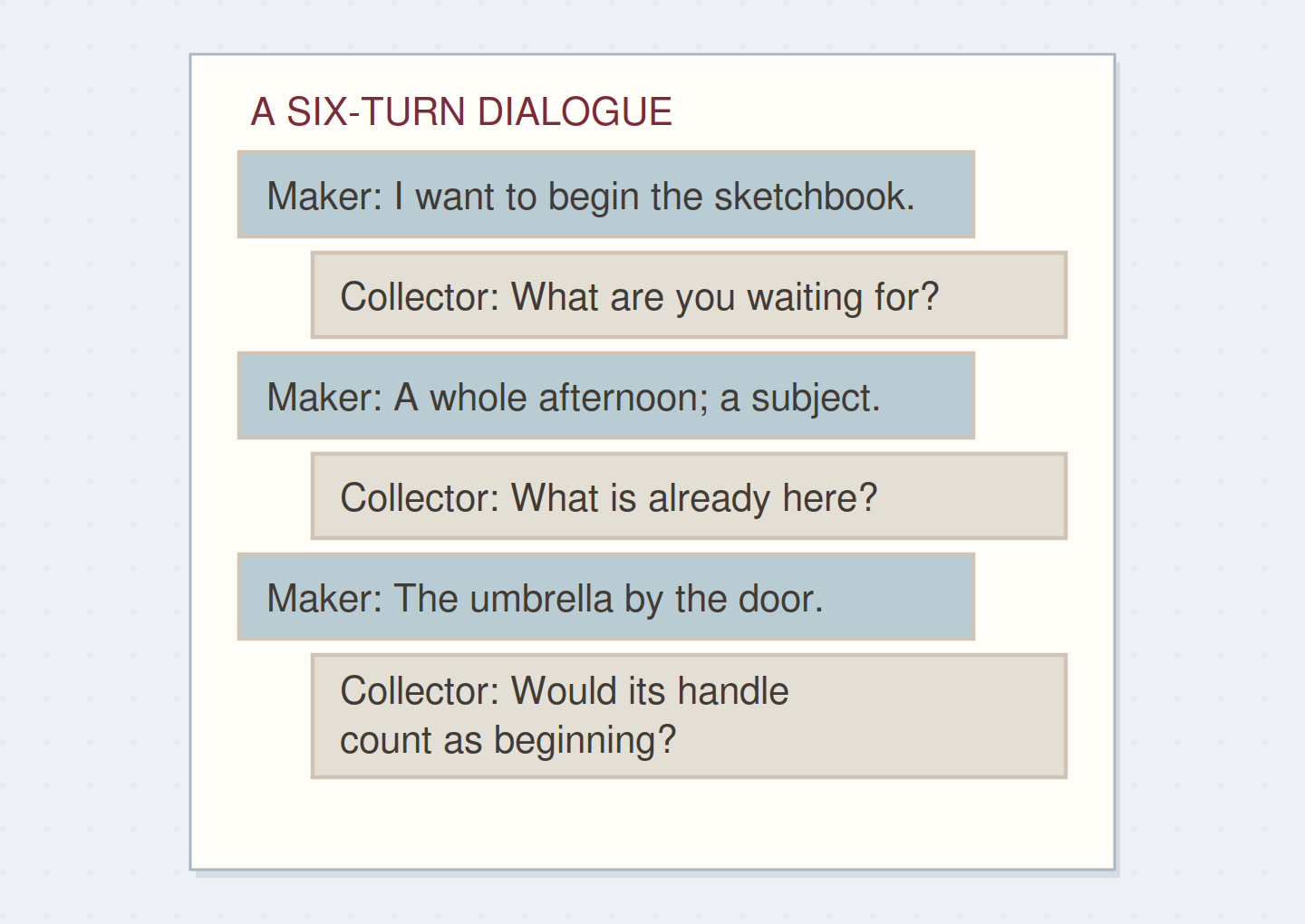
Try this original exchange. Maker: “I want to begin the sketchbook.” Collector: “What are you waiting to have?” Maker: “A whole afternoon and a subject worth drawing.” Collector: “What subject is already here?” Maker: “The folded umbrella beside the door.” Collector: “Would one drawing of its handle count as beginning?”
The last question is narrower than the first statement. It doesn’t prove that the writer must draw tonight. Below the exchange, the writer adds: “My starting rule was bigger than the actual task.” That sentence records a discovery about this project, without turning one conversation into a verdict about the writer’s character.
Replace a verdict with a question
The revision gives the second voice something useful to do.
Starting version
A verdict closes the conversation.
When both voices repeat themselves
Circle the repeated phrase and ask for an example. If both voices keep saying “I need more time,” ask “Time for which action?” If both say “It has to be good,” ask what “good” means on a first attempt. A concrete noun or action often gives the dialogue somewhere new to go.
If one voice becomes harsh, change its job. Rename “Critic” as “Questioner,” then give it a factual question to ask. You can also stop the alternating form and write a single sentence about why it isn’t useful today. The form serves the entry; you don’t have to maintain the performance.
Try a project, a room or an unfinished task
A dialogue with a project can ask what material is missing. A dialogue with a room might ask which activity you want to make space for. A dialogue with an unfinished task can separate the next visible step from the whole imagined workload. Label these exchanges as imaginative if you’ll want that reminder later.
Avoid supplying answers on behalf of a real person whose views you don’t know. Write “My imagined version of this conversation” if you choose to experiment with that format. Then return to a sentence about your own uncertainty. The page can explore a possibility without preserving it as something another person actually said.
Give a new partner a clear job
These are writing roles, not claims that objects have thoughts.
A project voice can ask about missing material.
Keep its questions about the work.
Keep one useful line and stop
After six turns, draw a line and write “What changed in the question?” You might name a smaller scope, an assumption you noticed or a distinction between wanting a result and wanting the process. “Nothing changed” is also an honest reading; it tells you this exchange reached its limit.
Stop once you have a sentence worth keeping or a clear reason to pause. A dialogue can finish with a better question. If you return, add a new date and respond to the old ending rather than silently rewriting the voices. That leaves a visible record of how the question developed.
Where this idea began
Want to follow the idea further? These community discussions and maker references are a good place to start.
- What is a soliloquy? (In relation to journaling)
The author asks how to understand a back-and-forth written conversation with oneself; replies distinguish dialogue from a theatrical soliloquy.
- A Short Course in Journal Writing — Kathleen Adams
Identifies dialogue as a journal-writing technique using a written exchange between voices.