Gather a few things See what you’ll need
- A notebook or dated document
- A pen or keyboard
- One ordinary, low-stakes choice
Pick a choice small enough to describe
Choose a decision you haven’t made yet and can summarize in one question. “Will I spend Saturday afternoon at the open drawing session or take a walk?” is specific. “What should I do with my life?” contains too many decisions for this page. Give the choice a date or occasion so you know which instance you mean.
In a community thread about decision-making, writers discuss using structured columns when freeform thinking keeps circling. Farnam Street’s decision-journal method emphasizes recording reasoning before the result is known. This entry uses that timing distinction while keeping the example personal, ordinary and manageable.
Keep the decision and result in order
The drawing-session example preserves what was known on each date.
Friday’s note records the reason and expectation.
It is written before attending.
Write the options and what matters this time
Name two or three real options, including postponing or choosing neither if those are available. Then list what matters for this particular occasion. You might want company, time outdoors, a chance to draw or a quiet afternoon. Avoid turning every preference into a permanent rule about yourself.
Write what you know beside what you’re assuming. “The session begins at two” may be confirmed information. “There will be people I know” may be an expectation. You don’t need a complicated scoring system. A few clear sentences can show which considerations are carrying the choice and which uncertainties remain.
“The original reason and the later result deserve separate dates.”
Describe an outcome you could recognize later
Before deciding, write what you expect the chosen option to be like and why. Include one uncertainty that could make the experience different. “I expect to complete one sketch because the session has a set subject; I don’t know how crowded the room will be.” That is easier to review than “It will be good.”
You can also name the tradeoff you’re accepting. Choosing company may mean giving up an afternoon outdoors. Recording that tradeoff prevents the later entry from treating every absent benefit as a surprise. The goal is a faithful snapshot of the choice, not a guarantee that you can predict the afternoon.
Write the before-entry
Replace the example with an ordinary choice; keep uncertain information visibly uncertain.
I’ll try the drawing session because I want company and a starting subject.
I expect one sketch; I don’t know how crowded the room will be.
I’m giving up the long walk. I’ll review after the session.
Your words have a place now.
Leave the actual outcome for a new, separately dated note.
- Words on this card
- 37
Read a complete before-and-after entry
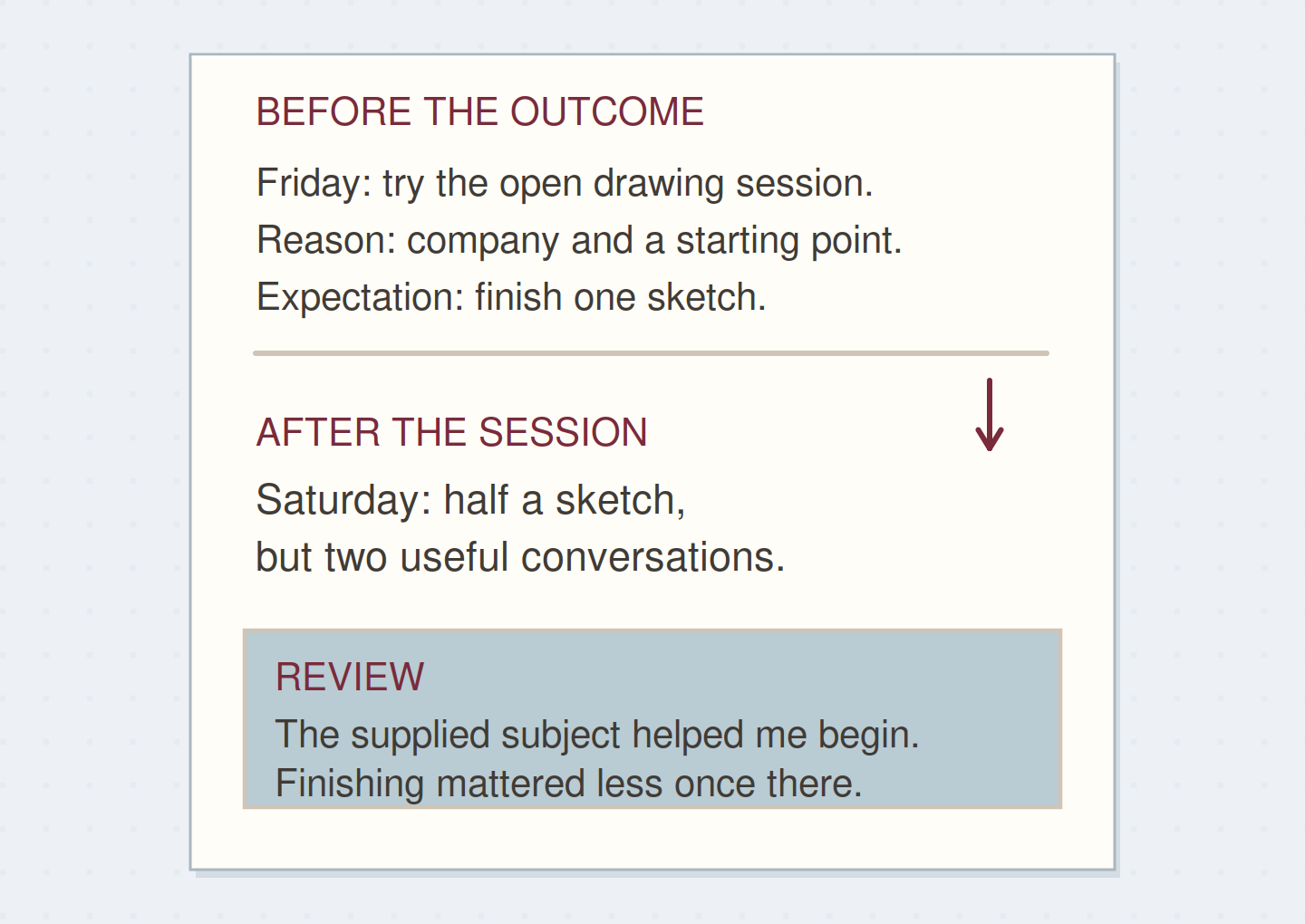
Before, Friday: “I’ll try the open drawing session. I want company and a reason to use the sketchbook. I expect to finish one sketch because a subject is provided. I’m giving up the longer walk. I don’t know how busy the room will be.”
After, Saturday: “The room was busy and I made half a sketch. I liked hearing how two other people approached the subject. The supplied subject helped me start; finishing mattered less once I was there.” The review adds, “Next time I’ll describe what I want to try, not only what I expect to finish.” That last line arises from this experience, not from an all-purpose rule.
Keep a retrospective account honest
The revision distinguishes a memory of a prediction from a saved prediction.
Starting version
A reconstructed prediction is presented as if it were recorded beforehand.
Separate the result from the earlier reasoning
If the afternoon goes badly, read the original note before calling the choice a mistake. Which parts depended on information you had? Which depended on an assumption? Which changed unexpectedly? A disappointing result and a reasonable choice can coexist, just as a pleasant result doesn’t prove that every assumption was sound.
If you forgot to write beforehand, don’t manufacture a dated prediction afterward. Label the page “Retrospective account” and note what you remember thinking. You can still reflect on the event, but it is a different kind of evidence from a note written before the outcome. Try the before-entry with another small choice.
Give the later review a narrow job
Choose a review point when the relevant outcome will be available: after the session, after using the new arrangement twice or when the borrowed book is finished. At that point, compare one expectation with what actually happened. Keep the original wording visible, and add the review beneath it with a new date.
Ask what you would want to know before a similar choice. The answer might be a practical question, such as whether the room has enough tables, or a preference you noticed, such as valuing conversation more than a finished drawing. It can also be “I’d choose the same option for the same reasons.”
Ask one useful review question
Different results call for different comparisons.
Check an assumption that shaped the choice.
Ask what information would help next time.
Finish without turning the journal into a judge
Close with one sentence about the reasoning you want to carry forward. Be specific enough that the sentence could inform another ordinary occasion, but leave room for different circumstances. “I enjoy a supplied starting point” is more useful here than “I should always join groups.”
The original reason and the later result deserve separate dates. Stop when you have a choice, an expectation, an outcome and one comparison. You don’t need to track every decision or rank yourself by how often events match your predictions. A few carefully chosen entries can make an interesting record of how you chose.
Where this idea began
Want to follow the idea further? These community discussions and maker references are a good place to start.
- Journaling for decision making?
Participants discuss using columns, pros and cons and imagined outcomes when an unstructured entry does not settle a choice.
- Decision Journal: Template and Example Included — Farnam Street
Separates information and expectations recorded before a decision from the outcome reviewed later.