Gather a few things See what you’ll need
- A notebook page or simple document
- A pen or keyboard
- A short passage, observation or remembered remark
Give each side a clear job
Label the left side “Line or observation” and the right side “My response.” You can divide a notebook page with a loose vertical line or use a two-column document. The division doesn’t need to be equal; leave more room on the side where you expect to write more.
Utah State University teaches double-entry journals as a reading method that places selected material beside connections and questions. A bullet-journal community discussion similarly pairs books with personal responses. This adaptation brings that relationship into a personal journal: the source starts the exchange, and the neighboring space holds what you make of it.
Give the same observation three possible responses
The starting material stays fixed while the writer tries different kinds of reflection.
A response can connect the observation to your practice.
The writer adds something personal.
Keep enough context to identify the starting material
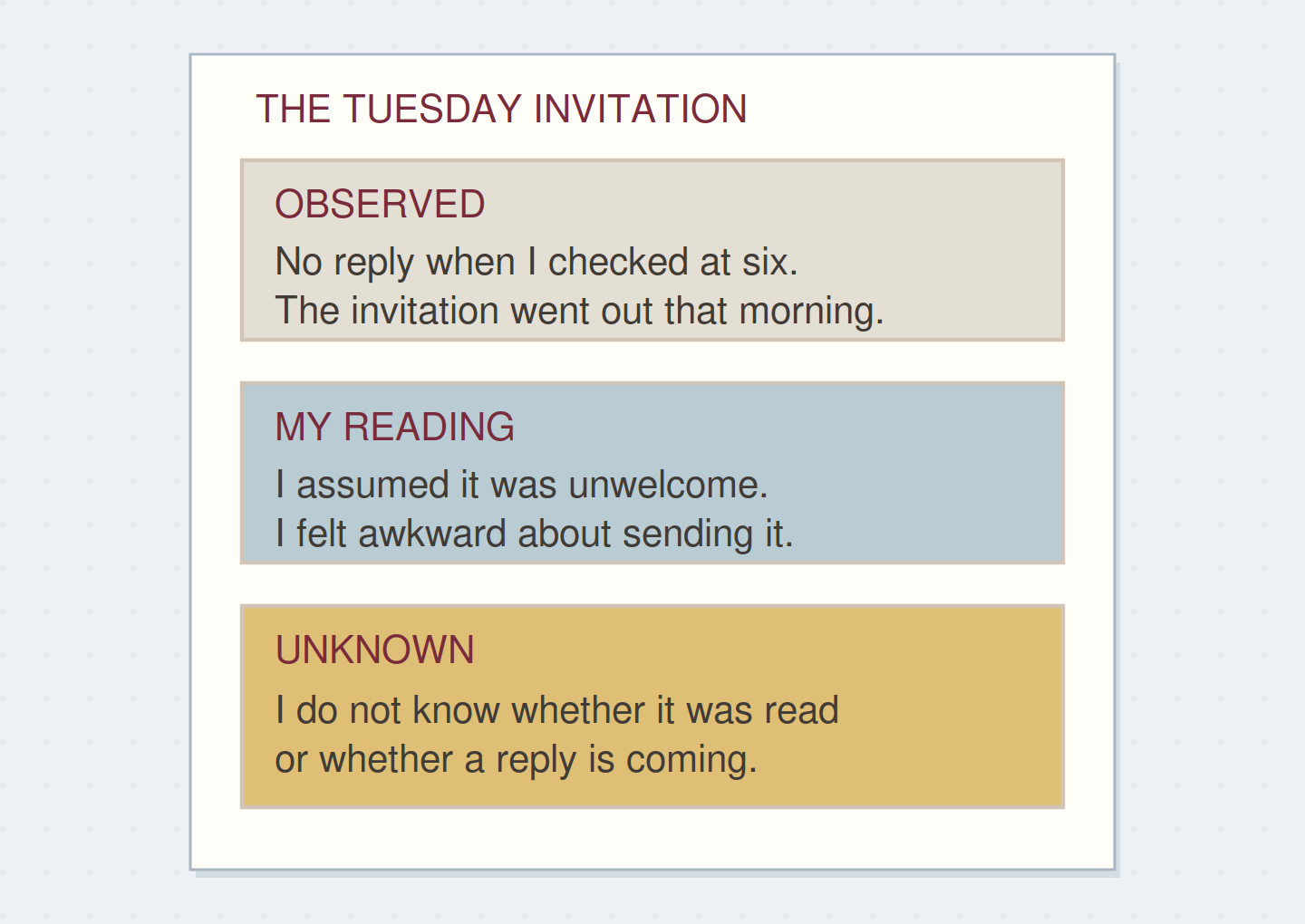
For something you read, note the title and a page or section reference. Copy only the short phrase you need, using quotation marks for exact wording. If you summarize, label it a summary. For a remembered remark, note the speaker by a description or initial and say “roughly” when you don’t recall the words exactly.
An observation can also begin the pair: “The instructor left the pencil marks visible.” It needs a place and date rather than quotation marks. These small distinctions keep your later response attached to the right kind of material. A remembered gist and an exact quotation can both be useful, but they aren’t interchangeable.
“The second column is where your response gets to stay.”
Respond to the particular line, not the whole subject
Write the first response the source invites. You might explain why it caught your attention, connect it to an experience or ask a question. “This reminds me of…” and “I’m not sure whether…” are useful openings because they leave room for a personal answer rather than demanding a formal analysis.
Keep each response beside the material it answers. If one entry grows longer, start the next pair below the longer side so the rows remain aligned. You don’t need a ruler or equal paragraph lengths. The visual relationship matters more than symmetry: you should be able to see which thought belongs with which prompt.
Make one source-and-response pair
Use an observation, a short quotation or an honestly labeled summary.
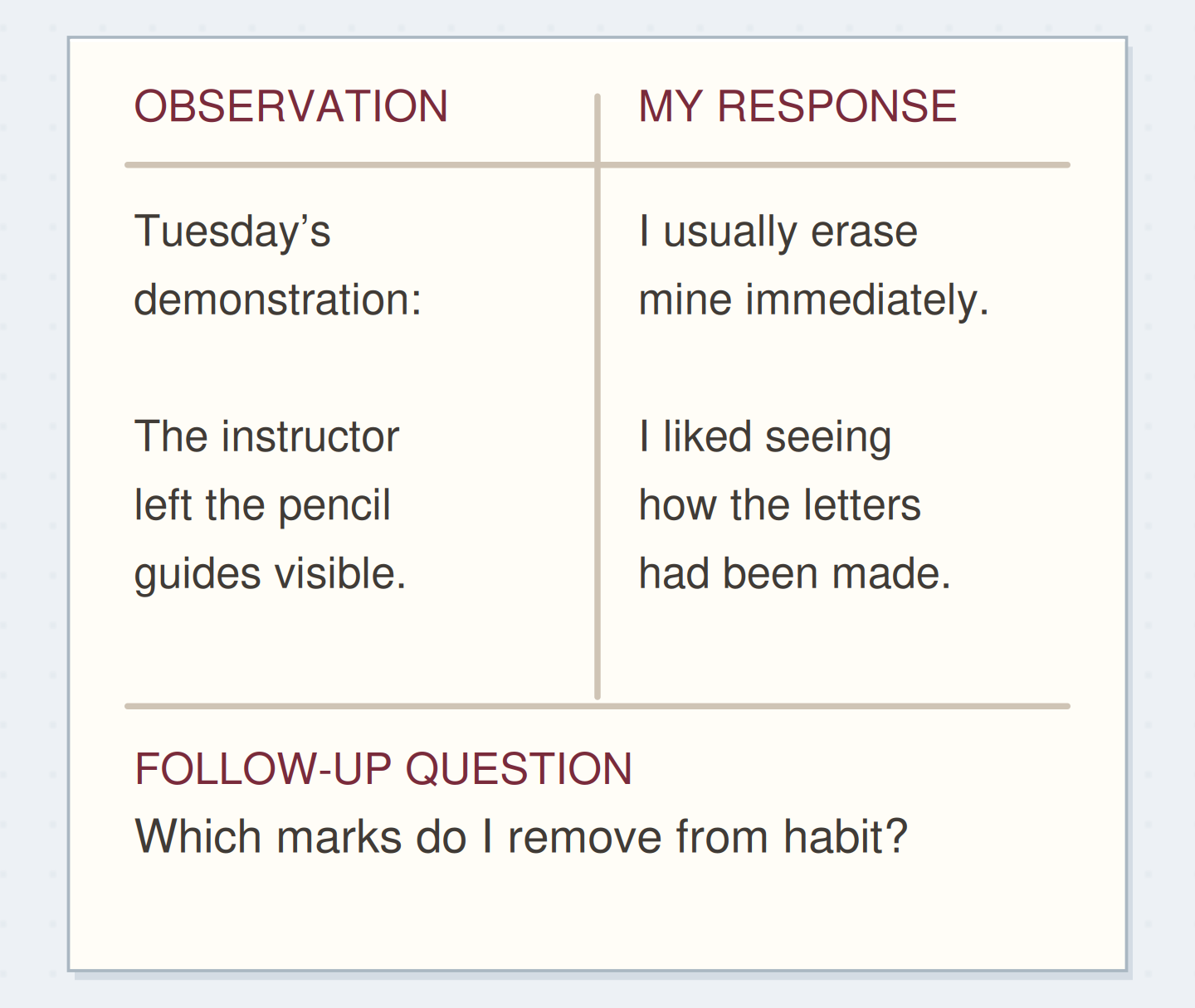
The instructor left the pencil guidelines visible.
Tuesday’s lettering demonstration — my observation.
I usually erase mine. I wonder which marks I remove only from habit.
Your words have a place now.
Keep exact quotations distinct from remembered gist and from your own words.
- Words on this card
- 26
Read a complete paired entry
Here’s an invented workshop example. Left: “Tuesday’s demonstration: the instructor left the pencil guidelines on the finished lettering.” Right: “I usually erase the construction lines immediately. Seeing them here made the letters feel made by a person rather than printed. I wonder which marks I remove because they are distracting and which I remove simply because I think finished work must hide its process.”
The left side records the observed action. The right side contains the writer’s preference, comparison and question. The page doesn’t claim to know the instructor’s reason. If the writer wants that information, asking the instructor would be a separate next step.
Add a response rather than a repetition
The revised second column contributes the writer’s own thinking.
Starting version
The right side repeats the left.
If the response only repeats the source
Read the right-hand sentence and ask whether it adds anything the left side didn’t already say. “The guidelines were visible” restates the observation. “I usually erase mine” introduces a personal connection. Try adding a memory, a question or the reason this particular detail caught your attention.
If you don’t have a response, leave that side blank or write “No response yet.” Some material becomes interesting later. You can also decide that the line doesn’t need to stay in this exercise and choose another one. Copying more source text won’t necessarily make a response appear; a smaller, more pointed excerpt may help.
Let one pair lead beyond the columns
After two or three pairs, choose one that makes you want to continue. Draw a short line below the table and write a paragraph in full width. You might follow the question about visible construction marks with an example from your own lettering or another object you’ve made.
Colorado State University’s double-entry assignment keeps commentary alongside prior writing, showing how the pair can support a longer response. Your journal version can remain informal. The column is a starting structure, and you can leave it when your thought needs a different shape. You don’t have to squeeze a developed paragraph into a narrow strip.
Identify what kind of material starts the pair
The source label changes with the material.
Exact wording needs a source reference.
Use only the phrase needed for your response.
Finish with a source and a response you can reconnect
Check that exact quotations, summaries and your own words are distinguishable. Add a missing title, date or page reference if you’ll need it. Then stop once you have a pair that says something you want to keep. Two short pairs may be more useful than a crowded page of unexplained excerpts.
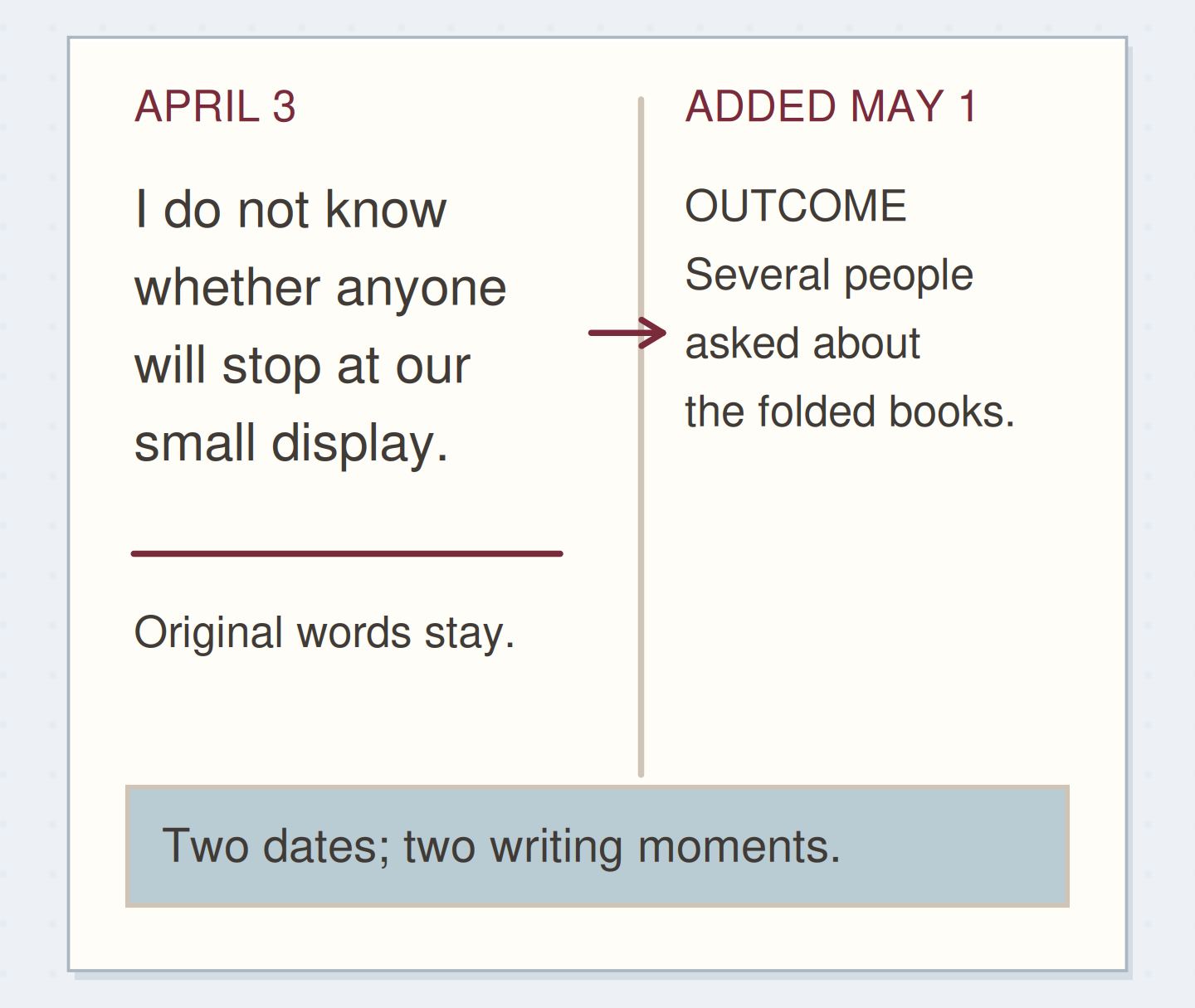
The second column is where your response gets to stay. You can return with a new date and add another thought, but the original response can remain as it was. The page records an encounter between material and reader, including the reader you happened to be when you first noticed that line.
Where this idea began
Want to follow the idea further? These community discussions and maker references are a good place to start.
- Ideas for 2020 trackers, lists, pages, reflections, etc.
The post includes books read with a short personal response; a reply describes lists of people or subjects to learn more about.
- Double-Entry Journal — Utah State University
Describes a reading method that pairs selected source material with the reader’s response in adjacent columns.
- Double Entry Journal Assignment Example — Colorado State University
Places a later reader response alongside earlier writing, keeping the material and commentary visibly distinct.