Gather a few things See what you’ll need
- A notebook page
- A pen
- One recent event or experience
Choose questions that depend on one another
Start with “What happened?” Follow with “What do I make of that?” Finish, if useful, with “What might I try or notice next?” The second question needs material from the first, and the third responds to your interpretation. That connection makes a ladder different from a page of unrelated prompts.
The University of Edinburgh explains the “What? So what? Now what?” reflective model and its earlier development by Borton, Driscoll and others. Community discussions about monthly reviews show readers looking for usable question structures. This informal journal adaptation keeps the connected movement while dropping the expectation of an assessed or comprehensive reflection.
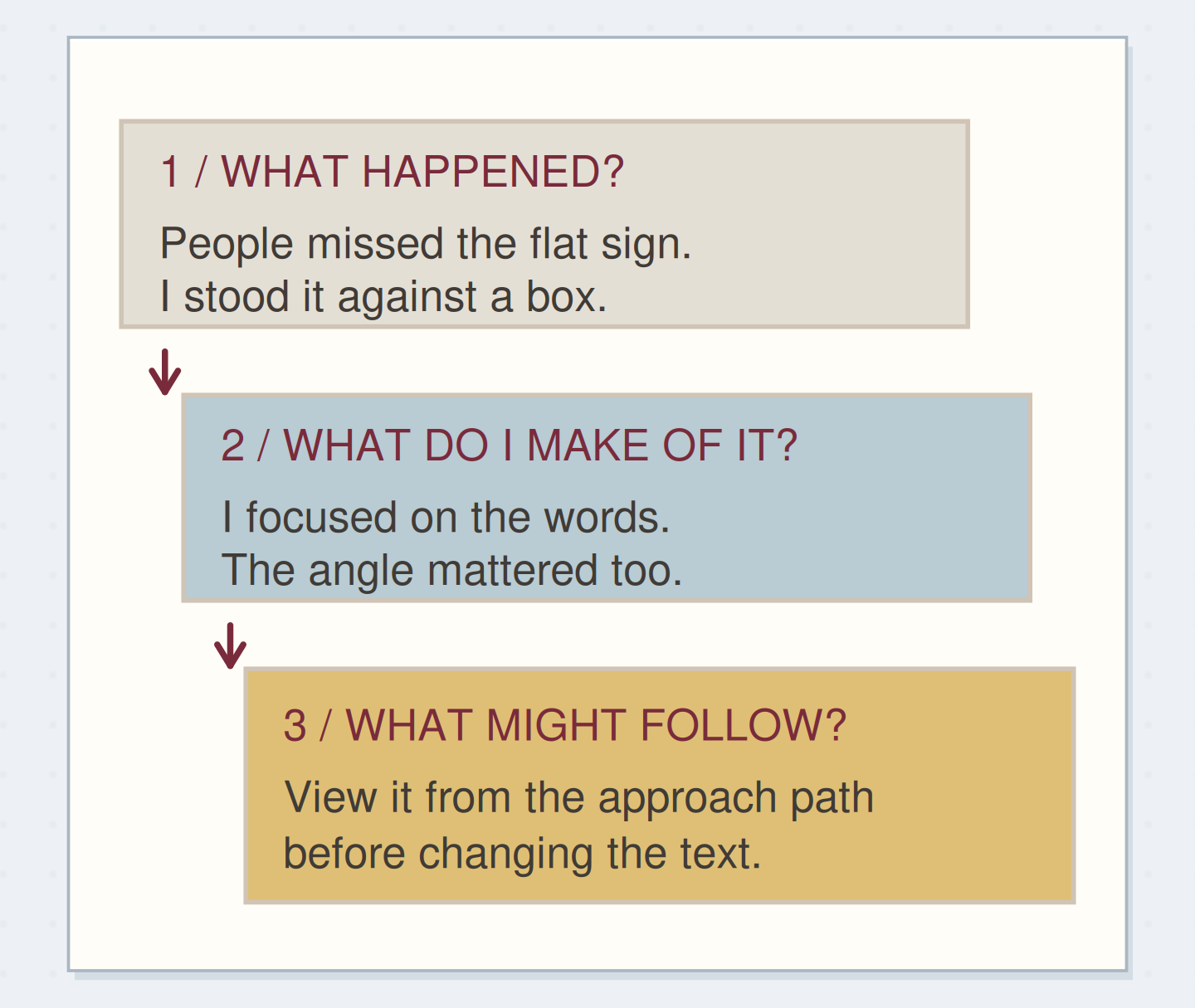
Follow the sign through three connected questions
Each answer supplies material for the question after it.
The first rung records a visible change.
Start with what happened at the table.
Put a small scene on the first rung
Choose one event from the period you want to consider. If you begin with “this week,” narrow it to a moment: making the display sign, arriving at a class or sharing a task. Write where you were, what you tried to do and what actually happened.
Keep explanation out of the first answer long enough to establish the scene. “I moved the sign twice before anyone noticed it” gives the next question something to work with. “I’m bad at communicating” already announces a broad conclusion. You can record that thought later as a thought, but begin with an event you can describe.
“A useful prompt follows the answer you just gave.”
Let the second answer stay close to the first
Ask which part of the scene matters to you now. Was there a surprise, an assumption or a detail you had overlooked? Use a sentence such as “I had assumed…” or “What surprised me was…” and connect it directly to something in the first answer.
Then consider whether a next step belongs here. You might want to try a different action, ask for information or simply notice the same feature next time. If no action follows, write “No next step yet.” The ladder doesn’t require converting every experience into a task. Its last rung can hold a question as easily as a plan.
Build a connected three-rung entry
Try the sign example or replace it with your own small event.
People asked about the swap table while the sign lay flat.
I had focused on the words and overlooked the viewing angle.
Next time I’ll look from the approach path first.
Your words have a place now.
A next move is optional; do not add a task merely to complete the structure.
- Words on this card
- 31
Climb the ladder with a display sign
Scene: “At the swap table, I put the sign flat beside the books. Two people asked whether they could take a book. I stood the sign against a box, and the next person read it before choosing.” Meaning: “I had been thinking about the wording, but the angle mattered too.”
Next: “At the next table, I’ll look at the sign from the approach path before changing the text.” The action follows from the particular observation. The writer hasn’t concluded that all signs need the same angle or that every misunderstanding is a layout problem. The ladder stays connected to what this scene can support.
Keep the conclusion at the scale of the scene
The revised version makes a smaller claim the example can support.
Starting version
The conclusion outruns one event.
Rescue a leap from one event to a verdict
If your second answer begins “I always” or “I never,” return to the scene and ask how much evidence it provides. Replace the sweeping statement with “In this instance…” or name what you still don’t know. The point is to make the reflection fit the material, not to demand a positive conclusion.
If the third rung produces a large project, shrink it to something that responds directly to the scene. “Improve all my communication” can become “Read the sign from the doorway.” You can also stop at the second rung when an observation is enough. An optional next step should remain optional in both wording and practice.
Change the ladder for a different subject
For a reading entry, try “Which passage stayed with me?”, “What did it make me question?” and “What would I like to read beside it?” For a making session, try “What changed while I worked?”, “What did that change reveal?” and “What would I repeat or alter?”
Keep the questions connected through the same piece of material. If the first answer concerns a passage and the last asks you to redesign your week, the ladder has wandered. Shorten it or write a second entry for the new subject. Three modest answers are usually more usable than three ambitious essays that never meet.
Choose a ladder for your material
The questions change together so that the answers remain connected.
Start from a passage and follow your question.
The last rung can be further reading.
Stop at the rung that gives you enough
Read the answers from the bottom upward. Can you see how the final thought arose from the scene? If a connection is missing, add one sentence or remove the unsupported conclusion. You don’t need to lengthen every answer to make the ladder look balanced.
A useful prompt follows the answer you just gave. Stop when you have a scene and a meaning you recognize, with a next step only if you want one. Save the wording of a ladder that worked for you, then adapt it freely. The structure should help you enter your material, not decide in advance what your experience must mean.
Where this idea began
Want to follow the idea further? These community discussions and maker references are a good place to start.
- Do you do monthly reviews? What sort of prompts/layouts do you include?
Participants discuss prompts for reviewing a period, including what to start, stop and continue.
- What? So what? Now what? — University of Edinburgh
Distinguishes describing an experience, considering its meaning and deciding what follows.