Gather a few things See what you’ll need
- A notebook page
- A pen
- One subject for a short list
Give the list a subject with a manageable edge
Choose a heading such as “Things I kept noticing this week” or “Small moments I would repeat.” Avoid a heading so broad that everything belongs under it. “My life” offers little help choosing a first item. A period, place or activity can give the list a useful edge.
A bullet-journal community discussion includes lists of books paired with short personal responses and subjects people want to learn more about. UNC’s brainstorming guidance also includes listing as a way to generate material. This reflective version takes one item into prose after gathering, instead of treating the number of items as the finished achievement.
Watch one list item become a paragraph
The other items can stay as phrases while the basket gets a follow-up.
Several concrete items give the writer choices.
The list is not ranked or turned into tasks.
Write several concrete lines without sorting them
Aim for five items as a starting experiment, or stop earlier if that is enough. Use phrases that point to something you can recognize: “the repaired basket handle,” “the neighbor’s question about the map,” “soup in the blue bowl.” Broad nouns such as “family” or “work” may need a small detail beside them.
Write in the order the items arrive. You can repeat a theme or include something that doesn’t seem to belong yet. Sorting while gathering can interrupt the useful part of the list, which is letting several possibilities become visible. If one item immediately wants a paragraph, follow it; finishing the list first is optional.
“A list can gather possibilities without creating obligations.”
Choose the line with a next sentence behind it
Read the list once. Look for an item that makes you want to add “because,” “I remember” or “I wonder.” It might be the most puzzling line rather than the most important one. Put a small underline or a word such as “follow” beside it.
Give that line one of three next moves. An example adds a scene. A question names what you don’t yet understand. A connection links it with another item or experience. Choose the move that fits the line, not the one that sounds most reflective. The aim is to make one item say more than its label.
Give one list item its next sentence
Try a detail and a follow-up without expanding the whole list.
The mended basket handle.
Someone wrapped the break in bright cord.
I wonder why visible repairs hold my attention.
Your words have a place now.
Unchosen list items may remain complete as short phrases.
- Words on this card
- 19
Follow one item from a short list
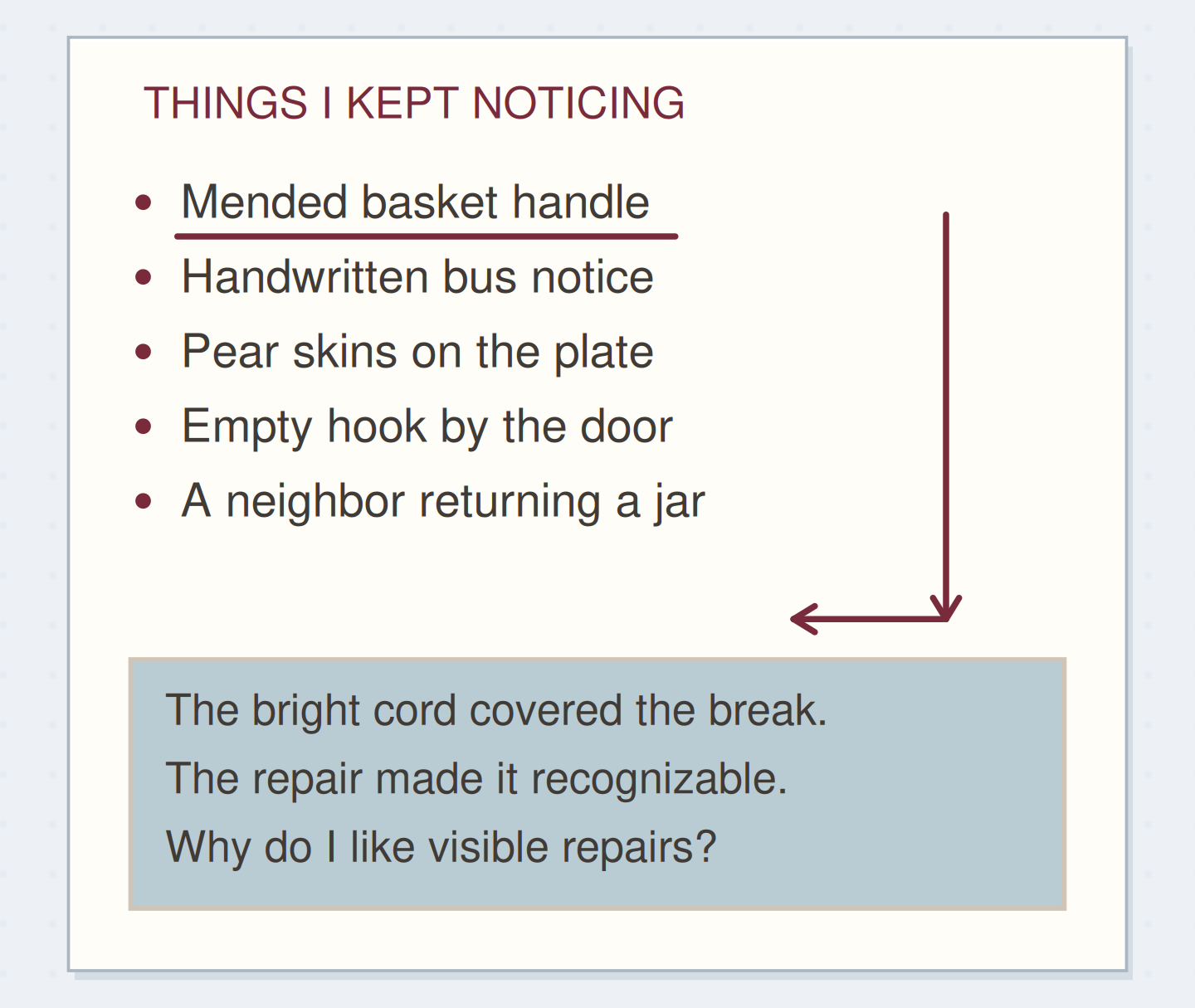
The list reads: “mended basket handle; a handwritten bus notice; pear skins curling on the plate; the empty hook by the door; a neighbor returning a jar.” The writer chooses the basket handle and adds, “Someone wrapped the break in bright cord rather than trying to hide it.”
The next sentence follows naturally: “I kept looking because the repair made the basket more recognizable.” Then comes a question: “What do I like about repairs that remain visible?” The paragraph arose from one item; the other four can remain phrases. Nothing requires turning the whole list into five separate essays.
Turn a category into an action
A verb helps a list item open into a scene.
Starting version
The noun identifies a subject but offers little movement.
When the list feels like an inventory
Choose one item and add a verb. “The bus notice” becomes “I watched two people point at the bus notice.” The action gives you a scene rather than a category. Ask what made you include this item on this day, even if the answer is only that it looked unusual.
If every item feels flat, change the heading from a broad category to a specific question. “Things” can become “What made me pause?” If no line wants to continue, keep the list as it is. A gathering page may be useful later, and it doesn’t need an immediate paragraph to earn its place in the notebook.
Try connecting two lines without forcing a theme
Sometimes two items seem related. Draw a small line between them and write the relationship in words: “Both show a repair,” “Both happened while waiting,” or “These felt completely different.” A contrast can be as useful as a similarity. The connection should arise from the items you actually wrote.
If the relationship becomes too clever to explain plainly, leave it as a question. You don’t need to make every list reveal a hidden pattern. A modest link between a repaired basket and a patched coat can be a satisfying subject, while the pear skins remain simply a detail from lunch.
Choose the follow-up that fits the line
A list item can lead somewhere without becoming a full story.
An example gives the line a scene.
Describe one occurrence.
Finish one follow-up and leave the rest available
Stop when the chosen item has a scene, question or connection you want to keep. Mark the follow-up with a short title if that will help you find it. You can leave the remaining items untouched, cross none of them off and still consider the entry complete.
A list can gather possibilities without creating obligations. If you return later, date the new paragraph so you can tell which response came first. You might discover that an item you passed over has become interesting. The list remains a set of available beginnings, not a queue of unfinished work that must be cleared.
Where this idea began
Want to follow the idea further? These community discussions and maker references are a good place to start.
- Ideas for 2020 trackers, lists, pages, reflections, etc.
The post includes books read with a short personal response; a reply describes lists of people or subjects to learn more about.
- Brainstorming — UNC Writing Center
Presents listing as a way to generate material before choosing a direction for writing.