Gather a few things See what you’ll need
- A notebook page
- A pen
- One brief event you remember
Choose a moment with a small turn
Look for an expectation followed by something different. You expected a door to open; it stuck. You meant to leave quietly; someone called your name. You reached for an ordinary bowl and found a note inside. The turn can be very small, as long as it gives the scene a before and an after.
Community discussions about ordinary Tuesdays and routine journal days show that everyday actions are available material. The Open University’s notebook guidance includes observations, phrases and scene notes. This exercise uses those materials to build a short narrative, with no need to make your day resemble a remarkable story someone else would publish.
Follow a small true story through its turn
The library scene needs a change, not a dramatic event.
The writer begins close to the action.
The morning’s other errands are outside this scene.
Choose where the scene begins and ends
Begin close to the action. If the story concerns returning a book, you probably don’t need the morning alarm, breakfast and bus journey. Start at the return slot. End when the small event reaches a natural pause, such as the book finally going through or the librarian offering another way to return it.
Choose one person’s viewpoint: usually yours. Include only information you know or clearly remember. If someone speaks and you remember the gist rather than the exact words, paraphrase instead of putting invented wording in quotation marks. The story can be lively while staying honest about the limits of your recollection.
“An ordinary story can end on a detail.”
Write three actions before adding explanation
Draft the scene as a chain of actions: you insert the book, it slides back, you turn it sideways. Add the detail that helps the reader see why the actions connect. Perhaps the dust jacket catches, or the slot flap closes too quickly. Let that detail do more work than a string of adjectives.
After the actions are clear, add one thought or reaction if it belongs. “I looked around to see whether anyone had watched” tells us something about your experience. Avoid explaining every action twice. A short story has limited room, and a well-chosen detail can make the moment understandable without a long commentary.
Draft a three-part micro-story
Use your own brief event and keep any remembered dialogue honest.
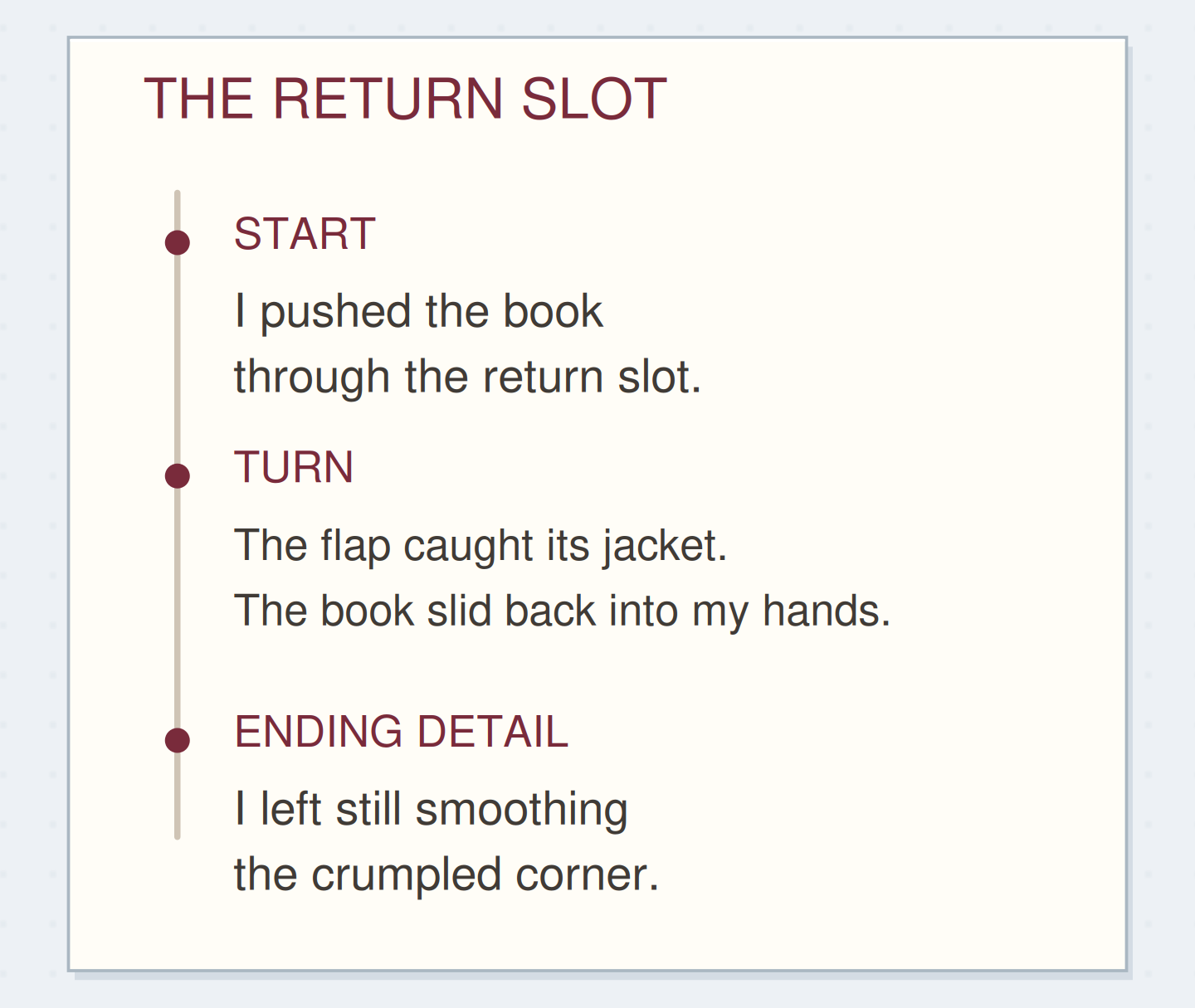
I pushed the library book through the return slot.
The flap caught the jacket and sent the book back into my hands.
I handed it to the librarian, still smoothing the corner.
Your words have a place now.
Paraphrase remembered speech when you do not recall the exact words.
- Words on this card
- 32
Read the return-slot example
“I pushed the library book through the return slot, but the flap caught its loose jacket and sent it back into my hands. I tried again, more ceremoniously this time, as though the slot required a better introduction. A librarian opened the desk drawer beside me and held out her hand. I passed her the book and left still smoothing its crumpled corner.”
The writer describes the action and uses one playful comparison about their own behavior. The ending stays with the book’s corner. It doesn’t announce a lesson about asking for help or being patient, because the scene is already complete as a small encounter.
Move from an errand summary to a scene
The revision gives one event room without lengthening the whole day’s account.
Starting version
The summary names an errand.
When the draft keeps becoming a day summary
Underline the sentence where something changes. Cut the sentences before it until you are near that moment. If the draft lists six errands, choose the one with an action you can picture and give the others a brief separate line elsewhere. A micro-story doesn’t have to carry the whole day’s record.
If nothing changes in the chosen moment, write a sensory entry instead or look for a shift in attention. You may begin looking at the clock and end watching a bird at the window. Don’t invent an incident to create a plot. An observation paragraph is a valid neighboring form when a narrative shape doesn’t fit.
Try an ending detail before a conclusion
End on an action, an image or a remembered phrase. “I left still smoothing the corner” closes the library scene with something the writer is doing. “And that taught me to accept assistance” would change the entry into an explicit reflection. Either is possible, but try the detail first and see whether it already gives you enough.
If you want a reflection, place it in a separate sentence or paragraph after a small space. That distinction lets the scene remain itself. The thought can be modest: “I think I was embarrassed by how formal I became with an uncooperative flap.” It doesn’t need to sound wise.
Choose a natural ending
Each ending leaves the scene in a different place.
An action can close the encounter.
Use a visible movement that belongs to the scene.
Stop when the small change is visible
Read the paragraph aloud or quietly to yourself. Can you locate the starting situation, follow the actions and notice where the scene ends? Remove a sentence that only repeats what the actions already show. Keep a plain word if it makes the movement easier to follow.
An ordinary story can end on a detail. Stop after one scene and one optional reflection, even if there is blank space below. Give it a short title if you enjoy titles, such as “The return slot.” You’ve kept a moment in a form that can bring it back without needing to tell the rest of the day.
Where this idea began
Want to follow the idea further? These community discussions and maker references are a good place to start.
- What does “simple living” actually look like for you on a normal Tuesday?
The question asks for ordinary-day reality; replies describe specific routines, errands, meals and leisure rather than exceptional events.
- Don’t know what to write in normal routine days when nothing special happens
Replies suggest ordinary moments, sensory descriptions and the writer’s current thoughts as material on uneventful days.
- Why take notes and what to note — Open University
Suggests collecting sensory observations, overheard language, facts and scene or character notes in a writer’s notebook.