Gather a few things See what you’ll need
- A notebook or plain paper
- A pen
- A familiar place you can observe comfortably
Choose a moment with edges
Pick a short slice of time: waiting for the kettle, crossing a lobby or standing at the checkout. A whole day contains too many competing details. Ask where the scene begins and ends. “From joining the queue to reaching the till” gives you a useful frame without requiring a dramatic event.
Writers in a community discussion about routine days suggest noticing coffee, weather and other sensory details. Andrea Stolpe’s Berklee teaching similarly uses places and objects to generate specific language. This journal adaptation adds a brief personal reflection after the description; it doesn’t require turning the material into a song or a finished story.
Move from a sound to a reflection
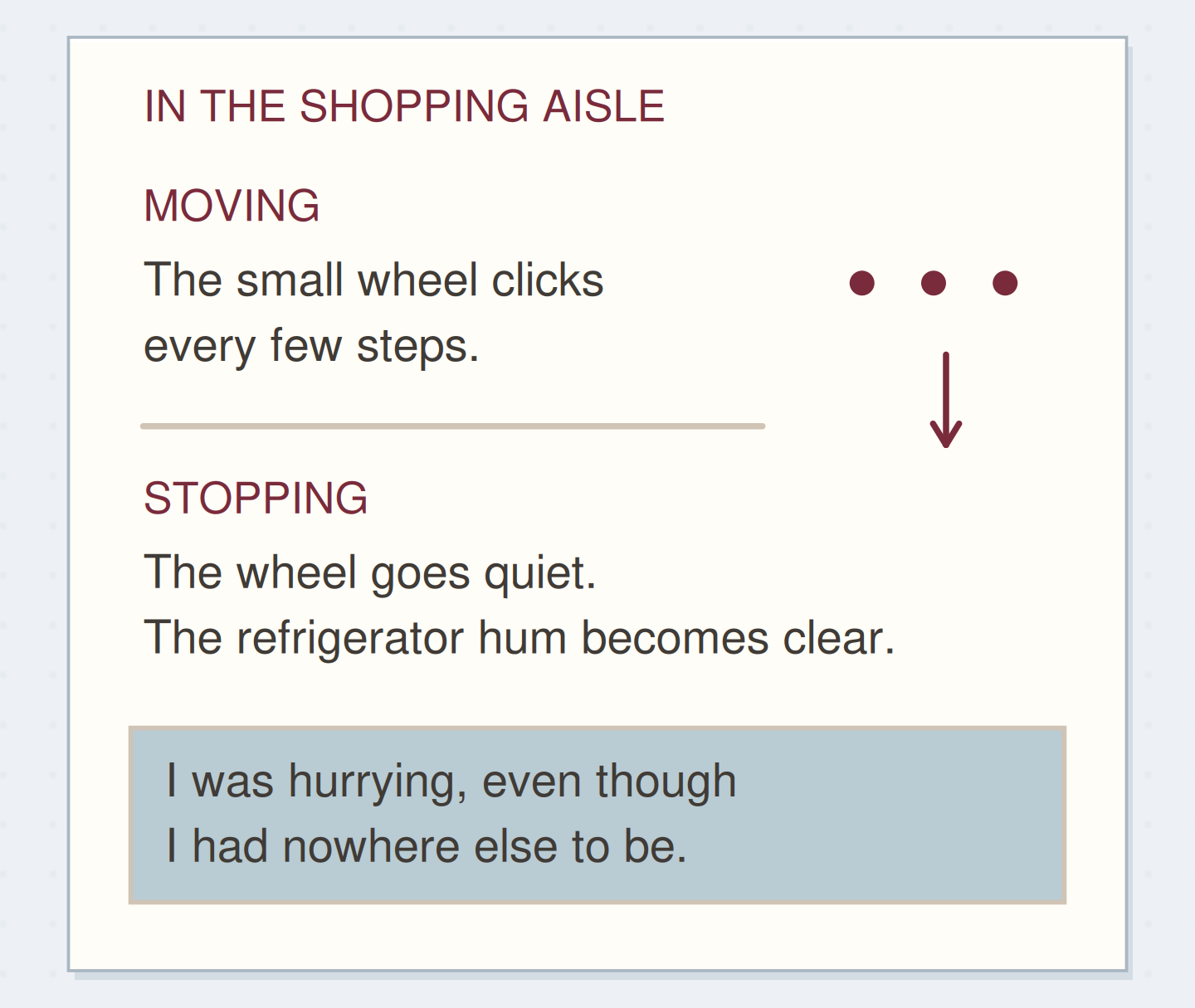
The cart example changes when the writer notices a contrast in sound.
The moving cart gives the scene a specific sound.
Begin with what the writer could hear.
Use the senses available to you
Choose two details you can actually notice or reliably remember. They might both be sounds, or one texture and one visual detail. There’s no requirement to complete a five-sense checklist. Use the ways you experience a place, and leave unavailable details out rather than guessing them for a fuller-looking paragraph.
Write rough nouns and verbs first: “wheel rattles,” “handle cold,” “bag knocks knee.” Add an adjective only when it distinguishes this detail. “Metallic clicking” is more specific than “interesting sound.” If you’re remembering, mark uncertainty directly: “I think the trolley was blue.” A missing color doesn’t weaken a scene that has another clear detail.
“One precise detail can hold an ordinary afternoon.”
Let description arrive before explanation
Write two sentences that stay close to the moment. What moves? What repeats? What changes when you do something? Then add a sentence beginning “I noticed…” or “This mattered to me because…” The transition is where description becomes reflection rather than a catalogue of sensations.
Keep the connection proportionate. A detail can show that you were hurrying, that you recognized a familiar place or that you enjoyed an unexpected pause. It doesn’t need to symbolize your entire life. The Open University’s notebook guidance includes sensory observations among useful writing material; your interpretation remains your own, made from the scene you chose.
Write a scene and its connection
Keep the first two fields descriptive; use the last for your own meaning.
The cart wheel clicked every few steps.
When I stopped, I heard the refrigerator hum.
I had been hurrying even though I had nowhere else to be.
Your words have a place now.
You may use two details from the same sense. Do not invent one to complete a checklist.
- Words on this card
- 27
Read a complete ordinary entry
“The small wheel on the shopping cart clicked every few steps. When I stopped to compare two jars, the clicking stopped too, and I could hear the refrigerator hum. I realized I’d been pushing quickly even though I had nowhere else to be. For the next aisle, I let the cart set a slower rhythm.”
Two sounds establish the scene. The change from motion to stillness gives the writer something to notice about their pace. The ending describes one choice in that moment. Nothing in the paragraph requires a grand lesson, a picturesque setting or the claim that slowing down is always the right response.
Replace an adjective with evidence
The revised description lets you hear the difference.
Starting version
The adjective gives a general impression.
When the scene feels flat or overdecorated
If the description is vague, replace one adjective with a comparison you actually mean. “Loud” could become “loud enough to hear over the refrigerator.” If every sentence is ornate, remove the metaphors and keep the action. “The cart’s iron song” may be fun, but “the wheel clicked” tells you more immediately what happened.
If no sensory detail comes back to you, switch to a present observation rather than inventing yesterday’s scene. Describe the edge of the page or a sound in the room. You can write “I don’t remember the rest.” Accurate limits give a memory its shape as much as the details you retain.
Try a closer view or a wider one
For a closer entry, follow one detail through a small change: the mug cools, the light moves or a repeated sound stops. For a wider entry, add the space around it: the queue, doorway or kitchen table. Choose the distance that makes your own observation easier to understand.
You can also write about an absence you noticed, provided you can place it in context. “The clock had stopped ticking” works if you usually hear it there. The useful question is what you experienced in this moment, not how many descriptive techniques you can fit onto a page.
Choose your distance from the scene
Each view changes which details need space.
Follow one detail as it changes.
A single object can hold the scene.
Stop when the detail has a connection
Read the entry and ask whether you can locate the moment, notice something specific and understand why you chose to write it. If all three are present, you can stop. You don’t need another sensory sentence just to make the paragraph longer.
One precise detail can hold an ordinary afternoon. Underline the line you most want to remember, or leave the paragraph exactly as it is. Next time, choose a different kind of detail only if you’re curious. Repeated sounds and familiar rooms can remain worthwhile subjects because the person noticing them may have something different to say.
Where this idea began
Want to follow the idea further? These community discussions and maker references are a good place to start.
- Don’t know what to write in normal routine days when nothing special happens
Replies suggest ordinary moments, sensory descriptions and the writer’s current thoughts as material on uneventful days.
- Songwriting Techniques Using Destination and Object Writing — Andrea Stolpe
Teaches using a destination or object to generate specific sensory language for writing.
- Why take notes and what to note — Open University
Suggests collecting sensory observations, overheard language, facts and scene or character notes in a writer’s notebook.